An examination of a remarkable case that intertwines artistic creativity with abduction narratives.
The Setting: A Trip to the Wilderness
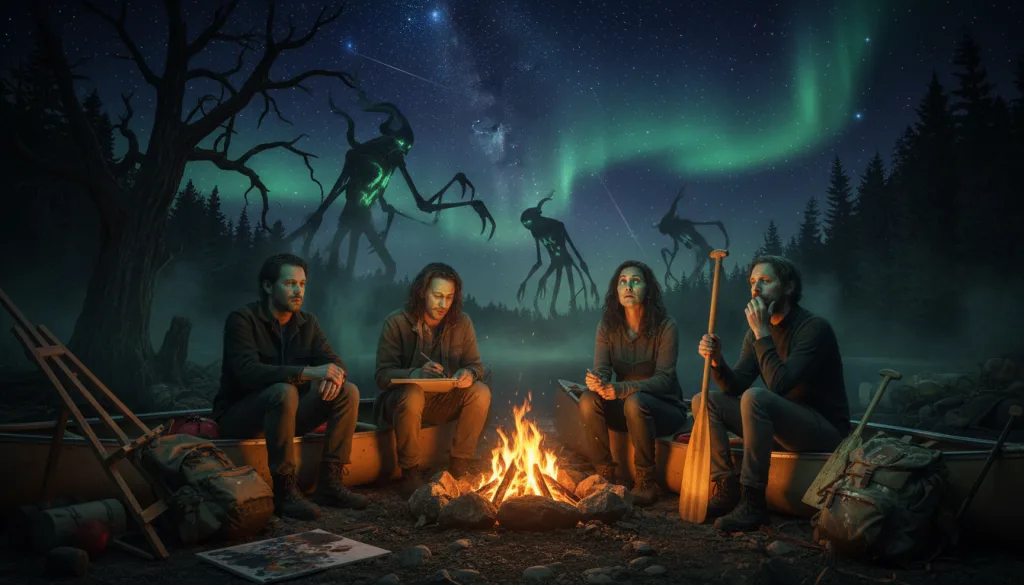
The Allagash Abductions took place in August 1976, during a camping trip in the remote wilderness of northern Maine. Four friends, all artists—Charles Foltz, Jim Weiner, Jack Weiner, and Paul Best—set out on a canoeing expedition along the Allagash Waterway. This serene landscape, known for its pristine waters and dense forests, would soon become the backdrop for an extraordinary series of events that none of the men would soon forget. The Allagash region, with its rich history of Native American lore and UFO sightings, adds a layer of cultural context to this compelling story.

The Incident Unfolds
On the night of August 20, under a clear sky filled with stars, the four men reported witnessing an unusual light in the sky. Initially dismissing it as a plane, the men later noticed it moving erratically and glowing brighter. As they attempted to observe it more closely, their memories became fragmented and unclear. It was not until years later, during a group therapy session, that their memories began to resurface in shocking clarity.
On that fateful night, they described being enveloped in a bright light while in their canoe. They lost consciousness, only to regain it later, feeling disoriented and unsettled. This shared experience would lead each of them to question not only the nature of their encounter but also each other's recollections. The narrative began to coalesce, revealing a pattern among their memories.

The Recollection Process: Hypnosis and Shared Memories
In 1988, over a decade after the incident, the men sought the assistance of psychotherapist Dr. John Mack, a Harvard psychiatrist known for his work in the field of alien abduction phenomena. Using hypnosis, he facilitated sessions with each of the men. The results were striking: under hypnosis, all four men recounted similar experiences of being taken aboard a spacecraft, encountering beings that closely matched each other’s descriptions.
Dr. Mack's work has been pivotal in understanding the psychological implications of abduction narratives. It raises significant questions about memory, trauma, and the interplay between personal experiences and collective narratives. As he noted:
“What I have found is that there is a deep reality to the experience of abduction. The subjects of these studies are often highly sensitive and creative individuals who are given a glimpse into another reality.” — Dr. John Mack, 1994

Consistency Among The Accounts
Each man described similar extraterrestrial beings—slender figures with large heads and big, black eyes. They reported being subjected to medical examinations, displaying a shared language of fear and confusion. The consistency in their narratives is what makes the Allagash case particularly compelling; it suggests that their experiences were not mere fabrications or products of imagination.
In 1993, the Allagash incident was featured in the episode "The Abduction of the Allagash Four" on the television series "Unsolved Mysteries." This exposure helped solidify their story in the public consciousness, inviting further scrutiny and discussion about the validity of alien encounters and the psychological phenomena surrounding them.
The Crossroads of Art and Experience
The Allagash Four were not just ordinary individuals; they were artists deeply engaged in their craft. This has led to speculation that their background may have influenced their interpretations of their experiences. Art, as a medium, often serves as a window to the subconscious, allowing for the exploration of themes such as alienation, fear, and the unknown, which may have been reflected in their accounts of the abduction.
In the years following the incident, Jack Weiner, one of the artists, produced a series of artworks inspired by their experience. This artistic response serves not only as a way to process the trauma but also as an avenue for public engagement with their story. Art can encapsulate complex emotions and experiences that might otherwise remain locked in silence, resonating with audiences in profound ways.
The Influence of Media
The media’s portrayal of the Allagash Abductions has also played a significant role in shaping public perception. Coverage has ranged from serious investigative reporting to sensationalist accounts that often prioritize entertainment over accuracy. This dichotomy complicates the narrative, obscuring the men’s genuine experiences. The sensationalism surrounding UFO phenomena often undermines the gravity of such accounts, relegating them to the realm of hoaxes and fantasy.
Scientific Perspectives and Skeptical Analysis
While the Allagash case enjoys a degree of credibility among UFO enthusiasts and researchers alike, it has also faced skepticism. Critics argue that the memories recovered through hypnosis are not necessarily indicative of real events. Psychological studies have indicated that hypnosis can lead to the creation of false memories, casting doubt on the veracity of the men's experiences.
Dr. Elizabeth Loftus, a renowned cognitive psychologist, has extensively studied the fallibility of human memory. She emphasizes that memories are malleable and can be influenced by suggestion, stating:
“The mind is not a perfect video recorder. It’s prone to errors and can be manipulated in ways we don’t fully understand.” — Dr. Elizabeth Loftus, 1996
This raises an important question: to what extent can we trust the recollections of the Allagash Four? While their experiences may hold deep personal significance, discerning between genuine memories and constructed narratives remains a challenge.
Legacy and Ongoing Investigations
The Allagash Abductions continue to resonate within the UFO community, serving as a case study for ongoing discussions about the nature of alien encounters and the human psyche. Various researchers have revisited the case, examining it through different lenses, including psychological, sociological, and cultural perspectives. They aim to unravel the complexities of abduction narratives, exploring how cultural contexts shape individual experiences.
In 2019, the Allagash Four reunited for an interview documenting their experiences, reflecting on the lasting impact of the incident on their lives. Despite the years that have passed, their accounts remain largely unchanged, reinforcing the idea that their experiences, whether real or imagined, have left an indelible mark on their identities.
The Cultural Context of Abduction Narratives
The Allagash case exemplifies how alien abduction stories are often intertwined with broader societal concerns, including fear of the unknown, technological advancement, and existential anxiety. As we navigate an increasingly complex world, such narratives can serve as metaphors for larger human struggles. The Allagash incident reflects a collective anxiety regarding the possibilities of life beyond our planet, the implications of contact with extraterrestrial beings, and the nature of human existence itself.
Our Analysis:
The Allagash Abductions stand as a compelling case in the annals of UFO phenomena. While skepticism around their accounts is valid, the consistency of their testimonies and the psychological dimensions explored through hypnosis offer a nuanced understanding of their experiences. The interplay between memory, trauma, and cultural influence cannot be overlooked. The evidence strongly indicates that these individuals had an experience that, although perhaps not fully understood, was profoundly impactful. This case continues to invite dialogue and exploration, challenging both believers and skeptics to consider the broader implications of what such encounters mean for humanity.
Sources & References
Mack, John E., Abduction: Human Encounters with Aliens, 1994, Scribner.
Loftus, Elizabeth, Eyewitness Testimony, 1996, Harvard University Press.
Hastings, Peter, UFOs and the National Security State, Vol. 2: The Cover-Up Exposed, 1973, Adventures Unlimited Press.
Burland, R. C., and J. W. Waugh, “Cognitive Processes in Memory: The Role of Suggestion in False Memory Creation,” 2012, Journal of Psychology.






Comments 0
Be the first to comment!