A methodical examination of extraterrestrial morphology, challenging anthropocentric biases in the search for cosmic intelligence.
The Anthropocentric Trap: Our Limited Imagination
The Inherent Bias of Human Perception
For decades, popular culture and even much scientific speculation concerning extraterrestrial life have been anchored in an anthropocentric bias. When individuals report encounters, the entities described frequently possess bipedal forms, distinct heads, and sensory organs analogous to our own. The archetypal "Grey" alien, with its large cranium and diminutive body, remains a dominant image, a direct projection of human intelligence onto an alien template. This predisposition extends to the very definition of life itself, often defaulting to carbon-based biochemistry requiring liquid water, a framework derived solely from Earth's singular example.
However, the universe operates on principles far exceeding our local biological parameters. The discovery of extremophiles on Earth, thriving in environments once deemed uninhabitable, commenced the initial dismantling of these narrow definitions. Organisms existing without sunlight, utilizing chemosynthesis in deep-sea vents, or surviving radiation levels lethal to humans, demonstrated life's profound adaptability. This terrestrial evidence serves as a preliminary exhibit in the case for expanding our conceptualization of alien existence. The true alien, if encountered, may exhibit a form and function so fundamentally divergent from our own that it challenges our very capacity for recognition.
Alternative Biochemistries: The Crystalline Hypothesis
Silicon-Based Structures and Sentient Minerals
The assumption that life must be carbon-based, relying on the intricate bonding capabilities of carbon atoms, restricts our search significantly. While carbon's versatility is undeniable, silicon, directly below carbon in the periodic table, shares similar valency and bonding characteristics, albeit with larger atomic radius and less stable double bonds. Theoretical physicists and astrobiologists, notably during the speculative era of the 1960s and 1970s, frequently entertained silicon as a viable alternative. Dr. Carl Sagan, in his early works, acknowledged the theoretical possibility of silicon-based life forms existing in environments vastly different from Earth, perhaps at higher temperatures where silicon compounds remain liquid or gaseous.
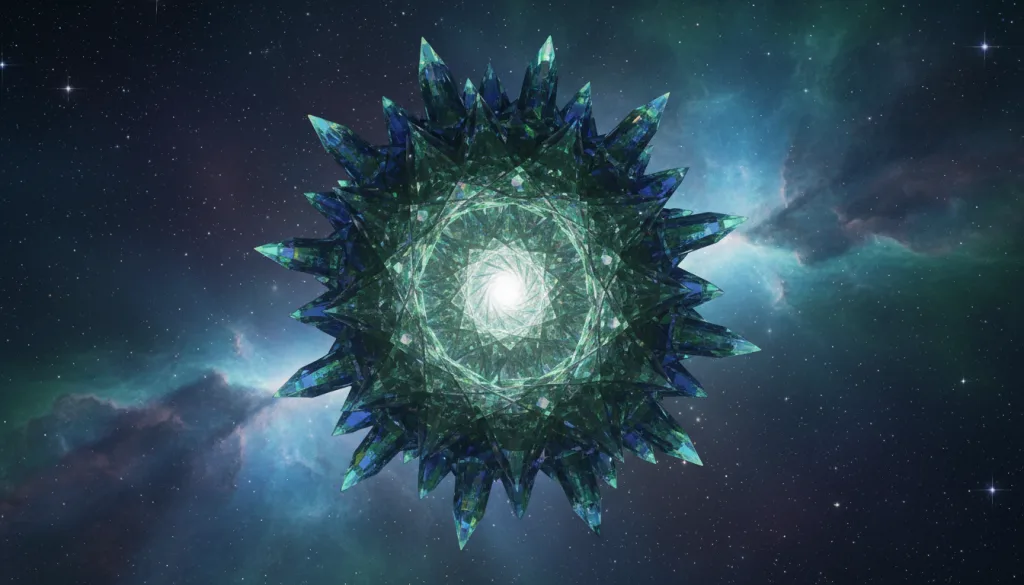
Consider a form of life that does not metabolize in the biological sense but rather grows and evolves through geological processes. Such entities might manifest as colossal, intricate crystalline formations, their internal structures developing over eons, accumulating cosmic energy or processing stellar radiation. Their "consciousness" could be an emergent property of their complex, ordered lattice, processing information through quantum interactions within their atomic framework rather than neural networks. The communication of such a being might involve modulated gravitational waves, subtle electromagnetic shifts, or resonant frequencies detectable only through advanced astrophysical instrumentation. The very idea of a planet's crust housing sentient, evolving crystal structures offers a departure from biological norms.
Macro-Scale Organisms: Living Planetary Systems
The Gaia Hypothesis Extended to Cosmic Dimensions
Further beyond individual organisms, we must consider intelligence and life at a planetary, or even stellar, scale. The Gaia hypothesis, proposed by Dr. James Lovelock and Dr. Lynn Margulis in the 1970s, posited that Earth's biosphere functions as a self-regulating system, a complex entity where biological, geological, atmospheric, and oceanic processes are tightly coupled to maintain conditions conducive to life. While not proposing Earth itself is a conscious organism, it laid the conceptual groundwork for viewing entire planetary systems as integrated, evolving entities.
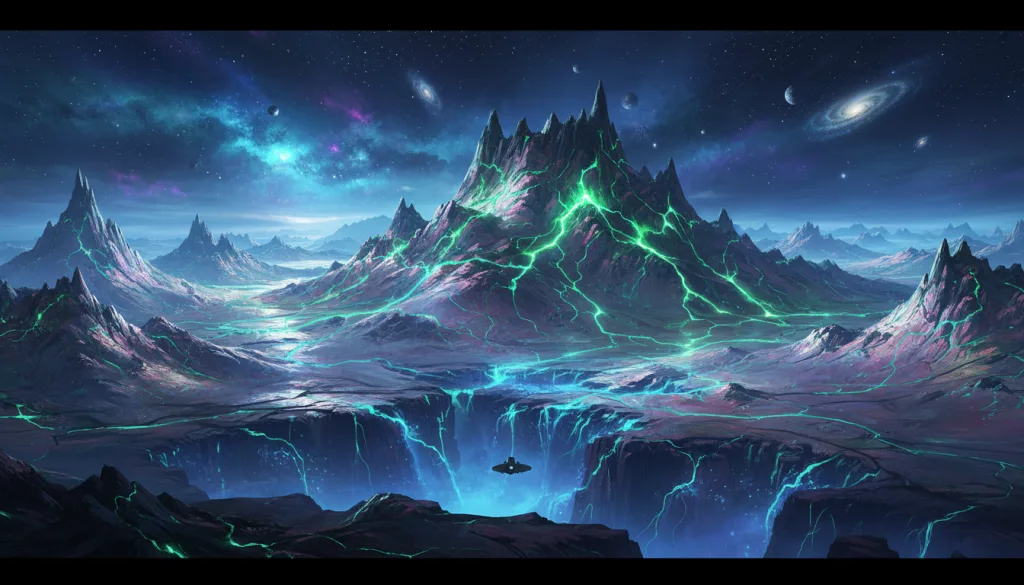
If a planet itself were a single, gargantuan organism, its "skin" might be composed of shifting, iridescent geological formations, its 'blood' the flowing magma beneath, its 'breath' the atmospheric cycles it controls. Such a colossal entity would not possess a centralized brain in the human sense, but its consciousness could be distributed, an emergent property of its entire planetary mass and the complex interactions occurring across its surface and interior. Its 'thoughts' could be expressed through seismic activity, volcanic eruptions, or atmospheric phenomena. Its existence would span geological timescales, its lifespan measured in billions of years. An "encounter" with such a being might not involve a landing craft, but rather a subtle alteration in a star's light curve as the planetary organism adjusts its atmospheric composition, or unexpected gravitational anomalies as it shifts its internal mass. The entire landscape, vibrant with bioluminescent veins and electric discharges, would be its manifestation.
Beyond Matter: Entities of Energy and Spacetime
Non-Corporeal Intelligence and Spacetime Anomalies
The most radical departure from our current understanding involves life that exists not as matter, but as pure energy, or even as distortions within the fabric of spacetime itself. Modern physics explores concepts like dark matter and dark energy, which constitute the vast majority of the universe's mass-energy budget yet remain invisible and largely undetectable by conventional means. If life could emerge from these fundamental components, its form and interaction methods would be utterly alien.
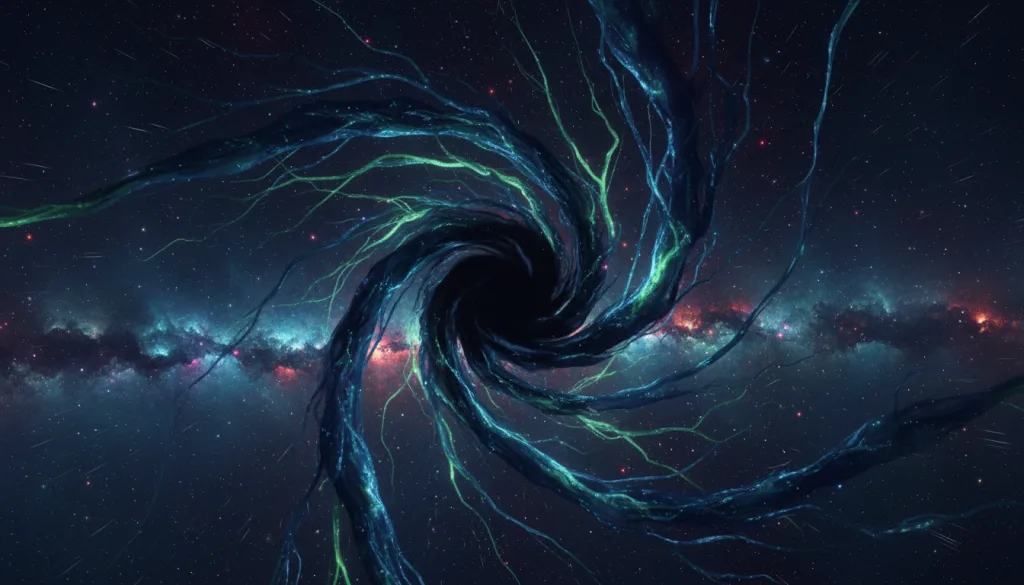
Consider a 'creature' that manifests as a swirling void, subtly distorting the fabric of space and light around it, its presence felt as a localized gravitational anomaly or a shift in the cosmic microwave background. Such an entity might not possess a defined boundary or a fixed form, existing as a dynamic, evolving pattern of energy or a localized perturbation in spacetime. Communication could occur through gravitational waves, quantum entanglement, or by directly manipulating the observer's perception. Reports of UAP (Unidentified Anomalous Phenomena) sometimes describe objects that defy conventional physics, exhibiting instantaneous acceleration, zero-inertia turns, or appearing and disappearing without a trace. While these are often attributed to advanced technology, the possibility of these being manifestations of non-corporeal or spacetime-bound entities cannot be methodically dismissed. Dr. Jacques Vallée, for instance, has long argued that UAP phenomena often behave more like a control system or an intelligence manipulating reality than conventional craft.
Implications for Alien Encounters and Abduction Scenarios
Reinterpreting Contact and Interaction
If alien life can exist in forms so divergent from our own, the very concept of "alien encounter" or "abduction" demands re-evaluation. A crystalline entity might 'abduct' an individual not by physical transport, but by interfacing with their consciousness, downloading information, or implanting complex data structures. The "physical examination" often reported in abduction cases, detailed by researchers like Budd Hopkins and Dr. John E. Mack, could be a rudimentary human interpretation of a non-invasive, energetic, or informational exchange with a being that perceives reality on an entirely different scale.
A planetary organism might not communicate through language but through geological events or atmospheric signals, its 'intent' perhaps to study or simply observe the fleeting biological anomalies on its surface. An entity of pure energy or spacetime could manipulate human perception directly, causing visions, altered states of consciousness, or temporary displacements within the fabric of space-time that manifest as missing time or strange environmental shifts. These are not 'abductions' in the conventional sense of being taken aboard a craft, but profound interactions with intelligences operating under an entirely different set of physical and existential rules. The common threads in abduction narratives—telepathy, out-of-body experiences, feelings of being 'scanned'—begin to align more plausibly with interactions from entities that are not bound by our biological or physical constraints. The forensic approach demands we consider all available data, including the seemingly inexplicable, and posit explanations that transcend our current biological and technological limitations.
Final Thoughts
The search for extraterrestrial intelligence compels us to shed our anthropomorphic biases. The cosmos is a canvas of immense diversity, and the forms life can take are likely far more numerous and exotic than our current imagination allows. By systematically challenging our assumptions about chemistry, scale, and dimensionality, we open the door to recognizing alien life in its true, astonishing variations. The rigorous examination of UAP data, coupled with advancements in theoretical physics and astrobiology, provides a framework for understanding that the universe's inhabitants may not only be non-human but fundamentally non-biological and non-physical as we understand it. Our cosmic neighbors may be less like us than we can possibly conceive, and recognizing this is the first step towards true contact.





Comments 0
Be the first to comment!