Exploring the theoretical pathways that may connect distant points in space and time.
Theoretical Foundations of Wormholes
In 1935, Albert Einstein and his colleague Nathan Rosen published a paper that would lay the groundwork for the concept of wormholes, now commonly referred to as “Einstein-Rosen bridges.” Their work, titled “The Particle Problem in the General Theory of Relativity,” introduced a radical framework for understanding the universe, suggesting that two black holes could be connected by a bridge of spacetime. This idea, initially a mathematical curiosity, has since captivated both scientists and science fiction enthusiasts alike.
Imagine standing at the edge of a deep chasm, where one side represents our reality and the other, an entirely different point in the universe. The chasm, representing a vast distance, could potentially be spanned by a wormhole. This hypothetical tunnel could allow for instantaneous travel between two distant points, fundamentally challenging our perception of space and time.
The implications of wormholes are enormous. Theoretical physicists have since speculated that if these bridges exist, they could enable travel across the cosmos, short-circuiting the limitations imposed by the speed of light, which Einstein declared as the ultimate speed limit in his theory of relativity. The famous equation, E=mc², illustrates the depth of this theory; however, the existence of wormholes raises more questions than it answers.
Characteristics of Einstein-Rosen Bridges
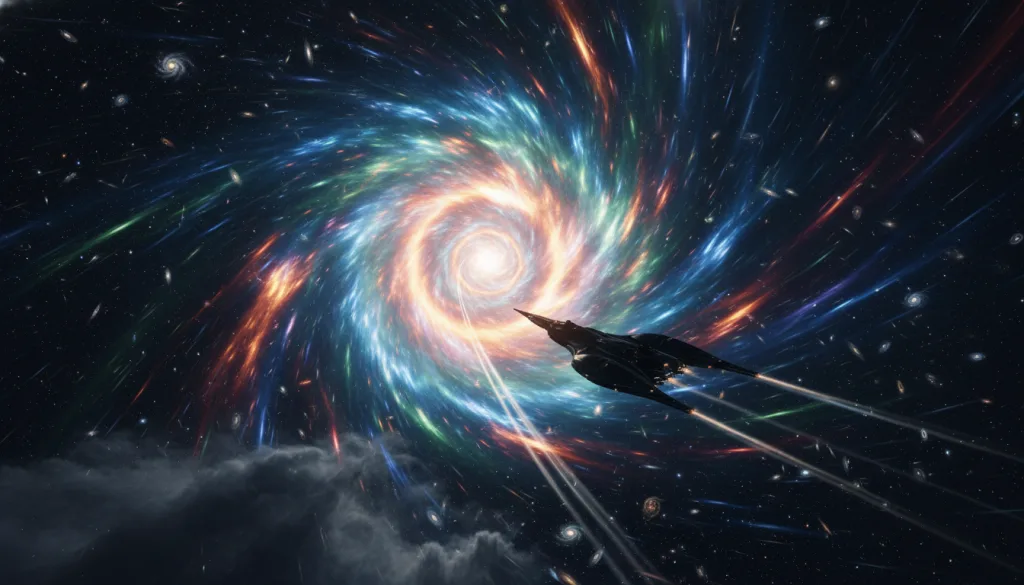
Einstein and Rosen described their bridges as solutions to the equations of general relativity under specific conditions. A wormhole would consist of two mouths connected by a throat. If these mouths were to open, they might serve as portals to different regions of spacetime. However, this theoretical construct comes laden with challenges. For one, traversable wormholes would require exotic matter to stabilize them. This exotic matter, characterized by negative energy density, has yet to be discovered or created in a controlled manner. A key proponent of this idea, physicist Kip Thorne, has stated, “Wormholes could give rise to time machines, but only if we could find the right kind of matter to keep them open” (Thorne, 1994). Without this exotic matter, wormholes remain firmly in the realm of speculation. The notorious physicist John Archibald Wheeler also contributed to this discussion, noting that “the road to the stars is paved with the fabric of spacetime itself” (Wheeler, 1977). He emphasized the need for a profound understanding of quantum mechanics to unlock the potential of wormholes.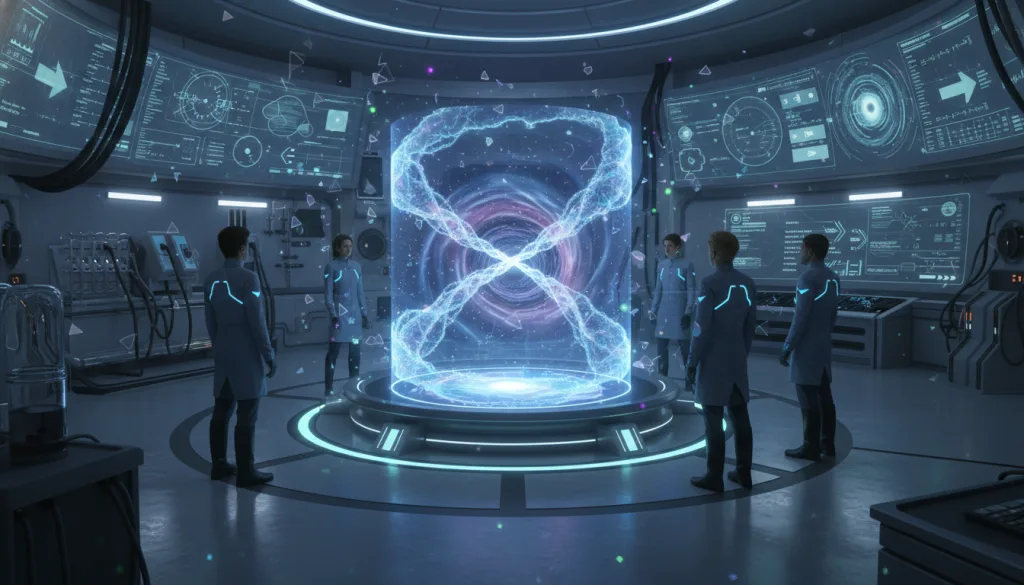
Wormholes in Popular Culture and Scientific Discourse
The concept of wormholes has permeated popular culture extensively. Movies like “Interstellar” and series like “Star Trek” have popularized the notion, presenting wormholes as practical tools for space travel. However, while these portrayals inspire curiosity, they often oversimplify the underlying science.
In 2014, the scientific community was abuzz with excitement when the movie “Interstellar” depicted a visually stunning representation of a wormhole. The film’s producers consulted with Kip Thorne to ensure some scientific accuracy in their portrayal. Thorne’s efforts underscored the potential for public engagement with complex scientific ideas through accessible media. Thorne later published a companion book titled "The Science of Interstellar," where he elaborated on the astronomical phenomena portrayed in the film, reaffirming his belief in the viability of wormholes under certain theoretical conditions.
However, the enthusiasm surrounding these ideas should not overshadow the rigorous scientific skepticism that permeates the field. Theoretical physicists like Sean Carroll have cautioned against drawing hasty conclusions from popular interpretations of wormholes. Carroll argues that “theoretical constructs in physics should not be conflated with actual physical possibilities” (Carroll, 2012). This distinction is crucial because it highlights the difference between theoretical speculation and empirical evidence.
The Mathematical Underpinnings
At the heart of Einstein-Rosen bridges lies the mathematics of general relativity. The Einstein field equations, formulated in 1915, describe how matter and energy influence the curvature of spacetime. Wormholes arise as solutions to these equations under specific conditions — often involving negative energy densities. The geometry of a traversable wormhole can be visualized using a simple analogy: consider a two-dimensional surface, like a sheet of paper, folded in half. A straight line connecting two points on opposite sides of the fold could represent a wormhole. This simplification demonstrates how the spatial separation can be reduced, allowing for a shortcut across the folded dimensions. However, the idea of traversable wormholes introduces paradoxes that challenge our understanding of physics. One such paradox involves the potential for time travel. If a wormhole were to connect two different points in time, it could allow one to travel backward into the past. This leads to logical inconsistencies, often referred to as “time travel paradoxes,” such as the well-known grandfather paradox, which raises questions like: If you were to travel back in time and alter a significant event, would you still exist?
Experimental Approaches and Future Research
While we have yet to observe wormholes directly, scientists are exploring various avenues to test the theoretical implications of these structures. One promising method involves gravitational wave astronomy. In 2015, the Laser Interferometer Gravitational-Wave Observatory (LIGO) made history by detecting gravitational waves for the first time, a phenomenon predicted by Einstein’s general relativity. This groundbreaking experiment opens a new window for astrophysical phenomena, including the potential detection of wormhole signatures.
LIGO’s discoveries have encouraged researchers to entertain the possibility that gravitational waves could somehow be influenced by the presence of a wormhole. Thus, the study of gravitational waves could inform our understanding of the universe and, in particular, the nature of spacetime. As physicist Rainer Weiss remarked, “We are on the verge of a new era in astrophysics” (Weiss, 2016).
In addition to gravitational wave observations, researchers are examining quantum field theories to uncover the potential existence of wormholes at subatomic scales. The work of Juan Maldacena, who proposed the AdS/CFT correspondence in 1997, has been particularly influential. His ideas suggest potential connections between different dimensions, hinting at the existence of wormholes in higher-dimensional spaces.
The interplay between quantum mechanics and general relativity remains a significant obstacle for physicists. The search for a unified theory that reconciles these two pillars of modern physics is ongoing. Many theorists believe that understanding wormholes could be integral to this quest.
Implications for Cosmology and Philosophy
The implications of wormholes extend far beyond physics. If they exist, they challenge our fundamental understanding of reality, raising philosophical questions about the nature of time, space, and existence. The concept of multiple universes, or a multiverse, is intricately linked to the idea of wormholes. If wormholes can connect different points in space and time, they may also serve as conduits between parallel universes, leading to a vast array of possibilities. This idea is not merely speculative. In 2002, physicists Leonard Susskind and Holger Bech Nielsen explored the concept of “quantum teleportation,” suggesting that information could travel instantaneously across vast distances, potentially implicating wormholes in such processes. They argued that the universe could be interconnected in ways we have yet to comprehend. The philosophical ramifications are profound: If wormholes can allow for travel across time and space, does this imply the possibility of manipulating reality itself? The very fabric of our understanding of causality comes into question. These are not trivial considerations but crucial inquiries that challenge the foundations of our existence.Conclusion: The Scientific and Philosophical Journey Ahead
The pursuit of wormholes and Einstein-Rosen bridges exemplifies the relationship between ambition and understanding in scientific exploration. While we remain entrenched in the boundaries of theoretical speculation, the existence of wormholes—if proven—could revolutionize our grasp of the cosmos.
It is crucial to approach this topic with both an open mind and a healthy skepticism. The ongoing research in gravitational waves, quantum mechanics, and cosmological theories may one day provide the empirical evidence needed to confirm or deny the existence of these enigmatic structures. Whether they remain a fascinating theoretical concept or transform into a practical reality is a journey that lies ahead.
In a world increasingly reliant on technology and scientific advancements, the idea of traversing vast cosmic distances through wormholes becomes an emblem of hope. It reflects our relentless pursuit of knowledge and understanding, urging us to reach beyond our current limitations. While the prospect of wormholes may seem fantastical, their potential implications within the realms of physics and philosophy remind us of the infinite possibilities that await.
Notre analyse : The evidence strongly indicates that while wormholes remain theoretical constructs, they represent a crucial intersection of physics and philosophy. The continued exploration of these ideas may lead us to a deeper understanding of the universe and our place within it.
Sources & References
Einstein, A., Rosen, N., "The Particle Problem in the General Theory of Relativity," 1935, Physical Review.
Thorne, K. S., "Black Holes and Time Warps: Einstein's Outrageous Legacy," 1994, W. W. Norton & Company.
Carroll, S., "From Eternity to Here: The Quest for the Ultimate Theory of Time," 2010, Dutton.
Weiss, R., "The Science of Gravitational Waves," 2016, Nobel Lecture.
Susskind, L., Nielsen, H. B., "Quantum Teleportation," 2002, Proceedings of the National Academy of Sciences.





Comments 0
Be the first to comment!