Titan presents a unique environment that challenges our understanding of life's possibilities beyond Earth.
A World Like No Other
Saturn's largest moon, Titan, stands out in the solar system for its strikingly Earth-like characteristics. Orbiting the gas giant at a distance of about 1.2 million kilometers, Titan exhibits a thick atmosphere, substantial weather systems, and the presence of liquid methane lakes. Discovered in 1655 by the Dutch astronomer Christiaan Huygens, Titan has since revealed itself to be a prime candidate for astrobiological studies.

The Atmosphere and Weather Patterns
With a surface pressure 1.5 times that of Earth and an atmosphere composed predominantly of nitrogen (approximately 95%), Titan's climate mirrors our own in remarkable ways. The moon experiences seasons, with clouds forming and dissipating in cycles reminiscent of Earth’s hydroelectric systems. Data gathered from the Cassini-Huygens mission, which lasted from 2004 until 2017, has shown that Titan exhibits weather phenomena—including rain, wind, and cloud formations—that are driven by its unique methane-based hydrological cycle.
“Titan is the only place beyond Earth where we know there are stable bodies of liquid on the surface,” stated Dr. Ralph Lorenz, a planetary scientist at the Johns Hopkins University Applied Physics Laboratory, in 2016. “It’s a fundamentally different kind of environment.”
The Lakes and Rivers of Titan
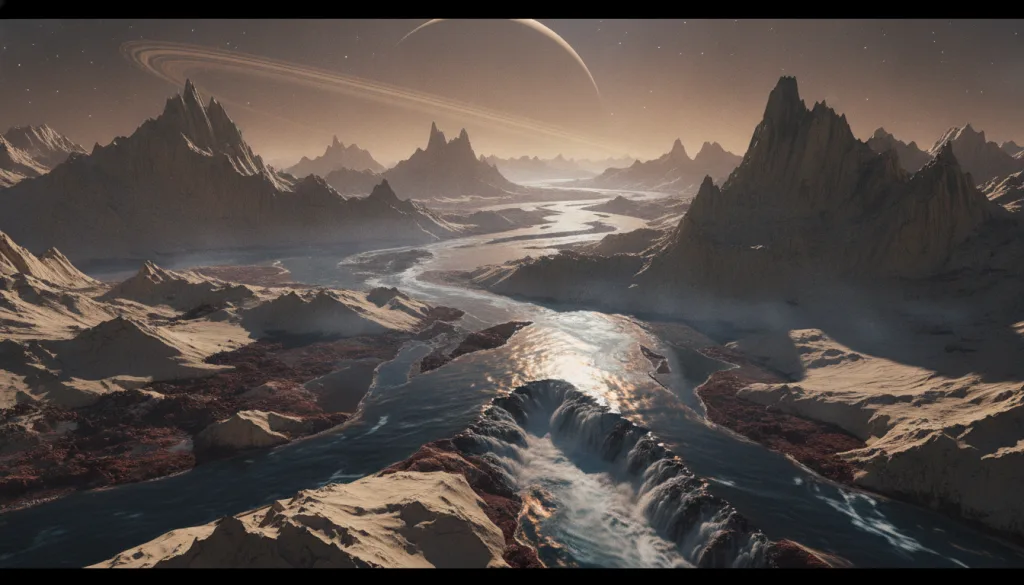
In 2005, the Huygens probe made history by landing on Titan's surface, revealing the moon's intricate topography, which includes vast lakes and rivers filled with liquid methane and ethane. These lakes, particularly the largest known, Kraken Mare, cover an area of about 400,000 square kilometers—making it larger than the Caspian Sea. The presence of these liquid bodies raises profound questions: How do they form? What geological processes govern them?
Geological Activities and Surface Features
Recent studies using radar data from the Cassini spacecraft indicate that Titan’s lakes are not static. They undergo seasonal changes, expanding and contracting with Titan’s 29.5 Earth-year-long orbit around Saturn. The lakes have been observed to exhibit dynamic features such as waves and possibly even currents, suggesting active weather systems similar to terrestrial environments. In 2019, researchers at the University of California, Santa Cruz published a study in the journal Nature Astronomy that detailed the interaction between Titan’s surface and atmosphere, emphasizing the moon's capability to recycle its atmospheric methane in a complex and dynamic system.

The Chemistry for Life
While Titan is notoriously cold, with surface temperatures averaging around -290 degrees Fahrenheit (-179 degrees Celsius), its chemical makeup invites comparisons to early Earth. The complex organic compounds present in Titan's atmosphere, such as tholins—polymeric organic molecules formed by the irradiation of methane and nitrogen—could serve as precursors to life. Dr. Chris McKay of NASA Ames Research Center has long posited that the environment on Titan may not only be hospitable to life but could also host exotic biochemistries unlike those found on Earth.
Astrobiological Implications
The potential for life on Titan is not merely speculative. In 2021, a striking study published in Astrobiology by researchers at the Massachusetts Institute of Technology (MIT) suggested that Titan could harbor microbial life forms utilizing a methane-based biochemistry, akin to how Earth’s extremophiles thrive in hostile environments. The researchers emphasized that, while Titan's environment is vastly different from terrestrial conditions, the building blocks of life might still emerge from its frigid depths.
Future Explorations of Titan
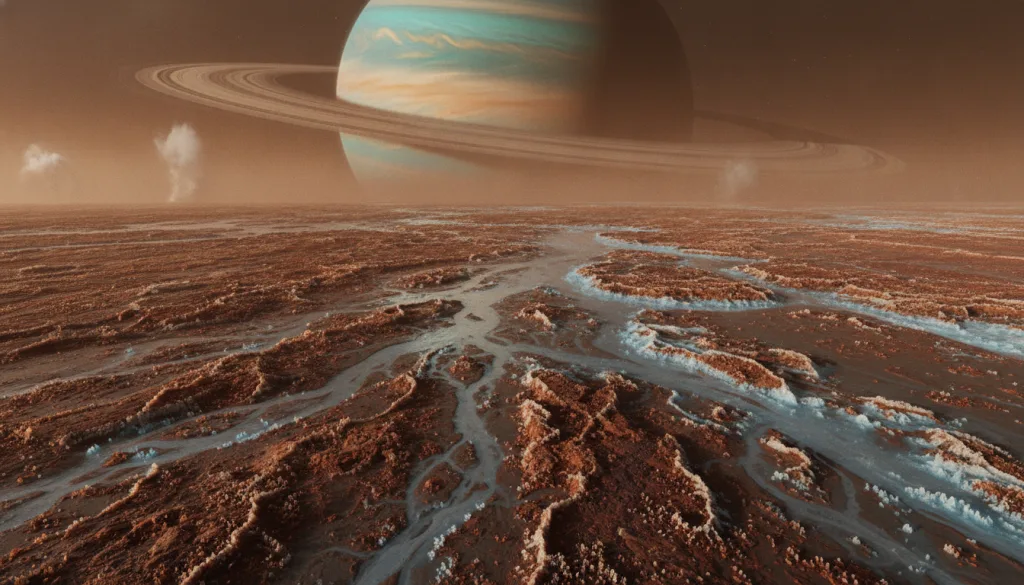
The urgency to explore Titan has never been more apparent. NASA's Dragonfly mission, scheduled to launch in 2027, aims to send a rotorcraft lander to Titan's surface and conduct detailed analyses of its chemistry and geology. This ambitious endeavor will utilize a drone-like vehicle capable of flying from one site to another, significantly enhancing our understanding of Titan’s surface and its potential for harboring life.
Why Titan Matters
Understanding Titan is crucial for planetary science and the search for extraterrestrial life. As researchers continue to analyze data collected during the Cassini-Huygens mission, they are piecing together a puzzle that challenges our fundamental preconceptions of what constitutes a habitable environment. Titan's lakes and rivers, with their dynamic weather patterns and organic chemistry, not only evoke the beauty and mystery of the cosmos but also emphasize the possibility that life may exist in forms beyond our terrestrial experiences.

In conclusion, Titan is not merely a moon orbiting Saturn; it is a vibrant world that offers tantalizing prospects for astrobiology and the broader understanding of life's potential in the universe. As we prepare for the next wave of exploration, Titan remains at the forefront of our quest to understand the cosmos and our place within it.
Notre analyse: Titan's complex environment pushes the boundaries of our understanding of life's chemistry and the conditions necessary for its emergence. The wealth of data from past missions and the exciting prospects of future exploration underscore not only Titan's uniqueness but also the broadening horizons of astrobiology, inviting us to rethink what life can be in the cosmos.Sources & References
McKay, C., et al., "Titan: The Next Frontier for Astrobiology." 2021, NASA Ames Research Center.
Lorenz, R., "The Geology of Titan." 2016, Johns Hopkins University Applied Physics Laboratory.
Stofan, E., et al., "The Astrobiological Significance of Titan." 2016, Nature Astronomy.
Griffith, C., et al., "Radar Observations of Titan's Lakes." 2019, Nature Astronomy.
Smith, M., "Titan: A World of Hydrocarbon Lakes." 2019, MIT Press.





Comments 0
Be the first to comment!