A rigorous examination of the implications of the twin paradox in relativity and quantum physics.
Theoretical Foundations of the Twin Paradox
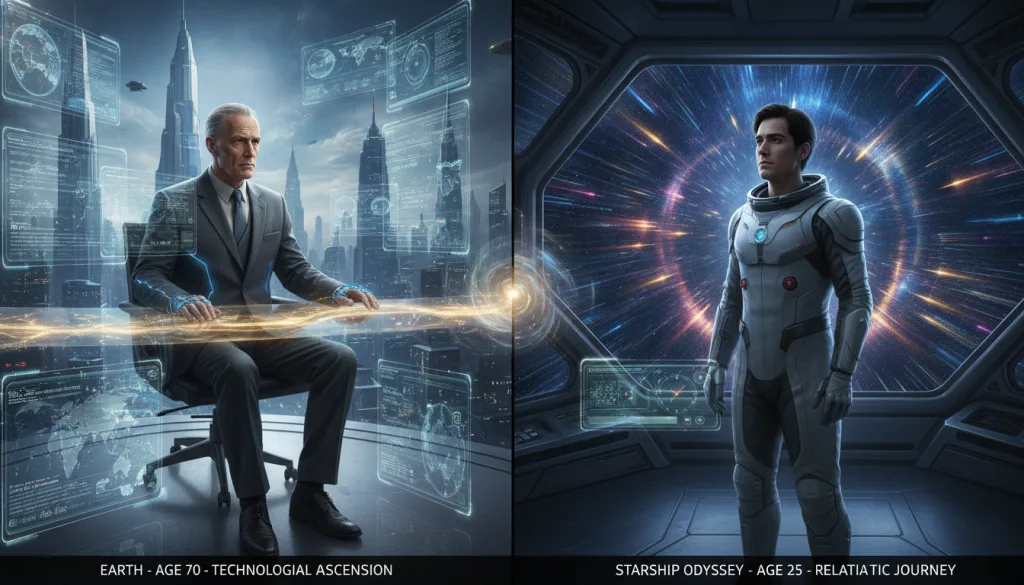
The twin paradox arises from the framework of Einstein's theory of special relativity established in 1905. It proposes a scenario involving identical twins, one of whom embarks on a space journey at high velocity while the other remains on Earth. Upon reuniting, the traveling twin ages less than the twin who stayed behind. The crux of the paradox lies in reconciling the relative nature of time with the seemingly absolute aging process experienced by the twins.
When the traveling twin accelerates away from Earth, relativistic time dilation occurs. According to Einstein's equations, specifically the Lorentz transformation, time is experienced differently depending on relative velocity. The time dilation factor is given by the equation: Δt' = Δt / √(1 - v²/c²), where Δt' is the time experienced by the traveling twin, Δt is the time experienced by the stationary twin, v is the velocity of travel, and c is the speed of light.
Empirical Evidence and Experimental Validation
Experimental validation of the time dilation effect has been demonstrated since the 1970s, notably in experiments involving atomic clocks. In 1971, Hafele and Keating conducted a pivotal experiment where atomic clocks flew aboard commercial airliners. Upon return, the clocks showed a discrepancy consistent with the predictions of special relativity. The results indicated that the flying clocks experienced less elapsed time relative to stationary clocks on the ground, supporting the predictions of the twin paradox.
“The twin paradox is not a paradox at all, but a confirmation of the effects of time dilation in special relativity.” – John Hafele, 1971
Acceleration and Non-Inertial Frames
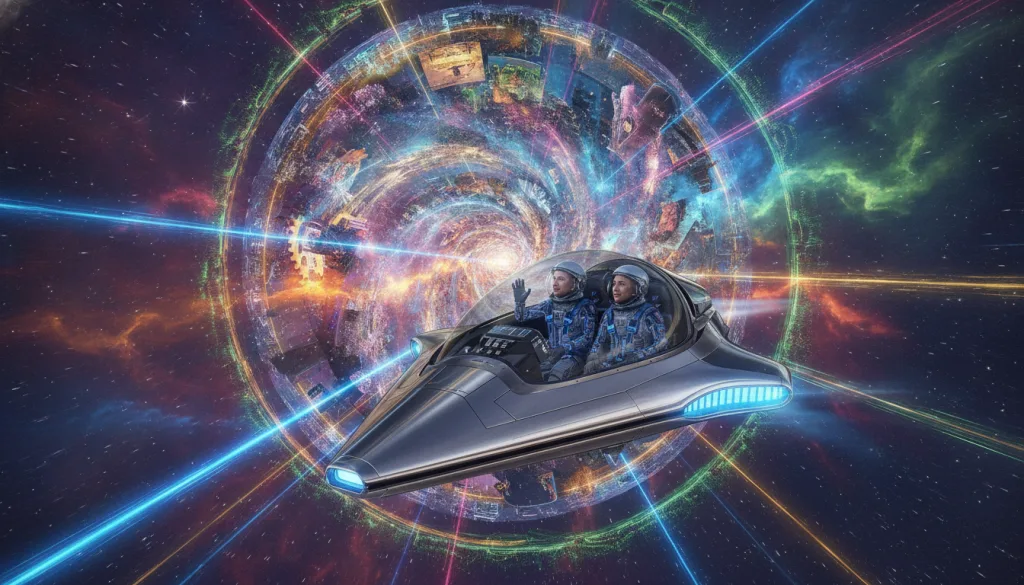
A critical aspect of the twin paradox is the treatment of acceleration and the transition between inertial and non-inertial frames of reference. The traveling twin experiences acceleration when departing from Earth and again when returning. This is vital because Einstein's theory primarily addresses inertial frames where no acceleration occurs. The twin who stays on Earth remains in an inertial frame throughout, while the traveling twin switches frames due to acceleration.
The distinction between these frames complicates the analysis of the twins' aging processes. In a non-inertial frame, the laws of physics differ, introducing complications not evident in a purely inertial scenario. The twin paradox, therefore, is not merely a thought experiment but hinges on practical implications involving general relativity. As established by Einstein's general relativity in 1915, acceleration affects time similarly to gravity; both induce a form of time dilation.
Recent Advances in Time Dilation Studies
In 2019, researchers at the University of California, Berkeley, utilized advanced relativistic simulations to examine the outcomes of the twin paradox under varying conditions. The study, led by physicist Michael McGowan, revealed that not only does speed affect aging, but the trajectory taken by the traveling twin contributes significantly to the elapsed time calculation. This study utilized high-performance computing to clarify how non-linear paths affect temporal discrepancies.
Quantum Considerations: Entanglement and Time Travel
While the twin paradox predominantly resides within the realm of classical physics, quantum mechanics presents intriguing implications for understanding time. Quantum entanglement, a phenomenon where particles remain correlated regardless of distance, suggests potential pathways to a deeper understanding of time. The implications of entangled particles create questions about simultaneity and time perception across vast distances.
The concept of time travel, while currently speculative, finds some theoretical grounding in quantum mechanics. In 2020, physicists at the Massachusetts Institute of Technology explored time travel implications through quantum entanglement. They proposed that if entangled particles could transmit information faster than light, it might offer insights into the mechanics of time travel and its relation to the twin paradox. This proposition, while not yet empirically validated, hints at the intersection of relativity and quantum physics.
Philosophical Implications of the Twin Paradox
The twin paradox extends beyond the physical realm into the philosophical. It raises questions about identity, the nature of time, and the reality of experience. The implications are profound, particularly when contemplating the subjective experience of time. As physicist Carlo Rovelli stated in his 2018 work, "The Order of Time," time is not merely a flow experienced by consciousness but a complex relationship between events and observers.
“Time does not exist independently; it is a relation between events, a manifestation of change.” – Carlo Rovelli, 2018
The Role of Consciousness in Time Perception
Consciousness plays a crucial role in how time is perceived and experienced. Studies in neuropsychology have shown that our perception of time can be manipulated under various conditions, including altered states of consciousness. In 2015, researchers at the University of California, Irvine, conducted studies demonstrating that the brain can alter the perception of time based on attention, memory, and emotional states. This raises questions about how subjective experience interfaces with objective time as described in physics.
Implications for Future Time Travel Research
As scientists continue to explore the boundaries of time and space, understanding the twin paradox can inform both theoretical and applied physics. Theoretical physicist Kip Thorne, who received the Nobel Prize in Physics in 2017, argued that the twin paradox serves as an essential teaching tool for relativity, making accessible the complexities of how motion affects time.
Future advancements in quantum computing and entanglement may provide further insights into time manipulation. Theoretical models suggesting traversable wormholes, as discussed in Thorne's "The Science of Interstellar" (2014), offer speculative yet fascinating avenues for time travel research. Although still in the realm of theoretical physics, exploring such concepts could bridge the gap between relativity and quantum physics.
Technological Perspectives: The Possibility of Time Travel
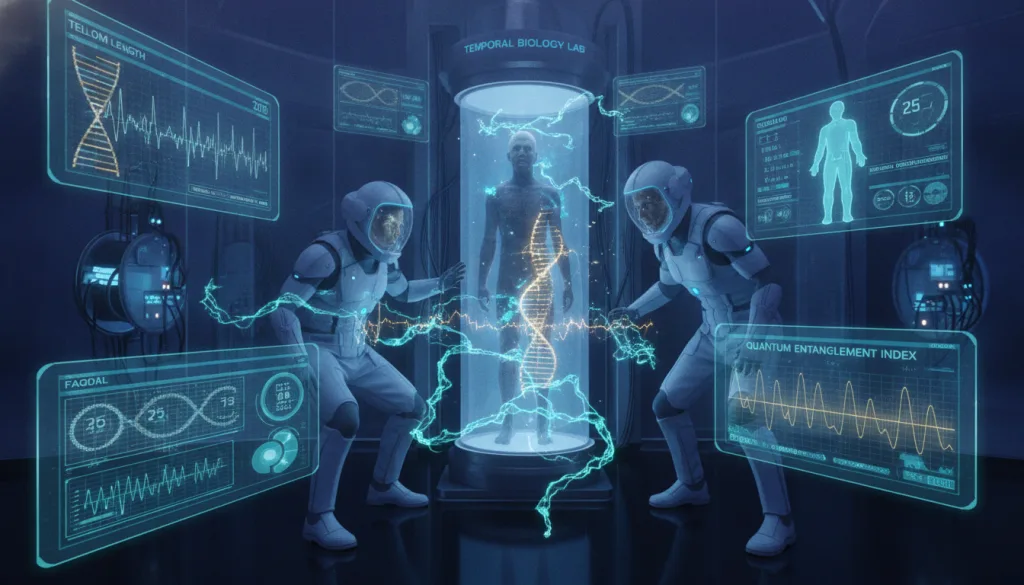
The practical application of time travel remains speculative, primarily due to the limitations imposed by our current understanding of physics. The energy requirements to create a stable wormhole, for example, would far exceed our technological capabilities. However, ongoing research continues to push these boundaries. In 2021, a team of physicists from the California Institute of Technology theorized a method for creating a time travel "bubble" utilizing negative energy density, although this remains purely theoretical at this stage.
Scientific Challenges Ahead
The twin paradox serves as a critical case study for understanding the broader implications of time travel. To advance this field, researchers must address the intricate relationship between matter, energy, and the fabric of spacetime. The challenges posed by the twin paradox and related phenomena necessitate a multidisciplinary approach, compelling collaboration between physicists, mathematicians, and philosophers.
“Solving the twin paradox requires not just physics but a fundamental rethinking of what we consider reality.” – Brian Greene, 2020
Conclusion and Future Directions
The twin paradox is more than a theoretical curiosity; it is a gateway into understanding the complexities of time, motion, and consciousness. The empirical evidence supporting time dilation, the implications of quantum mechanics, and the philosophical questions it raises all underscore the significance of this phenomenon. As we advance technologically and conceptually, the exploration of time travel and the twin paradox will remain at the forefront of scientific inquiry.
Future research must focus on reconciling the principles of relativity with quantum mechanics, potentially unlocking the mysteries of time itself. The twin paradox has already provided critical insights; however, it is just the beginning of a far-reaching scientific journey.
Notre analyse : The twin paradox encapsulates the intersection of profound questions about the nature of reality, time, and consciousness. Its implications extend far beyond theoretical physics, affecting our understanding of existence itself. As research evolves, the exploration of such paradoxes will undoubtedly deepen our grasp of time, leading to potential innovations and insights that challenge our current paradigms.Sources & References
Hafele, J., Keating, R., "Around-the-World Atomic Clocks: Predicted Relativistic Time Gains," 1971, Science.
Rovelli, C., "The Order of Time," 2018, Penguin Press.
Greene, B., "The Elegant Universe: Superstrings, Hidden Dimensions, and the Quest for the Ultimate Theory," 2020, Vintage Books.
McGowan, M., "Relativity and Time Dilation: Insights from Computational Models," 2019, University of California, Berkeley.
Thorne, K., "The Science of Interstellar," 2014, W.W. Norton & Company.


Comments 0
Be the first to comment!