Unraveling the secrets of life beyond Earth through the lens of astrobiology and planetary exploration.
The Significance of Biosignatures in Astrobiology
Biosignatures are crucial indicators of life, providing scientists with vital clues in the quest to identify extraterrestrial organisms. Defined as any substance—biological or chemical—that is indicative of life, biosignatures can take various forms, including specific gases, isotopic ratios, or organic molecules. The concept of biosignatures is integral to astrobiology, the study of life in the universe, as it helps researchers pinpoint where life might exist beyond Earth.
Historical Context
Since the 1976 Viking landers conducted the first successful missions to Mars, the search for biosignatures has evolved significantly. The Viking missions employed gas chromatography and mass spectrometry to analyze Martian soil. While they reported no conclusive evidence of life, the data gathered laid the foundation for future exploration.
In 1996, the discovery of meteorite ALH84001, believed to originate from Mars, caused a significant stir. Researchers, including David McKay from NASA, suggested that tiny structures within the meteorite could be fossilized microbial life. However, this claim was met with skepticism, leading to ongoing debates about the interpretation of biosignatures.
Current Missions Targeting Mars
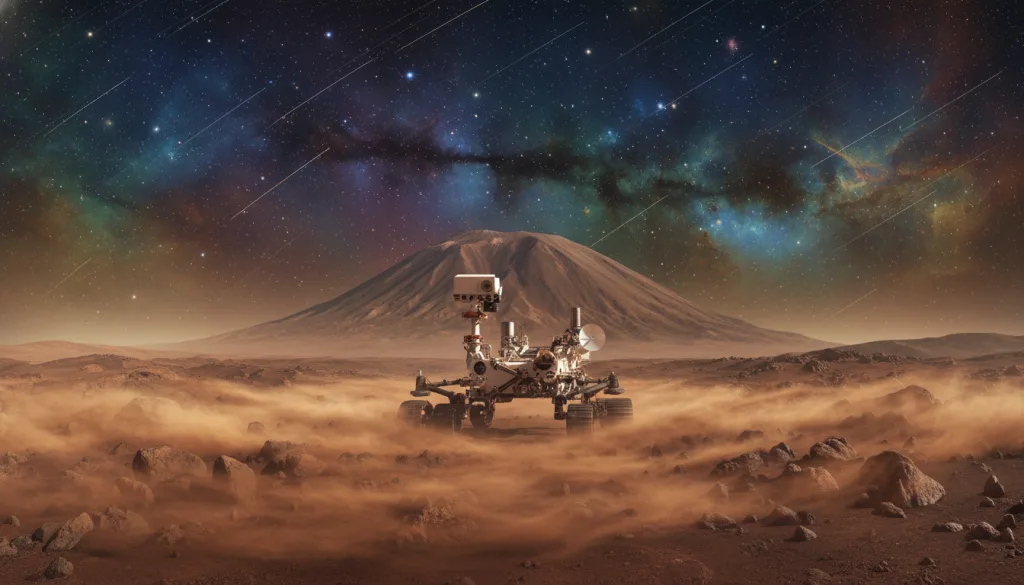
The Mars 2020 Perseverance Rover, launched on July 30, 2020, marks a pivotal moment in the search for biosignatures. Perseverance is equipped with an advanced suite of scientific instruments, including the Scanning Habitable Environments with Raman & Luminescence for Organics & Chemicals (SHERLOC) and the Mars Organic Molecule Analyzer (MOMA). These instruments are designed to detect organic compounds and analyze Martian soil and rock samples that may preserve evidence of past life.
Sample Collection and Future Return Missions
Perseverance's primary objective is to collect samples from the Jezero Crater, an ancient lakebed that is believed to have hosted microbial life billions of years ago. The rover is tasked with caching these samples for potential return to Earth in a future mission planned by NASA in collaboration with the European Space Agency. This sample return mission aims to bring back soil and rock samples by the late 2020s, allowing for detailed analysis using Earth-based laboratories and possibly confirming or refuting the presence of biosignatures.
Furthermore, the rover's ability to conduct in-situ analysis strengthens the likelihood of identifying biochemical markers on Mars. The findings from Perseverance may provide the most direct evidence of life beyond Earth in the coming years.
Exoplanets and the Broader Search for Life
While Mars remains a focal point, the search for biosignatures extends to exoplanets, planets located outside our solar system. With the advent of next-generation telescopes, such as the James Webb Space Telescope (JWST), launched on December 25, 2021, astronomers have begun to study the atmospheres of these distant worlds.
Recent Discoveries
In 2022, the JWST provided unprecedented insights into the atmosphere of exoplanet WASP-39b, revealing the presence of carbon dioxide, water vapor, and even sulfur dioxide. These gases can be produced by both biological processes and geological activity, thus complicating the interpretation of biosignatures. The findings, published in a study led by Natalie Batalha from the University of California, Santa Cruz, indicate that the search for biosignatures on exoplanets may be more complex than initially thought.
Additionally, the study of exoplanets in the habitable zone—regions around stars where conditions may be right for liquid water—has intensified. Notable candidates include Proxima Centauri b, discovered in 2016, which orbits the closest star to our sun, Proxima Centauri. These explorations are fueled by the knowledge that any biosignature detected might radically alter our understanding of life’s existence in the universe.
Challenges in Detecting Biosignatures
Despite advancements in technology, the search for biosignatures remains fraught with challenges. One of the primary issues is distinguishing between biotic and abiotic processes that produce similar signals. For example, methane is a well-known biosignature; however, it can also be generated by geological processes, as demonstrated by the Curiosity Rover's findings in Gale Crater. In 2019, Curiosity detected fluctuating methane levels, raising questions about their source.
Expert Perspectives
Experts like astrobiologist Sara Walker from Arizona State University emphasize the importance of developing robust biosignature detection methods. In her 2020 paper, she argues for a more nuanced approach that considers various environmental conditions and their effects on biosignature expression. Walker’s insight highlights the imperative for interdisciplinary collaboration between geologists, chemists, and biologists to refine the criteria for identifying life signatures.
Additionally, the potential for false positives looms large. In an era of increasing technological sophistication, researchers must remain cautious. The 2021 report by the National Academies of Sciences, Engineering, and Medicine underscores the importance of comprehensive frameworks for evaluating biosignature data. This report advocates for a clear distinction between biosignature and non-biosignature signals to avoid misinterpretations.
Conclusion: The Future of Biosignature Research
The future of biosignature research is bright yet complicated. Upcoming missions to Mars, ongoing observations of exoplanets, and advancements in analytical techniques promise to deepen our understanding of the potential for life beyond Earth. As researchers continue to refine their methodologies, collaboration across disciplines will be essential to decipher the myriad signals encountered in space.
Ultimately, the search for biosignatures is not solely about finding life; it is about understanding the universe itself. Each discovery, whether it confirms or denies the presence of extraterrestrial organisms, adds a piece to the puzzle of our existence. As we stand on the precipice of a new era in astrobiology, the quest for biosignatures will likely redefine our place in the cosmos.



Comments 0
Be the first to comment!