Exploring how physics may prevent time travel paradoxes from occurring.
The Essence of Time Travel in Physics
Time travel has captivated the human imagination for centuries, encapsulated in countless stories, films, and scientific theories. The desire to bend time has been a perennial quest, but the foundation of this ambition lies within the principles of physics. Notably, the Novikov self-consistency principle presents a theoretical framework that could make time travel conceivable while simultaneously preventing paradoxes that plague popular narratives.
What is the Novikov Self-Consistency Principle?
Formulated by Russian physicist Igor Novikov in 1980, the self-consistency principle posits that any actions taken by a time traveler in the past must be self-consistent with the future. In other words, if a time traveler were to go back in time, any events they instigate must align with the historical timeline, preventing any alterations that could lead to contradictions or paradoxes, such as the classic grandfather paradox.
The grandfather paradox raises a critical question: if you travel back in time and prevent your grandfather from meeting your grandmother, how could you exist to make that journey in the first place? The Novikov self-consistency principle asserts that such a scenario is impossible. Instead, any actions taken will already be factors in the timeline, thus preserving its integrity.
The Intersection of Quantum Physics and Time Travel
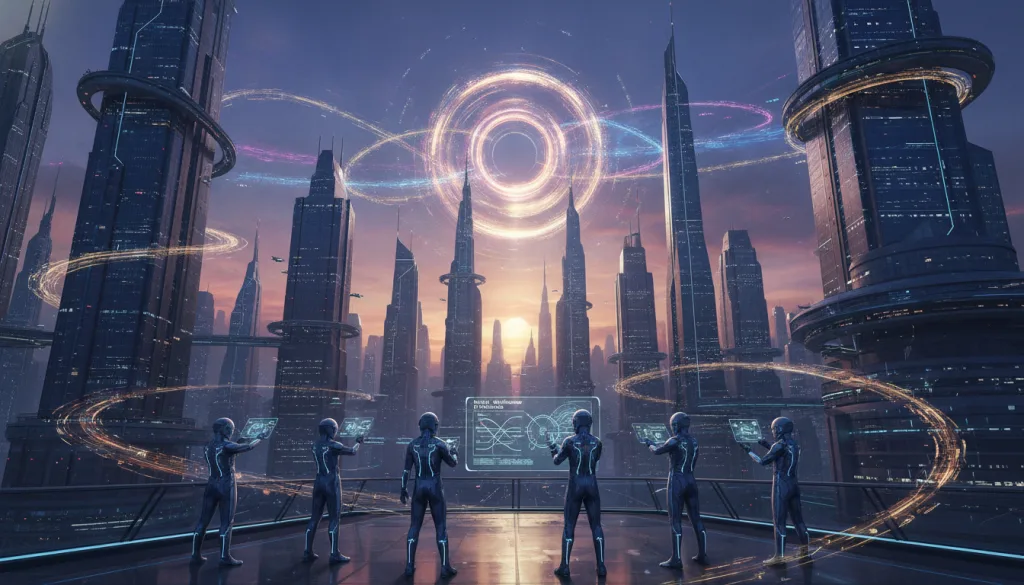
The Novikov principle is rooted in general relativity, primarily when it deals with closed timelike curves (CTCs). CTCs are theoretical constructs that allow for paths in spacetime that loop back on themselves, creating the possibility for time travel. The concept first gained traction in the context of Einstein’s general theory of relativity. In 1974, physicist Kip Thorne and others explored its implications, demonstrating that under specific conditions, CTCs could exist in rotating black holes known as Kerr black holes.
Mathematical Foundations
Mathematically, the Novikov principle can be illustrated through the equations governing spacetime geometry. A famous solution is the Gödel metric, proposed by Kurt Gödel in 1949, which indicates that time travel is theoretically possible in a rotating universe. However, the self-consistency principle demands that the actions of any time traveler remain coherent with the pre-existing timeline.
To put this into context, consider a time traveler who possesses a device that allows them to transport themselves back to 1920. According to the Novikov self-consistency principle, any event they trigger must ultimately lead to the same outcomes that historical records show. This might mean that the time traveler inadvertently causes their own existence, or their actions bypass any potential paradoxes.
Quantum Mechanics and the Many-Worlds Interpretation
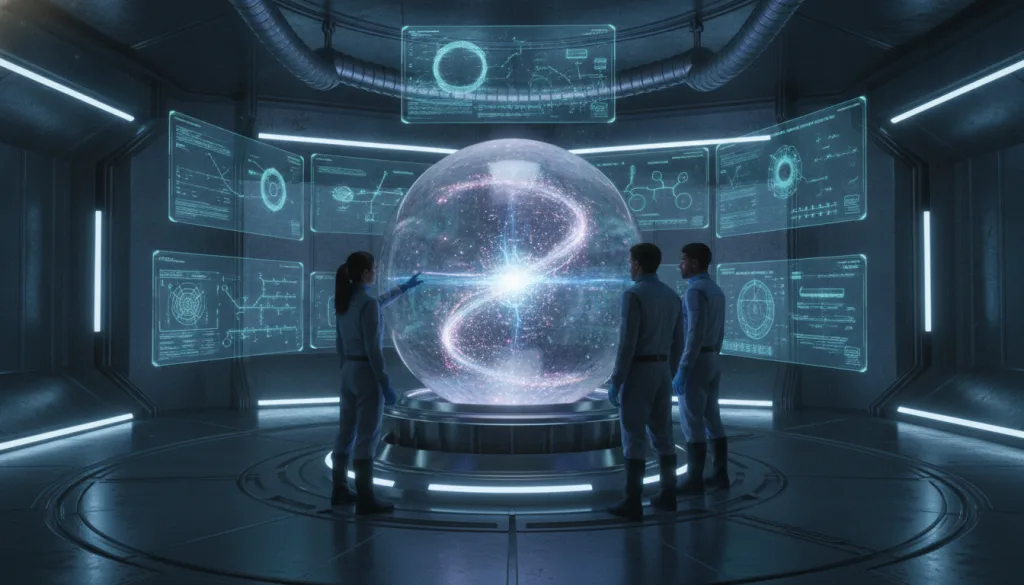
The relationship between the Novikov self-consistency principle and quantum mechanics brings additional nuance to the discussion. In the 1950s, physicist Hugh Everett III proposed the Many-Worlds Interpretation (MWI) of quantum mechanics. This interpretation implies that all possible outcomes of quantum measurements are realized in separate, branching universes. If time travel were to occur in this framework, it could theoretically allow for changes in one universe without affecting another.
In quantum terms, if a time traveler went back to change an event, they would create a new timeline. This new timeline would branch off from the original, thereby avoiding the paradoxes outlined by Novikov. As physicist David Deutsch stated in 1991, “In the many-worlds interpretation, time travel is possible without paradoxes.” This perspective introduces a broader understanding of how time travel might function within the cosmos.
“In the many-worlds interpretation, time travel is possible without paradoxes.” — David Deutsch, 1991.
Implications of Quantum Time Travel
The implications of combining the Novikov self-consistency principle with the MWI are significant. If time travel exists within the framework of quantum mechanics, it suggests that changes made in the past could lead to the emergence of alternate realities. This nuanced understanding positions time travel as a multidimensional experience rather than a linear one, allowing for a broader exploration of its potential consequences.

Consistent Histories Approach
Another quantum interpretation that aligns with the self-consistency principle is the Consistent Histories approach, developed by Robert Griffiths and others in the 1980s. This framework allows for the description of quantum systems without the need for wave function collapse, focusing instead on histories of events that maintain self-consistency. Here, time travel could be understood as a consistent history, where events unfold in ways that do not lead to contradictions.
The Consistent Histories approach provides a robust view of how time travel can integrate seamlessly within the laws of physics. This perspective asserts that any time travel events must conform to the pre-existing histories of both the time traveler and the affected timeline, thus preserving coherence and preventing paradoxes.
Real-World Applications and Experimental Verifications
While time travel remains a theoretical concept, researchers have begun to explore its implications through various experiments. For instance, in 2008, scientists at the University of California, Santa Barbara, utilized quantum mechanics to demonstrate a form of teleportation with photons, showcasing the potential for manipulating information across time and space. Their findings echoed the principles behind both the Novikov self-consistency principle and the Many-Worlds Interpretation.
However, these experiments remain far removed from the form of time travel we imagine in science fiction. The challenges of generating and sustaining the conditions necessary for closed timelike curves are monumental, and as of now, the practicality of time travel is still confined to theory.

Ethical Implications of Time Travel
Should time travel become a feasible reality, the ethical implications would be profound. The Novikov self-consistency principle offers a framework that could mitigate the potential risks of altering historical events. The very nature of the principle suggests that any attempt to change the past would ultimately remain consistent with the timeline, thus safeguarding against potentially catastrophic consequences.
Philosophical Considerations
The philosophical ramifications of the Novikov self-consistency principle extend beyond the realm of physics. The concept challenges our understanding of causality and the linear progression of time. If time travel were possible without paradoxes, it raises questions about free will and determinism. Are our actions predetermined by the timeline, or do we exercise agency even within the constraints of a consistent history?
These discussions are not merely academic but resonate deeply with our understanding of existence and reality. They compel us to confront the nature of time itself and our place within the continuum.
Conclusion: The Limits of Time Travel as Defined by Physics
The Novikov self-consistency principle stands as a formidable barrier against the chaos of paradoxes in the realm of time travel. It suggests that while the concept may be theoretically plausible, the mechanism of time travel must adhere to strict constraints that preserve the integrity of the timeline. By harmonizing with principles from quantum mechanics, such as the Many-Worlds Interpretation, we gain a more nuanced understanding of how time travel could function.
Ultimately, the evidence strongly indicates that any exploration of time travel must reconcile itself with the laws of physics. The Novikov self-consistency principle highlights the importance of maintaining coherence within our understanding of time and causality, and it challenges us to think critically about the very fabric of reality. The potential for time travel may captivate our imagination, but it is bound by the laws that govern the universe.
Notre analyse : La théorie de la self-consistency de Novikov souligne que, même si le voyage dans le temps pourrait être une possibilité théorique, nos actions dans le passé doivent respecter les principes de cohérence. Ce cadre limite les conséquences de nos actions dans le temps, rendant ainsi paradoxes et incohérences impossibles. Cette perspective offre un éclairage fascinant sur notre compréhension de l'univers.
Sources & References
Novikov, I. D., “Self-consistent solutions of the classical equations of motion for a particle in the field of gravity,” 1980, Soviet Physics — Doklady.
Deutsch, D., “Quantum Theory, the Church-Turing Principle and the Universal Quantum Computer,” 1985, Proceedings of the Royal Society A.
Griffiths, R., “Consistent Quantum Theory,” 2002, Cambridge University Press.
Kip Thorne, “Black Holes and Time Warps: Einstein's Outrageous Legacy,” 1994, W.W. Norton & Company.
Hawking, S., “A Brief History of Time,” 1988, Bantam Books.




Comments 0
Be the first to comment!