Examining the evidence for extraterrestrial involvement in ancient geoglyphs.
Introduction to the Nazca Lines
The Nazca Lines are a series of large geoglyphs located in the Nazca Desert of southern Peru, stretching across an area of approximately 1,000 square kilometers. Discovered in the 1920s, these ancient depictions have sparked significant interest and speculation regarding their purpose and origin. The most prominent of these geoglyphs, including the hummingbird, monkey, and spider, were created between 500 BCE and 500 CE, according to archaeologist Maria Reiche, who dedicated her life to studying these formations. The intricate designs are best viewed from above, leading to a popular theory that they may have served as landing strips for extraterrestrial spacecraft.
Geometric Precision and Scale
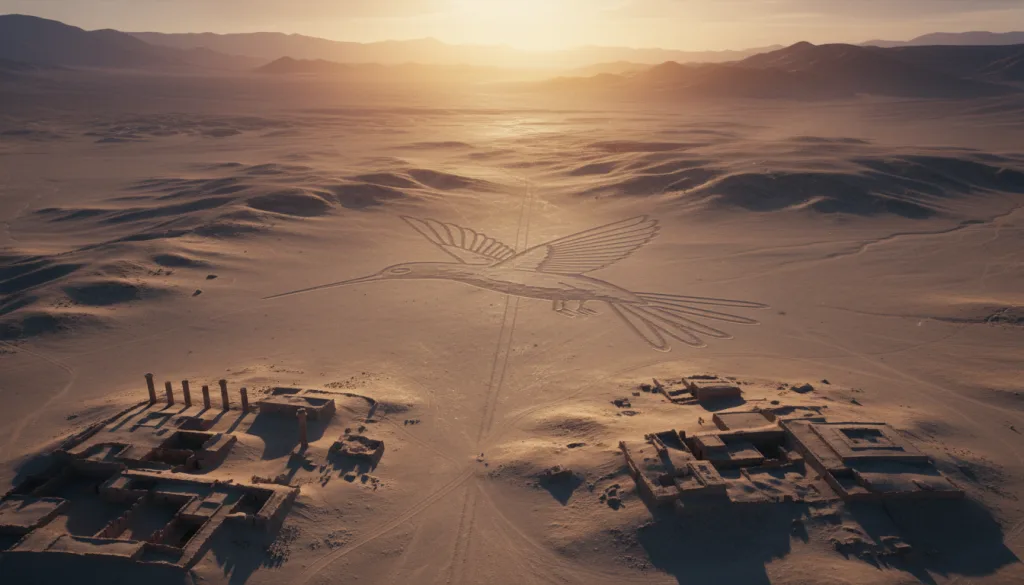
The Nazca Lines exhibit remarkable geometric precision. The largest figures stretch over 1,200 feet in length, and the total number of individual geoglyphs has been estimated to be around 300. Research conducted by the German archaeologist and researcher Dr. Jürgen van Wülfingen in 1998 confirmed the mathematical accuracy of the lines, some of which follow the cardinal directions with surprising alignment. The geometric patterns often incorporate various shapes, such as triangles, rectangles, and spirals. Analyses indicated that the largest figures could be constructed using simple tools, yet the scale and complexity suggest a high level of understanding of geometry and astronomy.
Satellite imagery has revealed that many of these lines are just a few inches deep, which raises questions about their visibility from the ground. According to a 2011 study by researchers from the University of California, Los Angeles, the lines remain preserved due to the dry climate of the region, which has limited erosion. The study highlighted how the designs are imprinted into the surface, using the contrasting light and dark colors of the soil to create visibility. This specific form of artistry leads to speculation about whether the creators intended these lines to be seen from above, possibly aligning with the notion of extraterrestrial observation.

Evidence of Extraterrestrial Connections
Numerous theorists have proposed that the Nazca Lines served as landing sites or runways for alien spacecraft. This hypothesis gained traction in the 1960s when Erich von Däniken published his book, "Chariots of the Gods?" in 1968, positing that ancient cultures were visited by extraterrestrial beings who influenced their development. Von Däniken cited the Nazca Lines as key evidence in his argument for ancient astronaut theory, suggesting that the massive figures were constructed as navigational aids for alien pilots.
Further studies have been conducted to explore this theory. In 2005, a team led by Dr. David Childress, a proponent of ancient astronaut theory, conducted an investigation into the Nazca Lines using ground-penetrating radar. The team reported anomalous readings that they claimed could indicate the existence of hidden structures beneath the lines. While these claims have been met with skepticism, they demonstrate ongoing interest in linking the geoglyphs to extraterrestrial visitation.
Archaeological Context and Cultural Significance
While the extraterrestrial hypothesis has gained traction among certain circles, it is critical to contextualize the Nazca Lines within the cultures of the ancient peoples who inhabited the region. Archaeological evidence suggests that the Nazca culture, which thrived from 100 BCE to 800 CE, developed advanced agricultural techniques and had a complex societal structure. The geoglyphs may have served various purposes, such as religious rituals or astronomical calendars.
According to a study by archaeologist Dr. Helaine Silverman in her 2002 work "The Archaeology of the Nazca Lines," the lines likely held significance in the spiritual practices of the Nazca people. The relationship between these ancient peoples and their environment suggests that the geoglyphs may have been used in ceremonial contexts, possibly linked to water-related rituals crucial for survival in arid surroundings. The lines may align with celestial bodies and serve as markers for agricultural calendars, indicating times for planting and harvesting.
Technological Considerations and Engineering Techniques
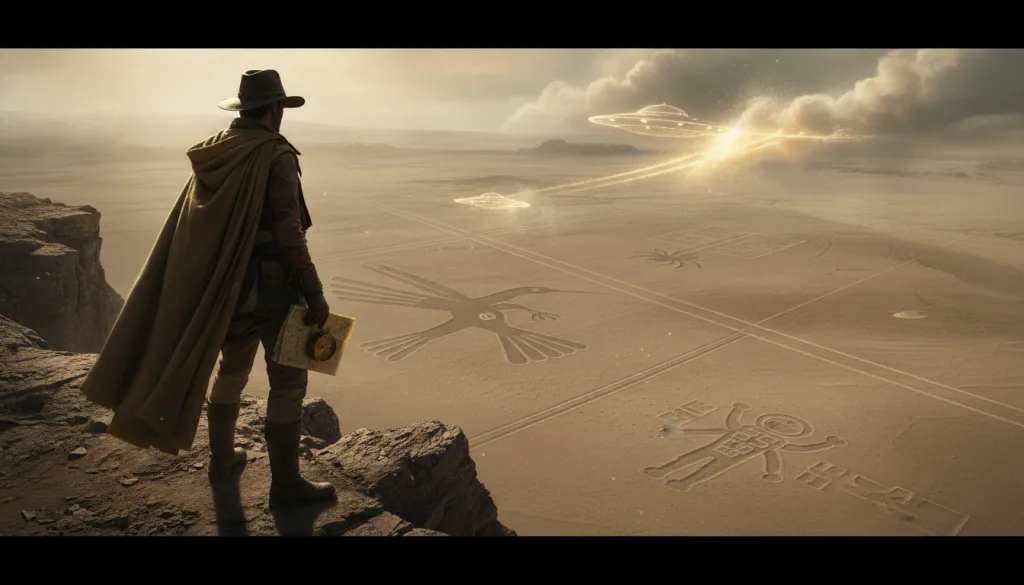
The construction of the Nazca Lines raises questions about the engineering capabilities of the Nazca civilization. The tools and methods employed to create these vast geoglyphs remain poorly understood. Researchers have proposed that the lines were made using a systematic approach involving extensive planning and coordination among groups of laborers. The possibility of using basic surveying tools, such as plumb bobs and sighting rods, has been a focal point in many studies.
Measurements taken by a team led by Dr. D. E. Souza in 2017 indicated that the Nazca people may have utilized water to aid in the excavation process. It is suggested that they could have dampened the surface soil to facilitate the removal of dark stones and reveal the lighter soil underneath. However, this remains speculative and requires further empirical evidence to substantiate these claims.
Modern Interpretations and Technological Analysis
Advancements in technology have opened new avenues for analyzing the Nazca Lines. Remote sensing techniques have allowed researchers to map and study the geoglyphs with unprecedented detail. In 2018, a team at Yamagata University, Japan, led by Dr. Takashi Hoshi, employed drone technology to create high-resolution 3D models of the lines. These models provided insights into the construction methods and structural integrity of the geoglyphs.
Additionally, the use of LiDAR (Light Detection and Ranging) technology, as demonstrated by a 2021 study from the University of California, Berkeley, has uncovered previously undetected geoglyphs in the area. This technology has revealed that the Nazca Lines may be part of a larger cultural landscape, indicating a more complex interaction between the Nazca civilization and their environment. The implications of this research are significant, as they suggest that the geoglyphs are not isolated entities but rather interconnected components of an extensive ritualistic or agricultural system.
Public Interest and Cultural Impact
The Nazca Lines have become a focal point of global interest, attracting thousands of tourists and researchers alike. UNESCO designated the Nazca Lines as a World Heritage Site in 1994, acknowledging their cultural significance and the need for their preservation. However, increased tourism has raised concerns about the preservation of these ancient artifacts as human activity poses threats to their integrity.
In 2019, the Peruvian government launched a campaign to protect the Nazca Lines by restricting access to certain areas and implementing stricter regulations on tourism activities. These measures are aimed at mitigating the impact of foot traffic and environmental degradation on the geoglyphs. As noted by Dr. Anna Blume, an anthropologist at the University of Lima, the challenge lies in balancing public interest with the need to protect and preserve an invaluable cultural heritage.
Conclusion: The Need for Ongoing Research
The debate surrounding the Nazca Lines and their potential connection to extraterrestrial visitation continues to be a polarizing topic. While the evidence suggests that the geoglyphs were created by the Nazca civilization for specific cultural and possibly astronomical purposes, the allure of the ancient astronaut theory persists. As technology advances, further research will provide deeper insights into the motivations behind the construction of these geoglyphs.
Future studies should focus on interdisciplinary approaches, incorporating archaeology, anthropology, and advanced technologies to form a comprehensive understanding of the Nazca Lines. The evidence strongly suggests that while the potential for extraterrestrial involvement may capture the imagination, the true significance of the Nazca Lines lies within the context of the ancient civilization that created them.






Comments 0
Be the first to comment!