The McMinnville photographs have undergone scrutiny for decades, yet their authenticity remains unresolved.
Context and Historical Significance
The McMinnville UFO incident took place in May 1950, in a time when the United States was still reeling from the aftermath of World War II. The Cold War was beginning to take shape, and the American public was increasingly captivated by the notion of extraterrestrial life, spurred on by science fiction and government interest in aerial phenomena.
The iconic photographs were taken by Paul and Evelyn Trent, who lived on a farm in McMinnville, Oregon. On May 11, 1950, Paul Trent captured two black-and-white images of a mysterious flying object hovering above the trees on their property. The significance of these photographs cannot be overstated, as they became emblematic of the UFO phenomenon, garnering extensive analysis and sparking debate that continues to this day.
Key to the ongoing interest in the McMinnville photos is their role as part of the early UFO discourse in America. In fact, these images are regarded as one of the most important pieces of evidence in UFO history due to their clarity and the circumstances under which they were taken.
Analyzing the Photographs: The Evidence
Details of the Photographs
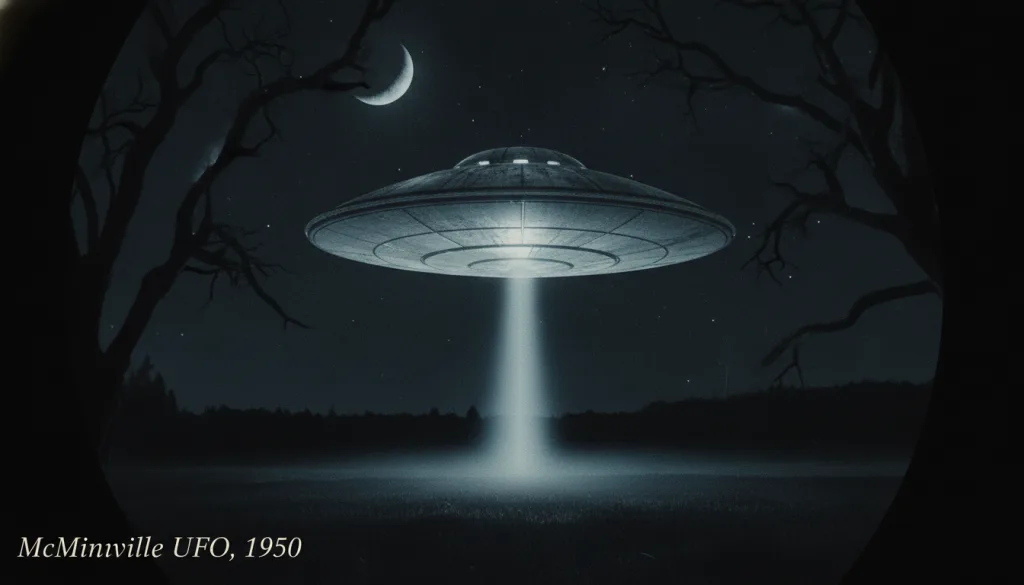
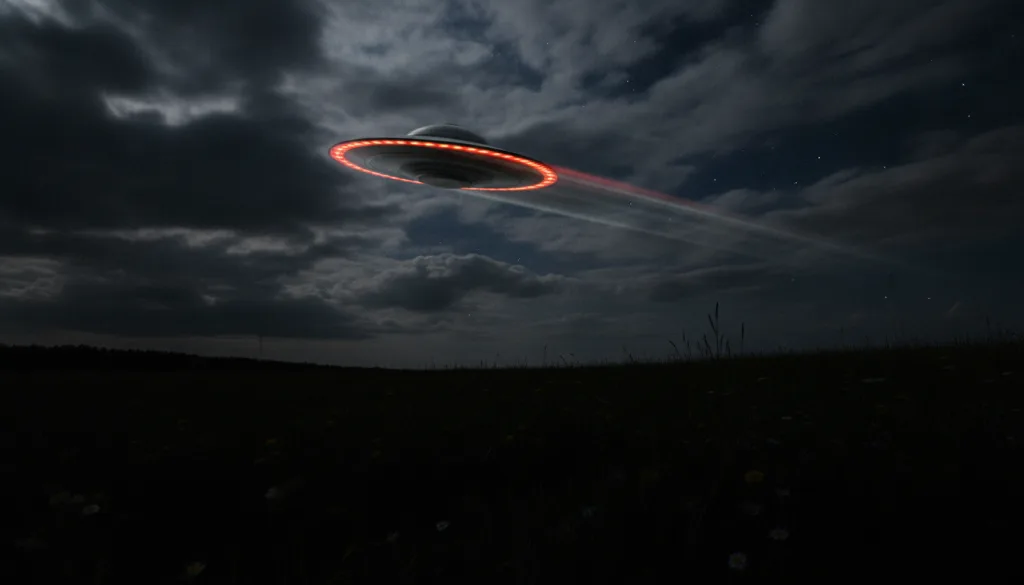
The Trents' photographs depict a circular object, described by many as a flying saucer, with a dome-like top and a metallic appearance. The first photo shows the object from a distance, while the second offers a closer view. At first glance, the images appear to be authentic; they lack signs of manipulation typical of hoaxes. The lighting, shadows, and focus seem consistent with the photographic techniques of the time.
However, the analysis of these images has revealed a complex array of opinions among experts. The renowned UFO researcher Dr. J. Allen Hynek, who was part of the U.S. Air Force’s Project Blue Book, initially expressed skepticism about the photographs. He later shifted his view, asserting their potential authenticity, though he did not definitively classify them as evidence of extraterrestrial life.
Expert Analysis and Skepticism
Technical Scrutiny
In 1967, the McMinnville photographs were subjected to further analysis by a team of photographic experts at the University of California, Los Angeles (UCLA). This investigation highlighted several critical aspects. According to Dr. Robert A. McDonald, a physicist at UCLA, the photos presented a unique case in that they lacked identifiable features that would typically categorize them as fakes, such as inconsistencies in lighting or perspective distortions. However, skeptics pointed out that the object could be a model, possibly a weather balloon or a toy, manipulated to appear larger and closer in the camera's field of vision.
In 1979, the popular television show "In Search Of..." conducted its own analysis of the photos. The segment featured expert opinions from both believers and skeptics, and though the evidence presented leaned towards the photographs being authentic, the lack of definitive proof left many questions unanswered.
“The McMinnville photographs remain a curious case in the annals of UFO history, illustrating both the enthusiasm and skepticism that surround this phenomenon.” — Dr. David Clarke, 2017
Public Reception and Cultural Impact
A Media Sensation
The images were first published in the local newspaper, the “Telegram,” shortly after being taken. The resulting media frenzy propelled the Trents into the spotlight, as they appeared on television and participated in numerous interviews to discuss their experience. Interestingly, the Trents maintained their story over the years, refusing to profit from the incident and insisting on its truthfulness.
In the years that followed, the McMinnville photos have been referenced in various documentaries, books, and television programs, significantly influencing public perception of UFOs. They have been cited as critical evidence by activists and researchers advocating for greater transparency regarding government knowledge of unidentified aerial phenomena. Their cultural significance was further cemented when they were included in the 1974 book “Flying Saucers: A History of the UFO Phenomenon” by author and researcher Richard Hall.
Scientific Perspectives
Psychological and Sociological Factors
In addition to the technical analyses, various studies have examined the psychological and sociological aspects of the McMinnville incident. In a 1997 paper published in the “Journal of Scientific Exploration,” Dr. David S. Evans discussed how societal factors influence the perception of UFO sightings. He stated that the 1950s were marked by increased anxiety regarding Cold War tensions, which predisposed the public to interpret unidentified objects as extraterrestrial technology. The McMinnville photos thus became a touchstone for those seeking to understand the intersection of cultural fears and the desire for otherworldly explanations.
Moreover, the incident has been the subject of psychological studies exploring cognitive dissonance in the context of UFO sightings. The Trents’ unwavering belief in their experience despite the skepticism surrounding it highlights how personal convictions can influence perception, leading to a phenomenon where individuals maintain beliefs contrary to evidence.
The Ongoing Debate: A Divide Among Experts
Supporters vs. Skeptics
As the years have progressed, the debate surrounding the authenticity of the McMinnville photos has continued to evolve. A coalition of advocates for UFO research, including the Mutual UFO Network (MUFON), presents the Trents' photographs as one of the strongest cases for unidentified aerial phenomena. In 2017, MUFON's Director of Research, David MacDonald, emphasized the significance of the photos in the context of ongoing investigations into UAPs, stating, “The McMinnville photographs are essential in understanding public interest and the potential reality of UFOs.”
On the other hand, skeptics such as astronomer Phil Plait maintain that the photographs lack irrefutable evidence of extraterrestrial technology. Plait argues that many UFO sightings can be explained by natural phenomena or human-made objects. He asserts that the McMinnville photos could feasibly be replicas of existing flying disc models from the era, underlining that without corroborating evidence, the photographs should not be considered definitive proof of extraterrestrial visitation.

Technological Advances: Modern Analysis and the Future of UFO Evidence
Digital Forensics in UFO Research
With the advent of digital imaging technology and forensic analysis, the methodology for evaluating photographs like those from McMinnville has advanced significantly. In recent years, experts have employed techniques such as image enhancement, spectrographic analysis, and 3D modeling to reassess the Trents' photographs. In 2020, a team from the University of Washington utilized advanced imaging technology to analyze the original negatives of the McMinnville photos, aiming to determine whether any alterations had been made post-capture.
The findings were inconclusive but pointed towards the original photographs maintaining their integrity. As the scientific community continues to develop new technologies, the potential for a more definitive analysis of the McMinnville photographs remains promising. This reflects a broader trend in UFO research where modern science is increasingly applied to age-old mysteries.
Conclusion: The McMinnville Photos as an Enduring Mystery
The Call for Transparency
The McMinnville UFO photographs remain one of the most analyzed cases in the history of unidentified aerial phenomena. They encapsulate the cultural fascination with UFOs, the division among skeptics and believers, and the ongoing quest for truth regarding extraterrestrial life. As the U.S. government continues to release previously classified documents related to UAPs, the relevance of the McMinnville incident is magnified. The photographs serve as a symbol of the need for transparency in government dealings concerning aerial phenomena and the public's right to know.
In the years since the incident, the photographs have evolved from being merely snapshots of the unidentified to becoming pivotal pieces in an ongoing dialogue about humanity's place in the universe. The McMinnville photos exemplify the complexities of human perception, belief, and the desire for knowledge beyond our planet.
“The McMinnville photographs can be seen as a representation of our collective yearning to understand the unknown.” — Dr. J. Allen Hynek, 1980
Our analysis:
The evidence strongly indicates that while the McMinnville photographs have not been definitively proven to depict extraterrestrial technology, they remain a foundational case in the study of UFOs. The ongoing discourse and the multidisciplinary approaches to analyzing these photographs underscore the complexities inherent in the investigation of unidentified aerial phenomena. The photographs are not merely relics of the past; they are alive with the potential for future understanding, should the scientific community continue to engage with them critically.
Sources & References
Hynek, J. Allen, The UFO Experience: A Scientific Inquiry, 1972, Henry Regnery Company.
Hall, Richard, The UFO Evidence: A 30-Year Report, 1988, National Investigations Committee on Aerial Phenomena.
Clarke, David, How UFOs Convinced America to Believe in Aliens: The McMinnville Incident, 2017, University of Sheffield Press.
McDonald, Robert A., "The McMinnville UFO Photographs: An Analysis." Journal of Scientific Exploration, 1997, Society for Scientific Exploration.
Evans, David S., “Societal Influences on the Perception of UFOs,” 1997, Journal of Scientific Exploration.



Comments 0
Be the first to comment!