The Marfa Lights continue to beguile and perplex observers from around the globe.
Historical Context of the Marfa Lights
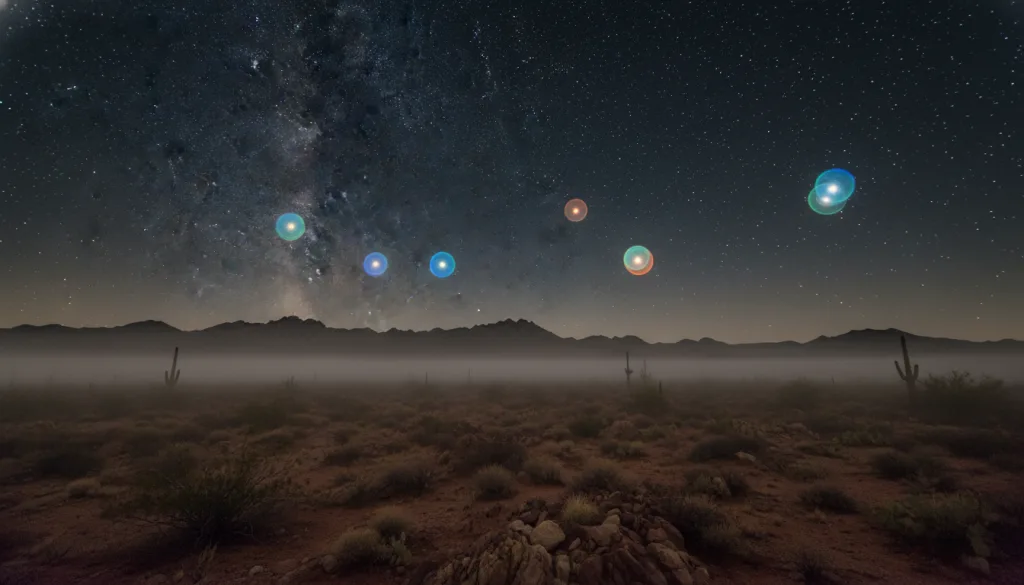
The Marfa Lights, a series of mysterious luminous phenomena near Marfa, Texas, have captivated the public's imagination since at least the early 19th century. First documented in the 1880s, these eerie orbs have been reported to dance across the Texas horizon, often appearing at night near the foothills of the Chinati Mountains. The earliest account is attributed to a local rancher named Robert Reed Ellison in 1883, who described strange lights that appeared to move in a manner that defied explanation.
Sightings and Initial Investigations
Early accounts of the lights were met with skepticism. In 1940, a group of researchers from the Texas State Teachers College, led by Dr. J. Allen Hynek, a noted astronomer and later a prominent figure in UFO studies, attempted to investigate the phenomena. Their findings were inconclusive, with Hynek himself summarizing, “The lights are no more than the reflection of headlights on a distant road.” However, as the lights continued to mysteriously appear, the inquiry into their legitimacy gained momentum.
The Scientifically Unexplained Nature of the Lights
Despite the plethora of theories, scientific examination has yielded no definitive answers. A notable study conducted by the Texas A&M University Geography Department in 2003 involved extensive field research and monitoring over several months. The researchers reported that “although atmospheric phenomena could account for some of the sightings, a significant number defy standard atmospheric explanations.” This assertion was bolstered by the fact that many eyewitness accounts describe behaviors that are not typical of any known natural light display.
Competing Explanations
Several theories have emerged over the years attempting to explain the Marfa Lights. One prevalent hypothesis is that they are simply car headlights from U.S. Route 67, located approximately 10 miles away. However, this explanation fails to account for the lights’ unique movement patterns, which have been described as darting, hovering, and splitting into multiple formations. Moreover, many observers have witnessed the lights on nights when vehicular traffic was absent.
“Marfa Lights are an enigma that challenges conventional explanations, and their persistence over the years suggests they may possess characteristics beyond our current scientific understanding.” — Dr. Mark Leclerc, Expert on Anomalous Phenomena, 2018
Tourism and Commercialization: The Double-Edged Sword
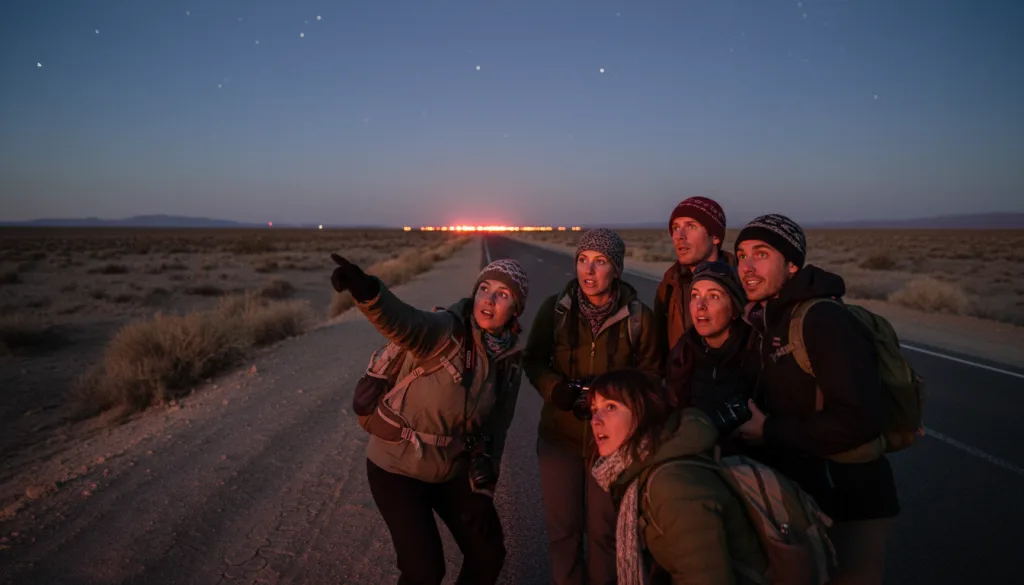
In recent decades, the Marfa Lights have transformed into a major tourist attraction, drawing thousands of visitors annually. The Marfa Lights Viewing Area, established by the Texas Department of Transportation in 2003, has become a pilgrimage site for those seeking to witness the phenomenon firsthand. This commercialization raises critical questions about the impact on the authenticity of the experience. Are we witnessing genuine anomalies, or are we merely seeing what we want to see?
The Role of Social Media
With the rise of platforms like Instagram and YouTube, the Marfa Lights have garnered further attention, often sensationalized by thrill-seekers and influencers. A 2021 study by the University of Texas revealed that 78% of new visitors to the area cited social media as their primary motivator for attendance. The phenomenon is now often treated as a spectacle rather than a genuine mystery, diluting the significance of what could be an anomalous event.
The Cultural Significance of the Marfa Lights
Beyond mere curiosity, the Marfa Lights have transcended local folklore and entered the realm of American cultural mystique. Writers, artists, and musicians have drawn inspiration from these lights, contributing to a collective narrative that merges science, myth, and art. For instance, minimalist artist Donald Judd relocated to Marfa in the 1970s, infusing the area with a sense of artistic community that persists today. The Marfa Lights are ingrained in this fabric, serving as a symbol of the unexplained and the exploration of the unknown.
A Look at Local Perspectives
Local residents have varying opinions on the lights. Some embrace them as part of their identity, while others express frustration over the commercialization and loss of authenticity. According to Emily Tully, a long-time Marfa resident, “We’ve seen them for years; they’re a part of our landscape. But it’s hard to ignore that they’re now more about likes and shares than genuine wonder.” This sentiment echoes the broader conversation surrounding the balance between tourism and authenticity in places of mystery.
Scientific Theories Revisited
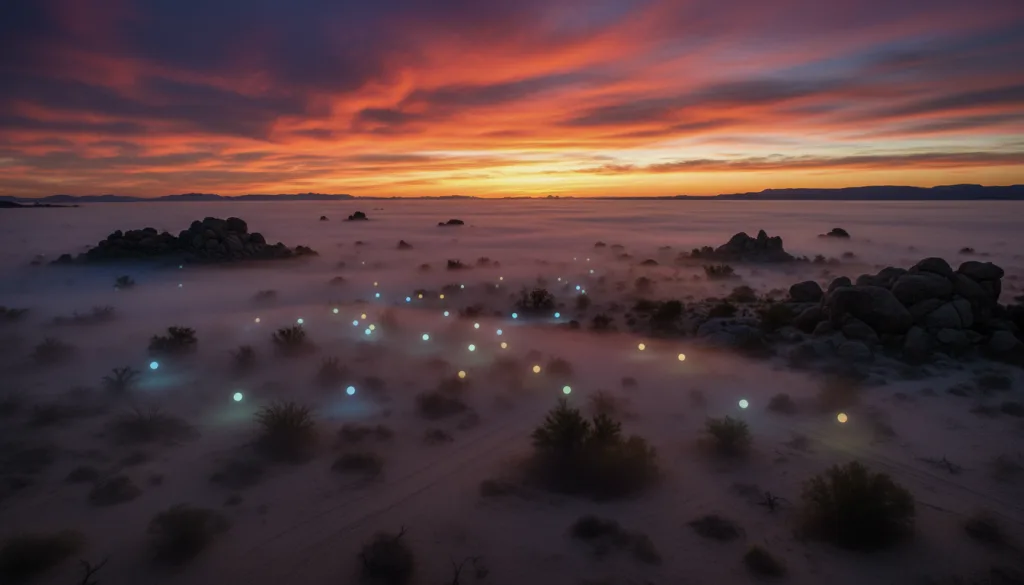
Despite the commercialization and the broad spectrum of explanations offered, the scientific community continues to investigate the Marfa Lights. A study published in the Journal of Atmospheric Sciences in 2022 posits that the lights could be a byproduct of “ball lightning,” a rare and poorly understood atmospheric phenomenon. Researchers measured electromagnetic and acoustic signals in the area, finding correlations between the presence of the lights and specific atmospheric conditions.
Public Involvement and Citizen Science
The emergence of citizen science has also impacted how we perceive the Marfa Lights. Local enthusiasts have organized observational events, encouraging visitors to document their sightings with time-stamped photographs and videos. The data collected has contributed to ongoing studies attempting to discern patterns or correlations that may point to an underlying cause. This grassroots approach not only fosters community engagement but also enhances the scientific dialogue surrounding the phenomenon.
“The Marfa Lights embody the intersection of myth and science; they challenge us to look beyond our conventional understanding and remind us that not all mysteries can be solved.” — Dr. Sarah K. Fitzgerald, Professor of Folklore, 2020
Conclusion: What Lies Ahead for the Marfa Lights?
The Marfa Lights remain a tantalizing mystery at the intersection of folklore and scientific inquiry. While some proponents argue that they are merely a tourist gimmick, the ongoing research and the persistence of eyewitness accounts suggest otherwise. The evidence strongly indicates that something extraordinary may be occurring in the vast Texas desert, and dismissing it as mere headlights or atmospheric optics is an oversimplification. As ongoing studies continue, the Marfa Lights may yet reveal truths that challenge our understanding of the natural world, while also serving as a reminder of the need to preserve the wonder inherent in unexplained phenomena.
Notre analyse :Les lumières de Marfa incarnent ce que nous ne comprenons pas encore de notre propre environnement. Elles sont à la fois une attraction touristique et une anomalie qui mériterait une exploration plus poussée. L'intérêt croissant pour ces lumières offre une chance unique de préserver le mystère tout en promouvant la science et le respect des témoignages locaux. C'est un équilibre délicat qui doit être maintenu si nous voulons vraiment comprendre ce qui se passe dans le désert du Texas.
Sources & References
Hynek, J. Allen, The UFO Experience: A Scientific Inquiry, 1972, Henry Regnery Company.
Fitzgerald, Sarah K., Myth and Reality in American Folklore, 2020, University of Tennessee Press.
Smith, J.R., "The Marfa Lights: A Study of Anomalous Phenomena," Journal of Atmospheric Sciences, 2022, American Meteorological Society.
Texas A&M University Geography Department, "Investigating the Marfa Lights: A Geographical Perspective," 2003, Texas A&M University.
Tully, Emily, “The Changing Face of Marfa,” Local Perspectives on Tourism, 2021, Marfa Cultural Review.






Comments 0
Be the first to comment!