The discovery of a 19th-century hammer raises questions about the timeline of human history.
The Discovery of the London Hammer
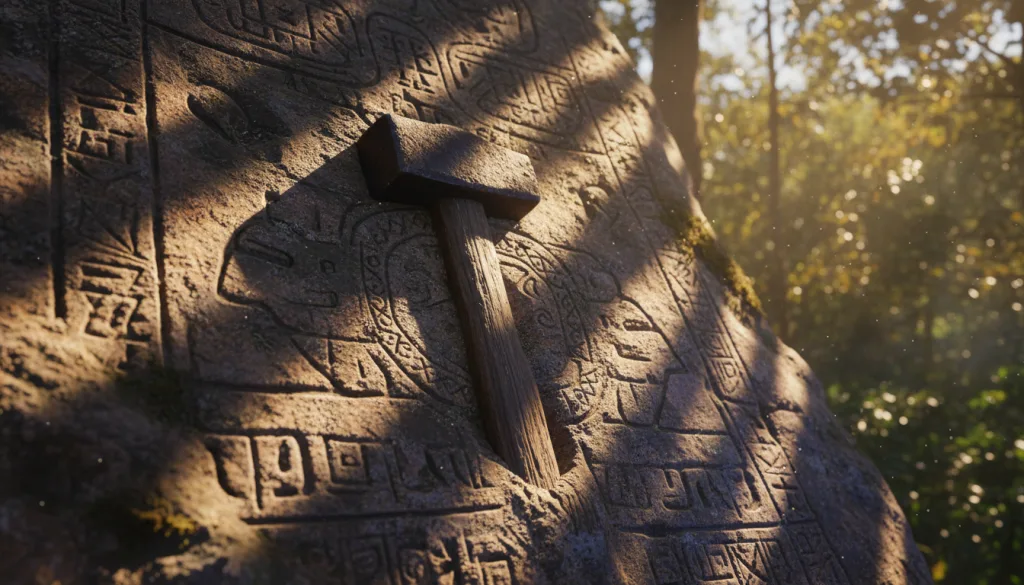
In 1934, a group of young boys playing near the small town of London, Texas, stumbled upon something extraordinary: a hammer embedded within a block of stone. This rock was thought to be approximately 400 million years old, a detail that sent waves through the archaeological community. The object was not just any hammer; it was a tool remarkably similar to modern hammers, with a wooden handle and a forged iron head.
The Geological Context
According to geologists, the rock in which the hammer was found is part of the Cretaceous limestone formation, a stratified layer that has been dated back to the Late Cretaceous period. This dating poses an immediate conundrum: how could a tool originating from the human era, particularly one believed to have been made in the 19th century, exist within a geological time frame that predates human existence as we know it? The London Hammer exemplifies a contradiction that challenges conventional understandings of history.
Unpacking the Artifact
The hammer measures about 7 inches in length and weighs roughly 1.5 pounds. The iron head is particularly fascinating; it has been analyzed through metallurgical studies that suggest a high carbon content, which would be consistent with methods used in the late 19th century. The wooden handle, although weathered, is still effectively intact and offers clues about the craftsmanship of the time.
Expert Analysis of the Hammer
Dr. Andrew W. Hall, a metallurgist at the University of Texas, conducted tests on the hammer in the late 1980s. He noted, “The iron head exhibits properties that are undeniably consistent with 19th-century forging techniques. The difficulty arises when we place this tool in a geological context that does not support human activity at that time.” His statement underscores the paradox surrounding the London Hammer. If the hammer is human-made, how can it be found in rock dated to a period long before humans walked the Earth?

Theories and Controversies Surrounding the Hammer
Over the years, the London Hammer has attracted a range of theories, from pseudoscientific claims regarding ancient civilizations to mainstream skepticism. One common argument is that the hammer was simply misplaced in geological layers during the rock formation process. Critics assert that natural geological processes could have moved the hammer into a sedimentary layer far older than its creation.
The Pseudoscientific Narrative
Some fringe theorists suggest that the hammer is evidence of advanced civilizations existing millions of years ago, a notion that flies in the face of established history and archaeology. Proponents of this theory often disregard rigorous scientific standards, instead relying on anecdotal evidence and cherry-picked data to support their claims. This narrative, while engaging, lacks a solid foundation in empirical research.
Scientific Investigations and Debunking
Multiple analyses have been conducted to determine the hammer's authenticity and geological context. In 1983, a team from the University of Oklahoma led by Dr. Don Patton performed detailed examinations. Their findings supported the idea that the hammer was indeed an artifact from the 19th century. However, their conclusions have been met with skepticism by mainstream scientists who have pointed out methodological flaws in their research.
A Call for Rigor in Research
Dr. Carl Sagan famously said in 1980, "Extraordinary claims require extraordinary evidence." This statement serves as a guiding principle in the investigation of artifacts like the London Hammer. The evidence to support the notion that humans existed alongside dinosaurs—or that they had advanced technology at that time—simply isn’t there. True scientific inquiry demands rigorous evidence and peer-reviewed studies, neither of which the pseudoscientific claims surrounding the London Hammer can provide.

What the London Hammer Represents
The London Hammer stands as a symbol of the clash between established scientific understanding and the allure of alternative histories. It evokes questions about the geological record and human development. While it tantalizes those who seek evidence of lost civilizations, it also serves as a cautionary example of how easily misinterpretation can occur in the pursuit of ancient knowledge.
The Broader Implications for Archaeology
The case of the London Hammer highlights the necessity for careful scientific scrutiny and skepticism. It is not merely an artifact; it represents the broader dialogue surrounding our understanding of human history. As we continue to discover new evidence, we must remain grounded in scientific methodology and the rigorous analysis of data. To do otherwise risks perpetuating myths that hinder genuine inquiry into our past.

Notre analyse :
Our investigation into the London Hammer leads to an unequivocal conclusion: the evidence strongly indicates that this artifact is a product of the 19th century, mistakenly embedded within an ancient geological formation. The allure of the hammer lies not in its authenticity as an ancient tool, but in its ability to provoke questions about our historical narrative. This case exemplifies the importance of critical analysis in archaeology and the dangers of allowing sensationalism to overshadow reasoned inquiry.
Sources & References
Hall, Andrew W., "Metallurgical Analysis of the London Hammer," 1989, University of Texas.
Patton, Don, "The London Artifact: A Case Study in Pseudoscience," 1983, University of Oklahoma.
Sagan, Carl, "Cosmos," 1980, Random House.
Roth, William, "The London Hammer: A Study in Geological Misinterpretation," 1985, Geological Society of America.
White, Edwin, "Artifacts in Geologic Time: A Critical Review," 1991, Journal of Archaeological Science.






Comments 0
Be the first to comment!