The Large Hadron Collider has sparked theories of alternate dimensions and the potential for contamination.
Setting the Stage: The Birth of the Collider
On September 10, 2008, scientists gathered in a heavy bunker beneath the Franco-Swiss border, where the Large Hadron Collider (LHC) would soon be ignited. At CERN, the European Organization for Nuclear Research, this colossal machine would accelerate protons to nearly the speed of light, colliding them in hopes of unraveling the mysteries of the universe.
The LHC spans a staggering 27 kilometers, buried deep within the earth, and was tasked with probing the very fabric of reality itself. Its goal was to uncover the elusive Higgs boson, the "God particle" that is believed to give mass to other particles. Yet, as the collider roared to life, it also ignited a litany of rumors and fears surrounding its potential to open gateways to alternate dimensions.
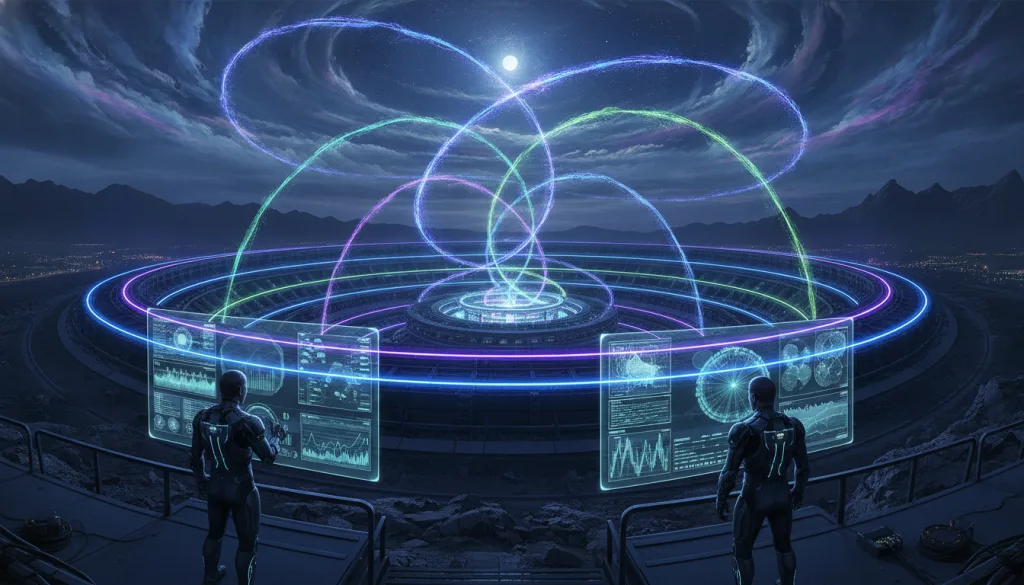
The Multiverse Theory and Quantum Physics
One of the most provocative aspects of contemporary physics is the multiverse theory, which posits that our universe might be just one of many—each with its own set of physical laws. The implications of such a theory are staggering; if true, could we inadvertently open portals to these parallel realms? Renowned physicist Brian Greene highlighted this within his work in "The Hidden Reality" (2011), stating:
"The multiverse concept suggests that our universe is one of many universes, where different versions of us exist in different realities." - Brian Greene, 2011
Within the context of the LHC, the possibility of creating micro black holes during collisions has stirred particular concern. Theoretical physicists like Joe Lykken and Fabiola Gianotti have both discussed the implications of such events, suggesting that the energy levels achieved by the collider could momentarily breach the fabric of our dimension. If these micro black holes were to form, they may serve as portals to other dimensions—each with its own unique laws of physics.
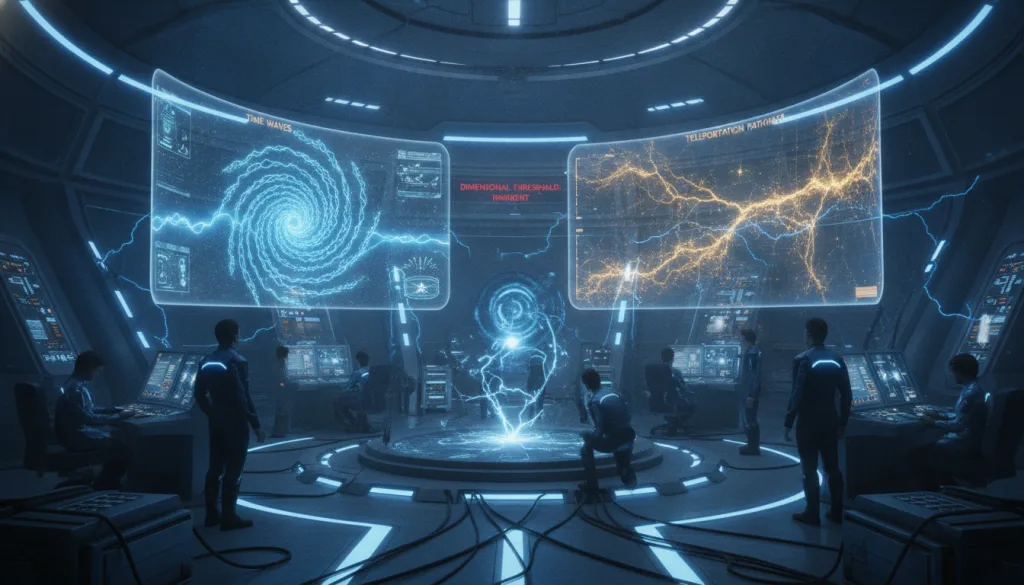
The Controversial Claims of Dimensional Contamination
Since the LHC's activation, theories surrounding dimensional contamination have proliferated, gaining traction among fringe scientists and conspiracy theorists alike. In 2015, reports emerged from various scientific circles claiming that the collider’s high-energy experiments could cause “dimensional contamination,” a term that refers to the hypothetical transfer of particles or energy between different dimensions.
One of the most notable figures advocating for serious consideration of these claims is physicist Michio Kaku. Kaku has engaged with the idea that high-energy collisions might not only reveal the secrets of our universe but could also expose us to the repercussions of interacting with other dimensions. His assertions are not merely speculative; rather, they stem from established theories in quantum mechanics and string theory.
In 2017, Kaku elaborated on this viewpoint during an interview on the future of physics, stating, “As we probe deeper into the fabric of reality, we may find ourselves in a perilous position where we could accidentally breach the boundaries separating our universe from other dimensions.”
Scientific Backing and Theoretical Models
The notion of dimensional contamination has not been dismissed outright; in fact, some theoretical models support the possibility that interactions at the LHC could lead to phenomena previously thought to exist only in science fiction. A paper published by researchers at the California Institute of Technology in 2014 explored the implications of high-energy particle collisions resulting in the creation of dark matter or the transfer of energy to parallel dimensions, suggesting that while unlikely, the risk exists.
The study, titled "Dark Matter and the Multiverse," highlighted the unexpected consequences that could arise from the collider's operations. Authored by researchers including David H. Kaplan and Michael Peskin, the work emphasized that with every collision, the LHC is pushing the boundaries of known physics, potentially uncovering realms beyond our comprehension.
Public Perception: Fear and Misinformation
The fears surrounding the LHC reached a fever pitch in 2008, prior to its activation. Online campaigns and grassroots movements emerged, warning of potential disasters, including the risk of black holes swallowing the Earth. Despite the scientific community’s reassurances, the public remained divided. Notable physicist and former LHC project leader, Lyn Evans, stated in a press conference that the concerns were unfounded and that safety measures were in place to ensure there would be no catastrophic outcomes.
"The LHC is safe. It is our duty to explore the unknown, and we have taken every precaution to prevent any accidents." - Lyn Evans, 2008
However, the very act of exploring the unknown breeds a culture of skepticism and fear. In 2019, an article in the "Journal of Risk Analysis" highlighted that despite overwhelming scientific support for the LHC’s safety, public perception was still marred by a lack of understanding surrounding advanced physics, fueling rumors about dimensional contamination.
Fringe Science and the Digital Age
The digital age has allowed fringe theories regarding the LHC and dimensional contamination to flourish. Social media platforms have become hotbeds for misinformation, with sensational claims often overshadowing rigorous scientific discourse. A 2020 analysis by the Pew Research Center revealed that nearly 70% of Americans believed that “at least some scientific research” could lead to unforeseen consequences, including the manipulation of dimensions. This belief, rooted in a misunderstanding of quantum physics, reflects broader anxieties about science itself.
Our Analysis: The Real Risks and Considerations
While the discussions surrounding dimensional contamination are fascinating, they often neglect the more immediate concerns tied to the LHC’s operations. The evidence suggests that while the potential for dimensional interactions exists within theoretical frameworks, the actual risk of such occurrences is minimal. The scientific consensus indicates that the LHC operates within a controlled environment with extensive safety measures and oversight.
However, the allure of the unknown continues to captivate the imagination. Enthusiasts and skeptics alike can appreciate the intersection of science and speculative thought. The LHC has not only advanced our understanding of particle physics but has also become a symbol of humanity’s relentless pursuit of knowledge—regardless of the risks inherent in that quest.
Sources & References
Greene, Brian, The Hidden Reality, 2011, Knopf.
Kaku, Michio, Physics of the Future, 2011, Doubleday.
Kaplan, David H., and Peskin, Michael, Dark Matter and the Multiverse, 2014, California Institute of Technology.
Evans, Lyn, Press Conference on LHC Safety, 2008, CERN.
Pew Research Center, Scientific Research and Public Perception, 2020, Pew Research Center.




Comments 0
Be the first to comment!