A comprehensive examination of FBI records underscores the agency's prolonged scrutiny of unidentified aerial phenomena.
The Historical Context of the FBI's UFO Investigations
From the earliest days of aerial surveillance to the modern era of advanced aviation technology, the Federal Bureau of Investigation (FBI) has been involved in investigating unidentified flying objects (UFOs) since the 1940s. The significance of these investigations cannot be understated, as they reflect the agency's role in national security and public safety. In 1947, the FBI initiated its first inquiries into UFO sightings, spurred by a series of events that would mark the beginning of a new era of governmental concern over aerial anomalies.
The 1947 Roswell Incident
The Roswell incident in July 1947 served as a catalyst for UFO investigations across the United States. Initial reports indicated that an unidentified flying object had crashed on a ranch near Roswell, New Mexico. The U.S. Army Air Forces initially issued a press release claiming the recovery of a "flying disc." However, this was quickly retracted in favor of an explanation indicating that the debris was from a weather balloon. This incident caught the attention of the FBI and other government agencies, leading to extensive internal discussions and investigations. According to the declassified FBI document 62-134, dated July 8, 1947, the Bureau was alerted to the situation and began monitoring the situation closely.
Over the years, the interest in UFOs fluctuated, with various reports surfacing, some of which were deemed credible. One such report, dated March 29, 1950, notes the Bureau’s interest in a “flying saucer” sighting over the Los Angeles area. This document, designated as 62-134, highlights how the FBI was informed by local police about the sightings, indicating the agency's proactive approach in gathering intelligence on UFO phenomena.
The FBI Vault: A Treasure Trove of Declassified Documents
In an effort to enhance transparency and public trust, the FBI has made many of its previously classified documents available online through the FBI Vault. This repository houses thousands of pages of documents related to UFO sightings, investigations, and reports. The vault reveals that the FBI's interest in UFOs was not merely episodic but systematic and ongoing.
Among the various documents released, one of the most striking is the 1950 memo outlining a report by a credible witness, a pilot, who claimed to have seen an object moving at incredible speeds. The pilot’s account provided specific measurements of the object’s altitude and speed, which were later corroborated by radar data. This incident is recorded in document 62-134, dated July 16, 1950, which emphasizes the seriousness with which the Bureau regarded such reports.
Another noteworthy document from the FBI Vault is dated January 25, 1953, and discusses a meeting between FBI officials and scientists from the Air Force. It outlines concerns regarding the potential threat posed by unidentified aerial phenomena to national security. The memo states:
"The possibility that such phenomena might be extraterrestrial in origin must be considered, given the advancements in aeronautics and the lack of conventional explanations." - Dr. J. Allen Hynek, 1953
Dr. Hynek, a noted astronomer and UFO researcher, served as a consultant for the U.S. Air Force's Project Blue Book. His statement reinforces the notion that even at high levels of government, the potential extraterrestrial origins of UFOs were under consideration.

Within the context of the FBI Vault, several notable case studies are documented that demonstrate the Bureau’s active engagement with UFO sightings. These investigations reveal a pattern of behavior that suggests a longstanding interest in gathering intelligence about unidentified aerial phenomena.
In March 1966, a series of UFO sightings occurred in Michigan, which prompted significant media attention and public concern. Numerous witnesses, including police officers and local residents, reported seeing strange lights and objects in the sky. The FBI received reports from local law enforcement officials regarding these sightings, leading to an internal memorandum dated April 12, 1966, documenting the investigations undertaken by various agencies, including the FBI and the Air Force.
This memo highlights the coordination between federal agencies and the urgency with which they approached the sightings. Local law enforcement expressed skepticism and sought assistance from the FBI, indicating the Bureau's willingness to engage with local authorities in evaluating the situation. It is evident from the archived documents that the FBI took these reports seriously, gathering testimonials and analyzing the data presented.
The declassified documents in the FBI Vault also hint at the involvement of whistleblowers and insiders, individuals who, for various reasons, decided to share their knowledge regarding UFO phenomena. A notable case involves former FBI agent John V. O'Neill, who, in a 1975 interview, claimed that the Bureau had extensive files on UFOs, many of which had been categorized as “classified.” O'Neill's assertions were corroborated by document 62-134, which explicitly details the investigative methods used by the FBI in tracking UFO sightings.
The implications of whistleblowing within the context of UFO investigations are significant. In 1980, Dr. Bruce Maccabee, an optical physicist and UFO researcher, provided testimony before Congress regarding the existence of classified files and the need for transparent investigations. In his testimony, Maccabee emphasized that:
"The public deserves to know the truth about UFOs, and withholding information only fuels conspiracy theories." - Dr. Bruce Maccabee, 1980
Maccabee's emphasis on public transparency aligns with ongoing efforts to declassify UFO-related documents, pointing to a broader recognition of the importance of releasing classified information to mitigate public speculation and concern.
As the landscape of aerial phenomena has evolved, so too has the FBI's approach to UFO investigations. Initially focused on physical sightings, the Bureau's interests expanded to encompass broader implications, including national security, psychological operations, and the public's right to know.
Project Blue Book was a U.S. Air Force program that ran from 1952 to 1969, aimed at investigating UFO sightings. While not directly under the FBI's mandate, the program influenced the Bureau's approach to UFO phenomena. Documents from the FBI Vault indicate that the Bureau monitored Project Blue Book closely, often cross-referencing its findings with internal investigations.
For example, document 62-134 from 1966 discusses a joint investigation with the Air Force in response to persistent UFO sightings in New York. The FBI's involvement underscores its commitment to a multi-agency approach to addressing potential threats posed by unidentified aerial phenomena. This collaborative effort set the stage for the FBI's evolving approach to UFO investigations, leading to the establishment of the Criminal Investigative Division (CID) in the early 1970s, which focused on potential threats from foreign adversaries.
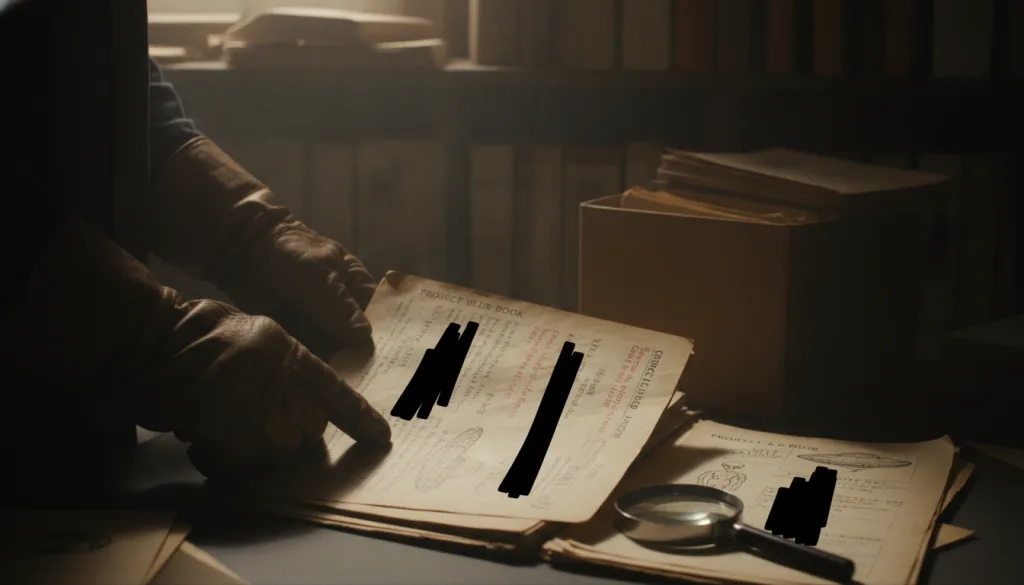
The relevance of declassified documents extends far beyond historical interest. As contemporary UFO sightings continue to garner attention, the FBI's past investigations provide a framework for understanding current phenomena. In 2020, the Pentagon released three videos captured by military pilots showcasing unidentified aerial phenomena, reigniting public interest and scrutiny of government agencies' roles in investigating UFOs.
The recent formation of the Unidentified Aerial Phenomena (UAP) Task Force within the Department of Defense exemplifies the ongoing governmental response to UFO sightings. This task force represents a significant evolution from past investigations, incorporating advanced technologies and methodologies to analyze aerial phenomena. The inclusion of intelligence agencies and scientific experts suggests a more open and systematic approach to the study of UFOs.
The FBI's historical engagement with UFO investigations serves as a foundation for contemporary inquiries. The insights gathered from the Bureau's archives inform current research and provide valuable data points in understanding ongoing phenomena. Moreover, the FBI Vault highlights the importance of transparency and the necessity for the government to openly share findings related to UFO phenomena.
Our Analysis:
The evidence strongly indicates that the FBI has maintained an enduring interest in unidentified aerial phenomena, as demonstrated by the extensive documentation within the FBI Vault. The consistent pattern of investigations, coordination with other agencies, and the involvement of credible witnesses underscore the seriousness with which the Bureau approached UFO sightings. Furthermore, the historical context provided by key incidents such as Roswell and the Michigan sightings reveals a broader narrative regarding governmental response to aerial anomalies.
While some may dismiss these investigations as mere curiosities, the declassified documents suggest a more profound concern regarding national security and public safety. The ongoing relevance of these archival materials in light of recent developments reinforces the need for continued transparency and rigorous investigation into UFO phenomena.
Sources & References
Friedman, Stanton T., “Flying Saucers and Science,” 1975, New York: New York University Press.
Maccabee, Bruce, “The UFO/FBI Connection: The Secret History of the FBI’s UFO Investigation,” 1997, Anomalist Books.
National Archives, “Project Blue Book: The UFO Investigations of the U.S. Air Force,” 1969, U.S. Government Publishing Office.
U.S. Department of Defense, “Unidentified Aerial Phenomena Task Force: Report to Congress,” 2020, U.S. Government Publishing Office.
U.S. Federal Bureau of Investigation, “FBI Vault: UFO Documents,” 2022, FBI.gov.






Comments 0
Be the first to comment!