A critical exploration of UFO technology and its portrayal through the decades.
The Early Days: Flying Saucers and the Post-War Era
In the aftermath of World War II, a wave of fascination with unidentified flying objects (UFOs) swept through the United States and beyond. The term "flying saucer" was popularized in 1947 after pilot Kenneth Arnold reported seeing nine unusual, disc-shaped objects near Mount Rainier in Washington State. This incident marked the beginning of a cultural phenomenon that would define the landscape of UFO sightings and investigations for decades.
During the late 1940s and 1950s, the concept of flying saucers was greatly influenced by the technological advancements in aviation and rocket science. The Cold War prompted heightened interest in military capabilities, and many citizens speculated that the strange sightings in the sky were advanced technology—either extraterrestrial or secret military craft. This period saw a surge in reported sightings and the emergence of UFO enthusiasts, researchers, and organizations dedicated to investigating these claims.
While many early reports can be attributed to misidentifications—such as weather balloons, experimental aircraft, or celestial phenomena—there was a palpable sense of intrigue surrounding the idea of advanced technological crafts. This culminated in the formation of the Air Force's Project Blue Book in 1952, which systematically investigated UFO reports. The program aimed to determine whether UFOs were a threat to national security and to scientifically analyze the claims made by witnesses.

The Technological Leap: The 1960s to the 1980s
The 1960s and 1970s saw a significant shift in the portrayal of UFOs in popular culture, largely influenced by the Space Age. As humans began to explore outer space, the possibility of advanced extraterrestrial civilizations became more plausible in the eyes of the public. Science fiction movies and television shows, such as "Star Trek," contributed to a growing fascination with the idea of technologically advanced beings capable of interstellar travel.
Reports during this period began to feature more intricate descriptions of UFOs. Witnesses often described crafts with complex designs, emitting lights or exhibiting maneuvers that seemed to defy the laws of physics. Notable incidents, such as the 1967 Shag Harbour incident in Canada—a case involving a reported crash of an unidentified object—further fueled speculation about alien technology and government cover-ups.
In the 1980s, the technological landscape continued to evolve, with the introduction of personal computers and the growing accessibility of information. This era also marked the rise of conspiracy theories surrounding UFOs, with stories of government secrecy and reverse-engineered alien technology entering the mainstream. Books like "Communion" by Whitley Strieber brought the idea of alien abduction into popular discourse, intertwining the narratives of advanced technology and human experience.

The Modern Era: Advanced Aerial Phenomena and the Military's Involvement
The turn of the millennium brought with it a new wave of interest in UFOs, though they were often referred to in military circles as Unidentified Aerial Phenomena (UAP). The 2000s and 2010s saw a series of highly publicized encounters, particularly involving U.S. Navy pilots. In 2004, the USS Nimitz encountered a series of unidentified flying objects off the coast of California, famously referred to as the Tic Tac incident due to the shape of the observed crafts.
The Tic Tac UFOs, described by pilots as white, oval-shaped objects capable of incredible speed and agility, reignited the debate over the existence of advanced aerial technology beyond human capabilities. Videos released by the Pentagon in 2017 and 2020 provided visual evidence of these encounters, leading to increased scrutiny and a reevaluation of how governments approach UAP sightings.
In 2020, the U.S. Department of Defense established the Unidentified Aerial Phenomena Task Force (UAPTF) to investigate these incidents. The increased transparency in government reporting and the acknowledgment of UAPs as legitimate objects of study were pivotal steps toward demystifying the phenomena. This shift in perspective has led to a more serious investigation into the potential technological origins of these crafts, whether they be foreign adversaries, advanced military technology, or something unexplained.
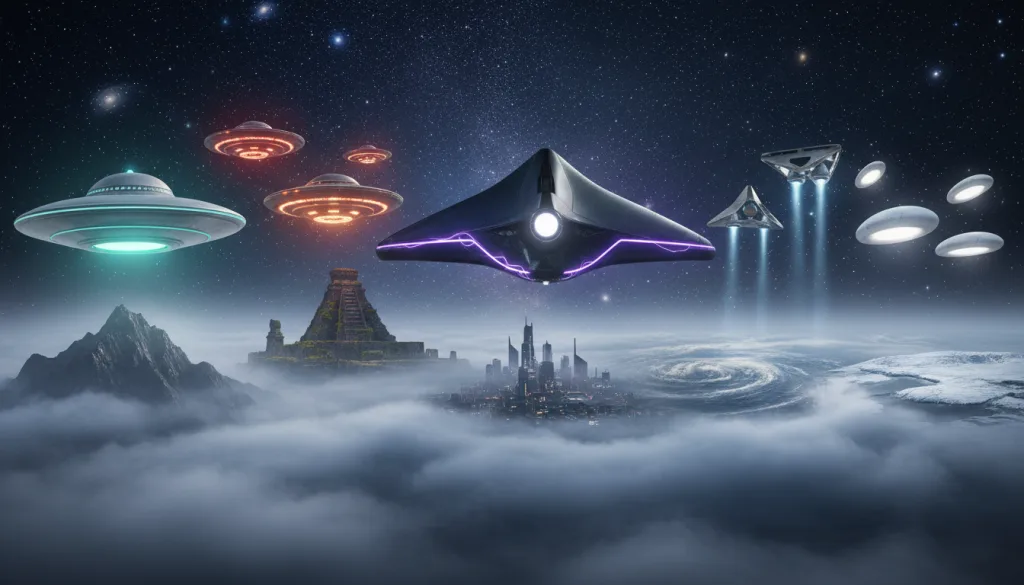
Technological Implications: What Could UFOs Tell Us?
The evolution of UFO technology has profound implications for our understanding of science, the universe, and the future of human innovation. While many sightings can be ascribed to natural phenomena or human-made technology, the continued reports of unexplained aerial phenomena challenge our current understanding of physics, aerodynamics, and propulsion systems.
For instance, many witnesses report UFOs exhibiting flight patterns and speeds that surpass known military aircraft, often performing maneuvers that appear to defy gravity. Some researchers speculate that if these crafts are indeed of extraterrestrial origin, they could employ propulsion technologies that remain beyond our current scientific understanding, such as manipulation of gravitational fields or advanced quantum mechanics.
The potential technological advancements that could arise from studying UAPs cannot be understated. If a clearer understanding of the underlying principles of these crafts is achieved, it may lead to breakthroughs in energy generation, materials science, and aerospace engineering. This tantalizing possibility has motivated various scientific communities to consider the implications seriously, leading to calls for collaborative studies involving scientists from diverse fields, including physics, engineering, and even philosophy.
Conclusion: The Ongoing Quest for Understanding
The evolution of UFO technology—from the early days of flying saucers to the modern encounters with Tic Tac-shaped crafts—reflects a complex interplay between human curiosity, technological advancements, and cultural narratives. As society continues to grapple with the implications of these sightings, it is essential to maintain a balanced perspective that combines skepticism with open-minded inquiry.
While many claims may ultimately have mundane explanations, the cumulative evidence of credible sightings and military encounters raises significant questions about the nature of our universe and our place within it. As investigations into UAPs continue to evolve, the quest for understanding these phenomena offers exciting possibilities for future scientific breakthroughs and a deeper comprehension of the mysteries that lie beyond our planet.




Comments 0
Be the first to comment!