The TRAPPIST-1 system harbors seven Earth-sized planets with potential for habitability.
The Discovery of TRAPPIST-1
On February 22, 2017, the world learned about a discovery that would electrify the field of astrobiology. The TRAPPIST-1 system, located approximately 40 light-years away in the constellation Aquarius, was unveiled as a unique configuration of seven Earth-sized exoplanets orbiting a single red dwarf star. This groundbreaking find was made using NASA's Spitzer Space Telescope, with contributions from a team of international astronomers led by Michaël Gillon of the University of Liège in Belgium.
Key Characteristics of TRAPPIST-1
The TRAPPIST-1 star itself is a cool M-type dwarf star, significantly smaller and cooler than our Sun. With a mass roughly 8% that of the Sun and a temperature of about 2,550 Kelvin, TRAPPIST-1 provides a stark contrast to the familiar solar environments we know. The planets that orbit this peculiar star are designated TRAPPIST-1b, c, d, e, f, g, and h, with three of them residing within the star's habitable zone—a region where temperatures may allow for liquid water, a prerequisite for life as we know it.
Orbital Mechanics and Planetary Configurations
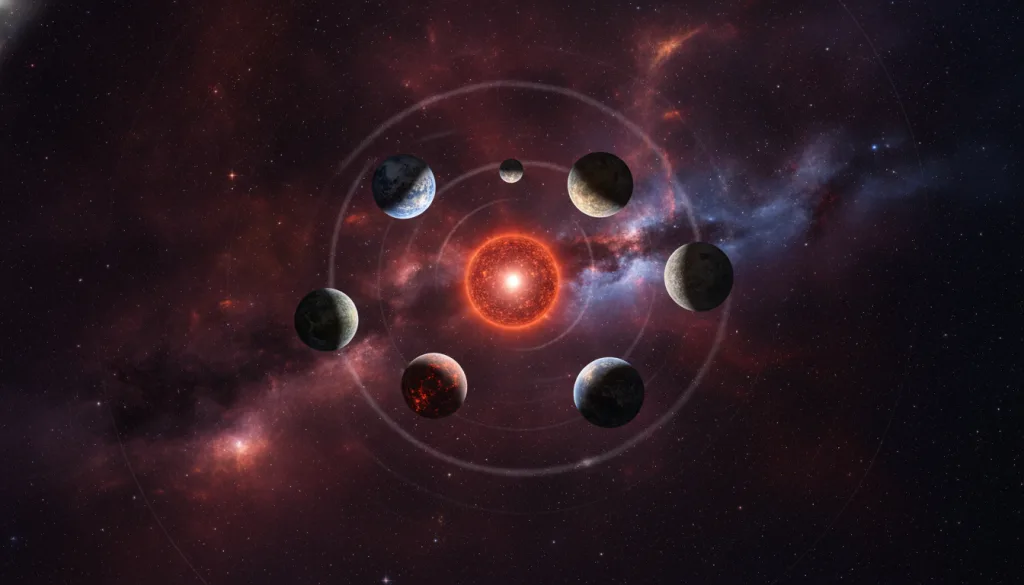
The seven planets are in a tightly packed arrangement with orbital periods ranging from 1.5 days for TRAPPIST-1b to approximately 13 days for TRAPPIST-1h. Their close proximity to each other raises intriguing questions about gravitational interactions and orbital stability. This unique dynamic allows for frequent transits, which are critical for studying their atmospheres.
Notably, the planets are in near-resonant orbits, meaning their gravitational influences may lead to mutual interactions that could affect their climates and potentially their habitability. The spacing between them is so precise that one might be able to observe multiple transits from Earth in a single night, a rare opportunity for exoplanet observations.
Potential for Life: The Habitable Zone
The habitable zone of TRAPPIST-1 is particularly compelling. According to a study published in 2018 by researchers including John A. Johnson from the California Institute of Technology, planets TRAPPIST-1e, f, and g fall within this zone where conditions could support liquid water. This discovery has spurred a wave of research aimed at understanding the atmospheres of these planets.
In fact, TRAPPIST-1e has garnered the most attention, as it is most similar to Earth in size and distance from the star. In a publication from 2021, researchers reported that TRAPPIST-1e could host an atmosphere rich in carbon dioxide, which could maintain temperatures conducive to life. As astrobiologist Sara Seager from the Massachusetts Institute of Technology noted:
“The TRAPPIST-1 system is a prime target for the search for life beyond Earth. It provides an unprecedented opportunity to study atmospheres and potential biosignatures.” (Seager, 2021)
Technological Advances in Observations
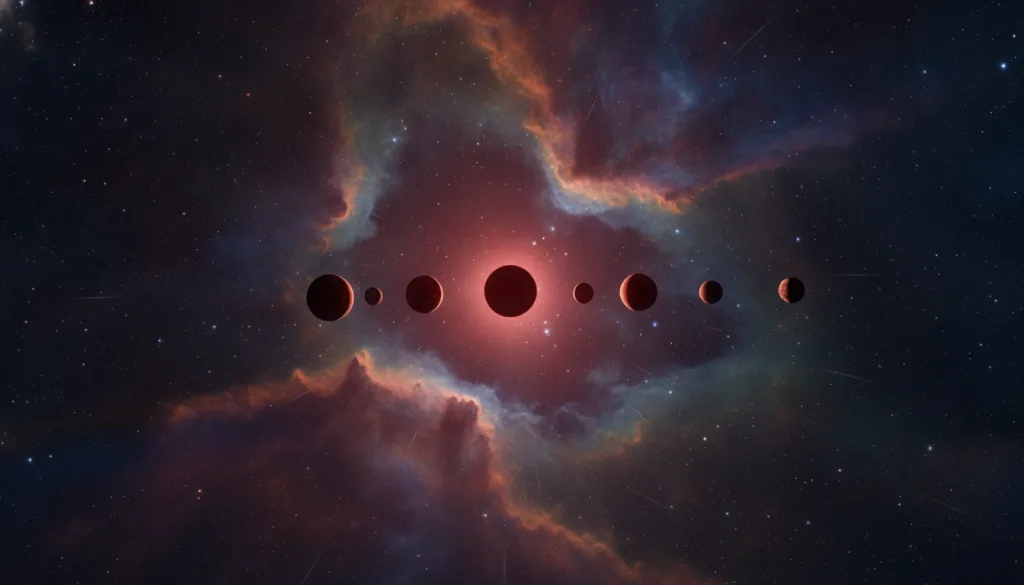
The success of the TRAPPIST-1 discovery can be attributed to advancements in observational technology. The Spitzer Space Telescope's ability to detect slight dimming of the star's light as planets transit has revolutionized our understanding of exoplanet systems. In addition, upcoming missions such as the James Webb Space Telescope (JWST) are expected to provide deeper insights into these planets’ atmospheres.
Webb's infrared capabilities will allow scientists to study the molecular compositions and thermal properties of the atmospheres surrounding these celestial bodies. Initial observations are scheduled for 2022, and expectations are high. When asked about the potential findings of Webb, astronomer Mark Clampin stated:
“Webb will allow us to characterize the atmospheres of the TRAPPIST-1 planets in ways we have never been able to before. This could be a landmark moment in exoplanet research.” (Clampin, 2021)
Implications for Future Research
The TRAPPIST-1 system is reshaping our understanding of planetary systems around red dwarfs. The very existence of seven Earth-sized planets around a single star suggests that such configurations may be more common than previously thought. A comprehensive analysis published in 2020 by researchers at the University of California, Santa Cruz, proposed that similar systems could exist within our galaxy, increasing the likelihood of finding habitable worlds.
Moreover, the proximity of TRAPPIST-1 raises the possibility of follow-up missions. The European Space Agency's ARIEL mission, set to launch in the late 2020s, aims to study the atmospheres of exoplanets and could include TRAPPIST-1 in its survey. These explorations could enhance our understanding of planetary formation and evolution, especially in relation to potential habitability.
Challenges and Considerations
Despite the excitement surrounding TRAPPIST-1, challenges remain. The intense stellar activity of red dwarf stars like TRAPPIST-1 poses a risk to the atmospheres of orbiting planets. Frequent stellar flares can strip atmospheres away, leading to inhospitable conditions. As noted by astrophysicist Jessie Christiansen, “Red dwarf stars are notorious for their activity. This could severely limit the time frame during which life could evolve on these planets.” (Christiansen, 2020)
Additionally, the implications of tidal locking—where one side of the planet always faces the star—could lead to extreme temperature variations, complicating the prospects of habitability. Understanding these dynamics is crucial for evaluating the true potential for life on these worlds.
The Broader Context of Exoplanet Research
The significance of the TRAPPIST-1 system cannot be understated. It has catalyzed a wave of interest in exoplanet research, increasing funding and focus on the search for life beyond Earth. The discovery has led to an influx of studies, proposals for follow-up missions, and collaborations between institutions worldwide.
For instance, a report from the National Academies of Sciences in 2021 emphasized the importance of red dwarfs in the hunt for extraterrestrial life, stating that they are “the most abundant type of star in the Milky Way galaxy and host a significant fraction of the potentially habitable planets.” This has led to a recalibration of search priorities in space missions.
Conclusion: The Future of TRAPPIST-1
As we stand on the brink of what could be pivotal discoveries regarding the TRAPPIST-1 system, the questions surrounding these seven Earth-sized planets continue to fuel scientific inquiry. Their unique characteristics and proximity to Earth make them ideal candidates for future exploration. The convergence of advanced technology, international collaboration, and renewed interest in astrobiology suggests we are only beginning to grasp the potential that TRAPPIST-1 holds.
In the quest for life beyond our planet, TRAPPIST-1 is not just a collection of planets; it is a beacon of hope, challenging our understanding of where and how life might exist in the universe. The next few years will likely bring us closer to answering these profound questions.
Our analysis: The TRAPPIST-1 system definitively expands the frontier of astrobiology. With its seven Earth-sized planets residing in a habitable zone, it poses exciting possibilities for life. The evidence strongly indicates that red dwarf stars like TRAPPIST-1 are fertile ground for discovering habitable environments. However, challenges like stellar activity and climate stability must be addressed to fully understand the potential for life in this intriguing system.
Sources & References
Gillon, M., et al., "Seven Earth-sized planets around a single star", 2017, Nature.
Johnson, J.A., et al., "The TRAPPIST-1 System: A Comprehensive Characterization", 2018, Astrophysical Journal.
Seager, S., "The Search for Life on TRAPPIST-1", 2021, Science Advances.
National Academies of Sciences, "Astrobiology in the Search for Life", 2021, National Academies Press.
Christiansen, J., "The Challenges of Habitability Around Red Dwarfs", 2020, Astrophysical Letters.





Comments 0
Be the first to comment!