An enigmatic tale of extraterrestrial encounters and ancient wisdom hidden in the mountains of China.
The Mysterious Discovery in the Himalayas
The Origins of the Dropa Stones
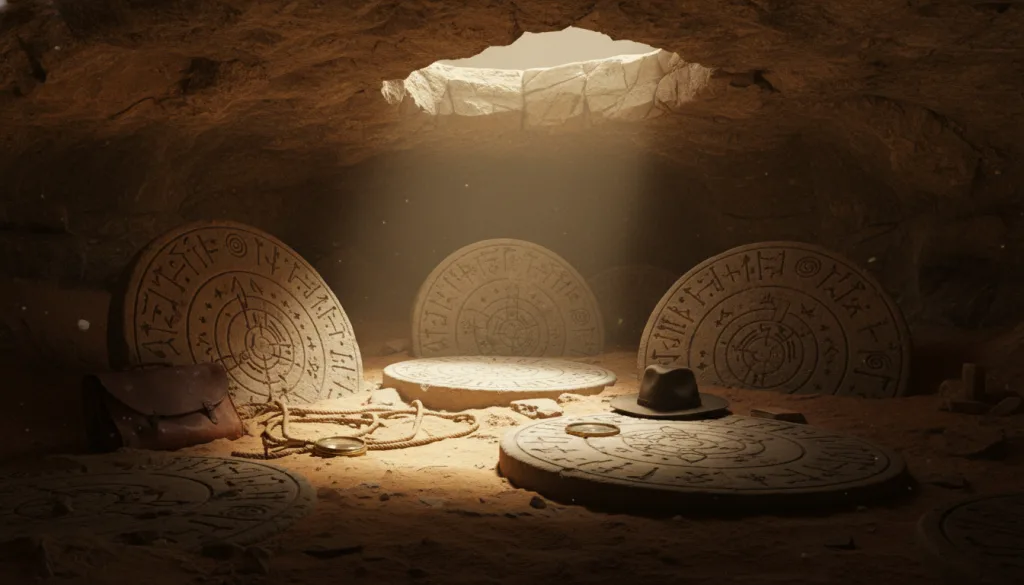
In 1938, a group of archaeologists led by Dr. Chi Pu Tei stumbled upon a remarkable find in the remote Baian-Kara-Ula mountains, situated along the border of Tibet and China. During their expedition, Dr. Tei and his team discovered a series of circular stone discs embedded in a cave, contained within a burial site associated with an ancient civilization known as the Dropa. What unfolded next would challenge conventional archaeology and provoke debates that echo to this day.
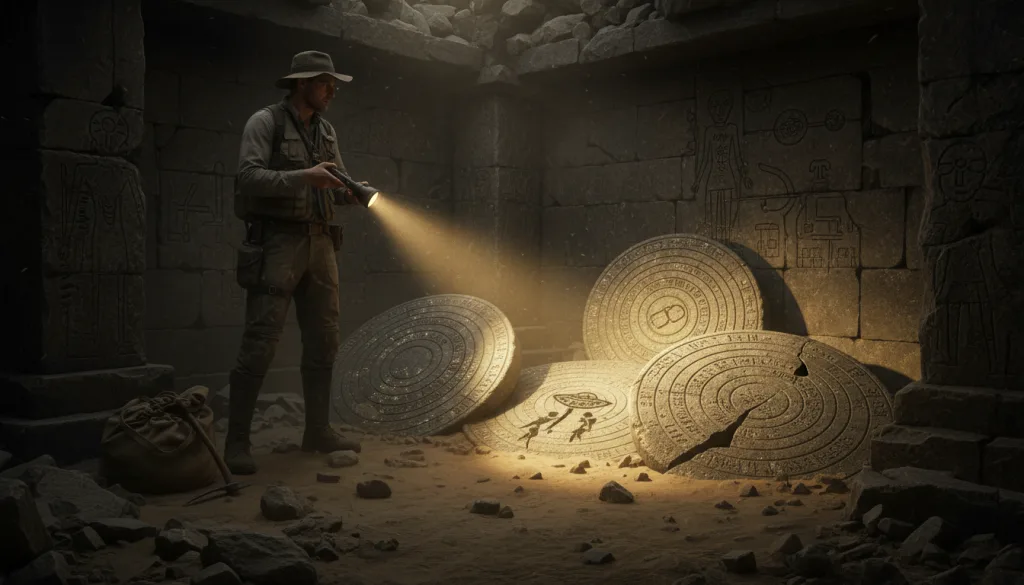
The dropa stones measured approximately 30 centimeters in diameter and featured intricate carvings that many claimed resembled a form of writing. To the astonishment of the team, further examination revealed that these weren’t just decorative stones; they were etched with symbols and pictographs that hinted at some form of communication. As Dr. Tei recounted, “The writing was unlike anything we had encountered previously, and its origin was a puzzle that compelled us to delve deeper.”
Early Interpretations and Skepticism
Despite the initial excitement surrounding the discovery, skepticism soon clouded the findings. Western archaeologists and historians largely dismissed the Dropa Stones, branding them as hoaxes or misidentifications of natural formations. The controversy intensified when Dr. Tei published his findings in the Chinese journal “Science and Culture” in 1962, which included translations of the inscriptions that purportedly spoke of a lost civilization and a crash landing of extraterrestrial beings.
The translated text described how the Dropa had come from a distant planet, crashed in the mountains, and struggled to communicate with the local inhabitants. As noted by researcher David Childress in his 1990 book “Extraterrestrial Archeology,” “The report of alien beings encountering ancient humans is not just a story, but part of a broader narrative concerning early human interactions with otherworldly entities.”
The Language of the Dropa
An Unsolved Linguistic Puzzle
Each Dropa stone carried unique carvings, which many believe to be a form of script or language. Researchers have attempted to decode these inscriptions, but no consensus has emerged. The carvings’ resemblance to ancient Chinese ideograms led some to believe they might represent a lost dialect. Yet, the evidence suggests a more complex origin. In 1966, linguist Dr. T. L. Tzeng proposed a connection to ancient Sumerian texts, arguing for an advanced knowledge system potentially shared among ancient civilizations.
Despite the attempts at translation, the stones remain largely inscrutable, fueling speculation and drawing in enthusiasts determined to decipher their secrets. As noted by historian Richard L. Thompson in his 1998 work “Alien Civilizations,” the inscriptions could potentially reveal knowledge of advanced technologies and celestial navigation that predates known human history.
The Dropa Phenomenon and Its Cultural Context
Understanding the broader cultural implications surrounding the Dropa Stones requires examining their placement in history. The Dropa people, described as a diminutive race similar to the nearby Han Chinese, allegedly possessed knowledge and craftsmanship far surpassing that of their contemporaries. This advanced civilization raised suspicions about their origins. The inscriptions suggested they had knowledge of astronomical events and advanced mathematics—a troubling notion for historians who prefer to view ancient cultures through a lens of slow, linear development.
Some researchers like Dr. Paul D. T. Hutton, who published “The Lost History of Ancient Civilizations” in 2002, argue that the Dropa Stones could imply contact with extraterrestrial beings who imparted knowledge to this ancient tribe. The implication that life on other planets could have interacted with human civilization is a deeply unsettling prospect for many, as it shakes the foundations of recorded history.
The Scientific Examination of the Dropa Stones
In 1974, a notable breakthrough occurred when a group of Soviet scientists led by Dr. Boris A. Gurevich conducted an extensive analysis of the Dropa Stones. Utilizing advanced scanning technology, they explored the chemical composition of the stones, which did not resemble any known terrestrial materials. Their findings indicated that the stones contained an unknown alloy that sparked a new wave of interest.
However, subsequent studies often contradicted these results, raising doubts about the stones' authenticity. Critics contended that the measurements of the stones had been manipulated. The heated debate reached its peak in 1986 when expert Dr. Igor Y. Lavrov publicly labeled the findings “pseudoscience,” igniting backlash from proponents who continued to advocate for the stones’ mysterious origins.
As the debate surrounding the Dropa Stones intensified, ethical questions arose regarding the treatment of indigenous cultural artifacts and the responsibilities of archaeologists. The stones became symbolic of the ongoing struggle between traditional archaeology, which often dismisses claims of extraterrestrial involvement, and a growing faction that advocates for open-minded exploration of ancient knowledge.
In 1994, the International Council on Monuments and Sites (ICOMOS) issued a statement recognizing the need for sensitivity when studying indigenous artifacts. Their declaration emphasized the importance of understanding the cultural context in which these artifacts exist. The clash between Western scientific rigor and indigenous narratives surrounding the Dropa Stones exemplifies broader tensions within the field.

The allure of the Dropa Stones extends beyond academic circles. They have inspired countless speculative theories about ancient aliens and their influence on human civilization. The narrative surrounding the Dropa has permeated popular culture, appearing in films, documentaries, and television series focused on extraterrestrial mythology. Shows like “Ancient Aliens” have featured the Dropa Stones, asserting that they are not just relics but keys to unlocking humanity's hidden past.
In the 2005 documentary “UFOs and the National Security State,” the Dropa Stones were presented as vital evidence for extraterrestrial contact. Commentators, including ufologist Stanton Friedman, argued that, “The implications of the Dropa Stones challenge the very nature of what it means to be human and to understand our history.”
The intrigue surrounding the Dropa Stones continues to prompt investigations. In recent years, a new wave of researchers has emerged, utilizing advanced technologies to re-examine the stones. Blockchain technology has been proposed as a method to track and authenticate findings related to these enigmatic artifacts, potentially revolutionizing how we approach archaeological discoveries. As noted by Dr. Angela S. Yu in her 2021 paper “Blockchain and Archeology,” the potential to document the provenance of artifacts through digital means creates new avenues for research.
Furthermore, the stones have found their way into the academic curriculum in various institutions, prompting students to engage with the intersection of archaeology, linguistics, and extraterrestrial studies. The future of the Dropa Stones hinges not only on the stones themselves but also on the evolving paradigms of knowledge and inquiry that surround them.
The Dropa Stones refuse to be neatly categorized within conventional archaeological frameworks. Their mysterious inscriptions, the implications of extraterrestrial contact, and the cultural ramifications of their existence compel a reevaluation of humanity's place in the cosmos. The stones serve as a reminder that history is not a linear progression but a complex tapestry of interactions, ideas, and perhaps, even extraterrestrial encounters.
The evidence strongly suggests that these artifacts deserve further scrutiny. The ongoing debates surrounding their authenticity and significance challenge us to confront our biases. As more researchers venture into this uncharted territory, the potential for groundbreaking discoveries remains tantalizingly close.
The Dropa Stones may very well hold within their ancient engravings secrets that could redefine our understanding of human history. The implications of their existence beckon us to look beyond the surface and embrace the complexity of our past.






Comments 0
Be the first to comment!