A groundbreaking experiment challenges our understanding of time and reality.
The Quantum Enigma Unfolds
In the quiet corridors of the California Institute of Technology, on May 29, 1999, a team of physicists led by Dr. Scully conducted an experiment that would raise eyebrows within the scientific community and beyond. This experiment wasn’t merely a step forward in quantum physics; it seemed to invite us to reconsider the very nature of causality and time itself.
At the heart of their research was the double-slit experiment, a classic demonstration of wave-particle duality. In the original setup, light or particles can behave both as waves and particles, creating an interference pattern when not observed. However, when observed, they collapse into definite states, eliminating that pattern. The implications of this were already perplexing. Could our observation actually influence the outcome of an event?
Dr. Scully and the Quantum Eraser
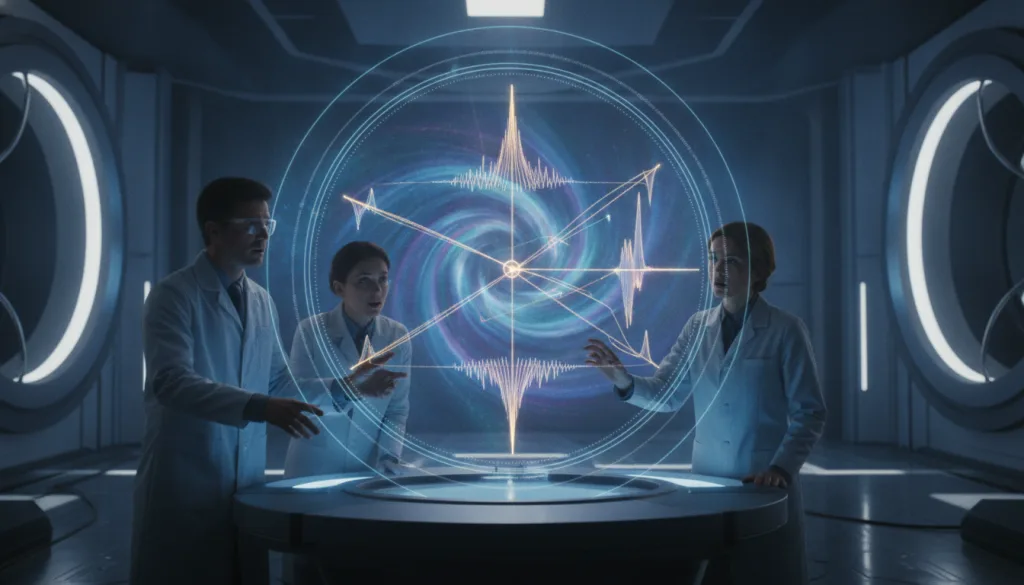
Dr. Scully’s innovation lay in the delayed-choice quantum eraser, which expanded upon the original double-slit experiment. The eraser allowed researchers to "erase" the information about which path the particles had taken after they had already been detected. This led to some unsettling results: Even when the decision to erase that information was made after the particles had already passed through the slits, the particles behaved as if they had not been observed at all. The past seemed to change based on present actions.
Dr. Scully articulated the perplexing nature of this experiment, saying, “The great distinction between classical and quantum physics is that in quantum physics, the act of measurement itself modifies the outcome” (Scully, 1999). This encapsulated the essence of the delayed-choice quantum eraser experiment — it suggested that the act of observation could influence reality, even retroactively.
The Mechanics Behind the Madness
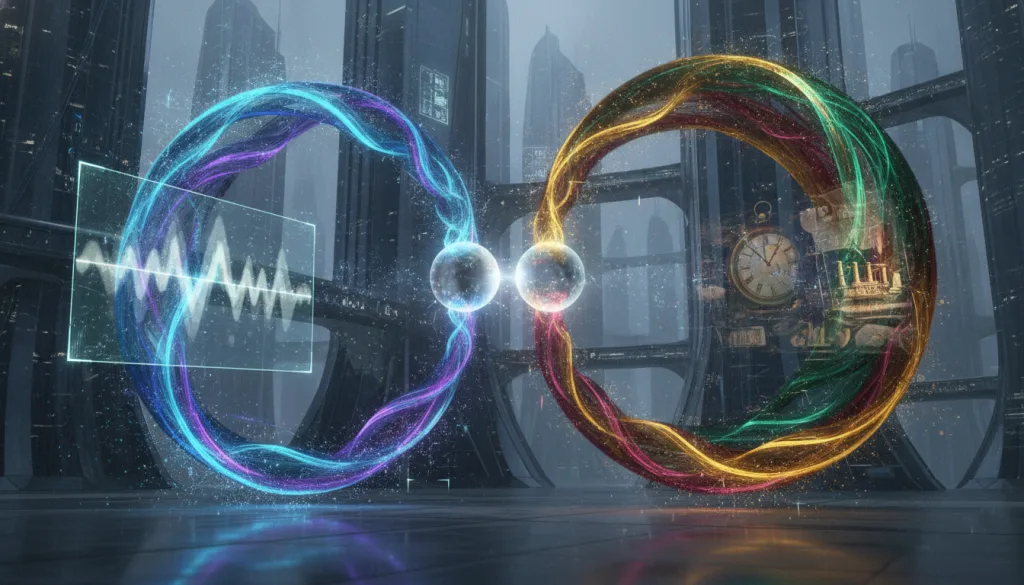
To understand the significance of the delayed-choice quantum eraser, one must grasp the mechanics at play. The experiment utilized entangled photons, where one photon is sent through a double-slit apparatus, and its twin photon is directed toward a separate detector. The key innovation was the introduction of beam splitters and polarizers that allowed the experimenters to manipulate which-path information after the first photon had already been registered by the detector.
In essence, the researchers could choose whether or not to observe the path taken by the photon after it had already made its journey. If they decided to keep the path information, the interference pattern disappeared, confirming the particle-like behavior. But if they "erased" that information, the photon acted as if it were a wave again, displaying the interference pattern. This phenomenon fundamentally challenges our conventional understanding of time.
The Concept of Retrocausality
The implications of the delayed-choice quantum eraser extend into the realm of retrocausality — the idea that the future can influence the past. Distinguished physicist and philosopher David Albert articulated this in his 1996 work, “Time and Chance,” where he suggested that if future events can influence past actions, the very fabric of time might be more complex than linear progression.
The findings from the quantum eraser experiment have prompted a slew of theoretical frameworks attempting to reconcile these paradoxes. One such framework is the Many-Worlds Interpretation, posited by Hugh Everett III in 1957. This interpretation posits that every quantum event branches into multiple realities, thereby sidestepping the issue of retrocausality but complicating our understanding of existence itself.
Philosophical Ramifications
The philosophical implications are staggering. If one accepts the findings of the delayed-choice quantum eraser, one must confront the question of whether free will exists. If our choices can alter the past, what does that mean for human agency? The American philosopher and cognitive scientist Daniel Dennett, in his 2003 work “Freedom Evolves,” argues that free will is a complex interplay of consciousness and determinism, a notion that quantum mechanics could potentially complicate further.
Moreover, the challenge of reconciling objective reality with subjective experience looms large. The implications of quantum mechanics have been discussed extensively by physicist and author Carlo Rovelli, who contends that “Time is not a universal clock that ticks uniformly for everyone; it is a complex interplay of events and their observations” (Rovelli, 2018). This perspective suggests that rather than having a linear timeline, the universe may be more akin to a multifaceted tapestry of experiences and entangled events.
Scientific Critiques and Support
Despite its provocative findings, the delayed-choice quantum eraser experiment has not been immune to critiques. Skeptics argue that the interpretation of these results may be a misstep, conflating correlation with causation. Some physicists, such as Anton Zeilinger, have lauded the experiment for its demonstration of quantum entanglement, but they caution against jumping to conclusions regarding retrocausality.
In a 2013 interview, Zeilinger stated, “Quantum mechanics shows us that the universe is fundamentally weird, but drawing conclusions about time and causality from these experiments requires cautious deliberation” (Zeilinger, 2013). This highlights the ongoing debate within the scientific community about how to interpret these results and their broader implications.
Applications and Future Research
As we venture deeper into the 21st century, the ramifications of the delayed-choice quantum eraser experiment extend beyond mere philosophical inquiry. The principles unveiled could one day be harnessed in advanced technological applications. Quantum computing, for instance, heavily relies on the principles of quantum superposition and entanglement, principles illuminated by the quantum eraser experiment.
The emergence of quantum communication and cryptography technologies may also benefit from these findings. The idea that information transfer could be influenced by the choices made at a later time opens avenues for secure communications that are theoretically resistant to interception. Insights gained from quantum mechanics could lead us toward a future where instantaneous communication across vast distances becomes a reality.
The Ongoing Quest for Understanding Time
The quest to comprehend the nature of time continues to intrigue researchers in diverse fields. As physicists investigate the very fabric of spacetime, they are not merely unraveling the mechanics of the universe; they are challenging our fundamental assumptions about reality. The delayed-choice quantum eraser serves as a reminder that our understanding of time is not static, but rather, a fluid narrative shaped by our choices, perceptions, and the inexorable march of scientific inquiry.
As scientific inquiry journeys further into the depths of quantum mechanics, the questions surrounding causality, free will, and the essence of time will remain hotly contested. The unresolved nature of these concepts beckons us to confront limits of human understanding — and in doing so, the very essence of what it means to exist within the cosmos.
Our Analysis:
The evidence strongly indicates that the delayed-choice quantum eraser challenges traditional notions of time and causality. This experiment, while complicated and controversial, offers a glimpse into a reality where our perceptions and decisions might influence the very fabric of existence itself. As we stand on this precipice of scientific discovery, the implications are profound. We find ourselves questioning whether we are mere spectators of a preordained universe or active participants in a complex and evolving narrative.
Sources & References
Scully, M.O., & Drühl, K., “Quantum Eraser: A Proposed Experiment to Test a Fundamental Aspect of Quantum Mechanics,” 1999, California Institute of Technology.
Albert, D., “Time and Chance,” 1996, Harvard University Press.
Rovelli, C., “The Order of Time,” 2018, Penguin Press.
Zeilinger, A., Interview, “Quantum Physics and the Philosophy of Time,” 2013, Physics Today.
Dennett, D., “Freedom Evolves,” 2003, Viking Press.

Comments 0
Be the first to comment!