A persistent cosmic mystery challenges our understanding of the universe.
The Discovery of the Cold Spot
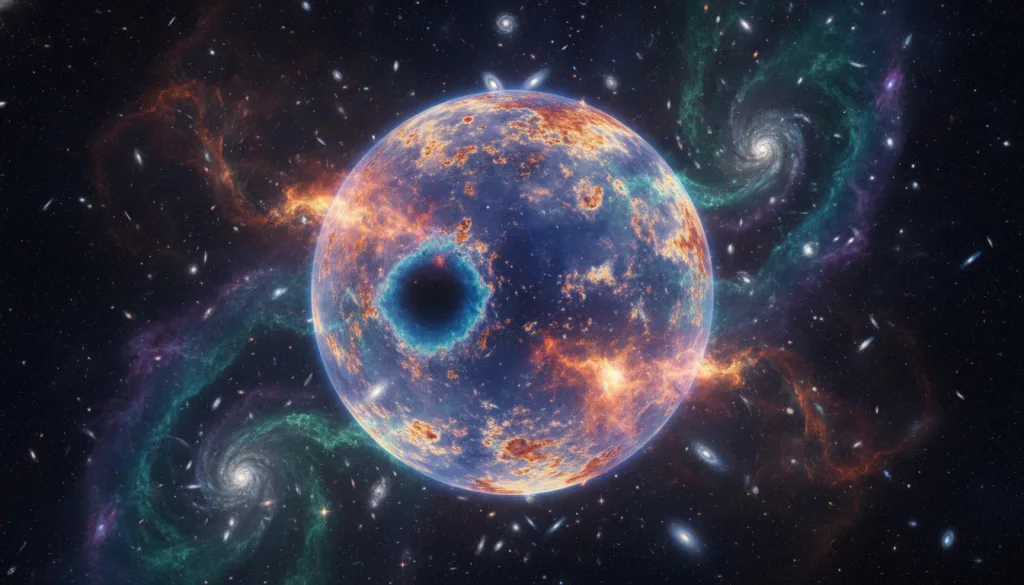
The Cosmic Microwave Background (CMB) radiation, a remnant from the Big Bang, provides a snapshot of the universe approximately 380,000 years after its inception. Among the myriad patterns captured within this radiation, one particular anomaly stands out: the Cold Spot, a region in the southern hemisphere of the sky that exhibits a temperature significantly lower than its surroundings. Discovered in 2004 by the Wilkinson Microwave Anisotropy Probe (WMAP), this Cold Spot measures about 70 microkelvins below the average temperature of the CMB. The existence of this Cold Spot challenges the cosmological models that have long been foundational to our understanding of the universe's evolution. The coordinates of the Cold Spot are approximately right ascension 10h 53m and declination -5° 20'. It occupies a celestial expanse of about 10 degrees across, an area that represents about 0.7% of the total sky, yet it contains a temperature fluctuation that undermines expectations based on the standard model of cosmology. Not only is this anomaly perplexing, but it also raises questions about the very fabric of our universe, suggesting that there may be unexplained phenomena at play.
The Role of WMAP and Planck
The Wilkinson Microwave Anisotropy Probe, launched in 2001, was instrumental in refining our understanding of the CMB. By mapping the minute temperature fluctuations across the sky, WMAP provided a wealth of data that helped establish the basic parameters of the universe, including its age, composition, and curvature. However, the Cold Spot emerged as a significant outlier in these measurements. Following WMAP, the Planck satellite, launched in 2009, continued to map the CMB with even greater precision. Released in 2013, the Planck data corroborated the existence of the Cold Spot but also highlighted its peculiarity. The data supported the notion that this feature is statistically unusual, with a probability of only about 1 in 100,000 of being a random fluctuation. Dr. Jean-Loup Puget, a scientist involved with Planck, stated in 2014, "The Cold Spot offers a tantalizing glimpse into physics beyond the standard model of cosmology." This statement underscores the necessity to rethink our existing paradigms when faced with such anomalies.
Potential Explanations for the Anomaly
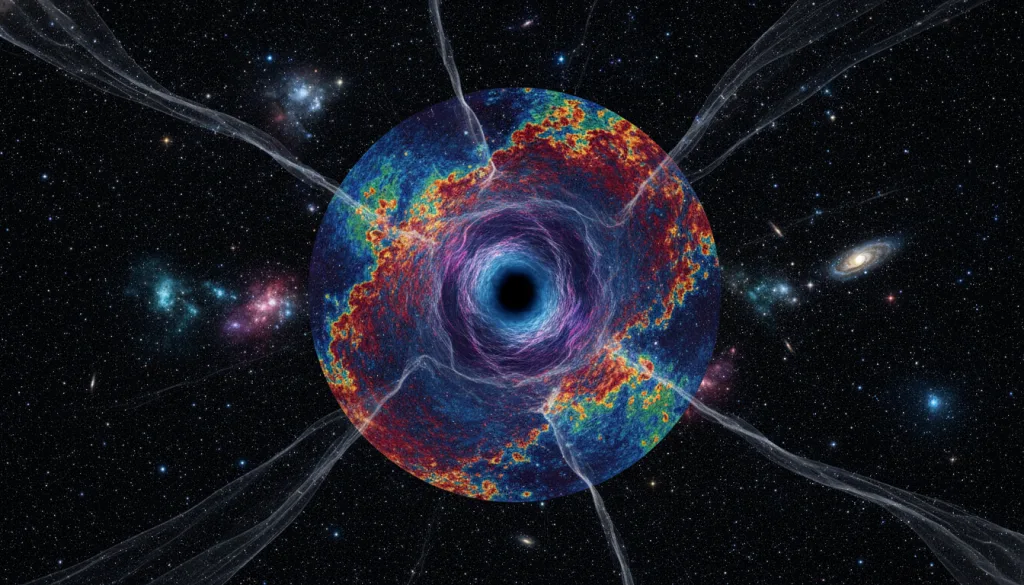
Over the years, various hypotheses have been proposed to account for the Cold Spot. One of the leading explanations involves the possibility of a vast supervoid, a cosmic region with significantly fewer galaxies than average. In 2015, a team led by astronomer Dr. Istvan Szapudi from the University of Hawaii published a paper suggesting that this supervoid, located roughly 1.8 billion light-years away, could account for the Cold Spot's unusual temperature. According to their findings, the gravitational effects of this void could lead to a cooling of the CMB radiation as it passes through, effectively stretching and diluting it.
However, while the supervoid theory offers a compelling framework, it does not fully resolve the anomaly. The size of the proposed void is immense, and its interactions with surrounding cosmic structures remain poorly understood. Furthermore, the Cold Spot's unusually large scale poses difficulties for the supervoid hypothesis, which typically applies to much smaller regions. As such, questions linger about whether the Cold Spot is an isolated phenomenon or part of a more complex cosmic structure.
Alternative Theories: Cosmic Strings and Multiverse Implications
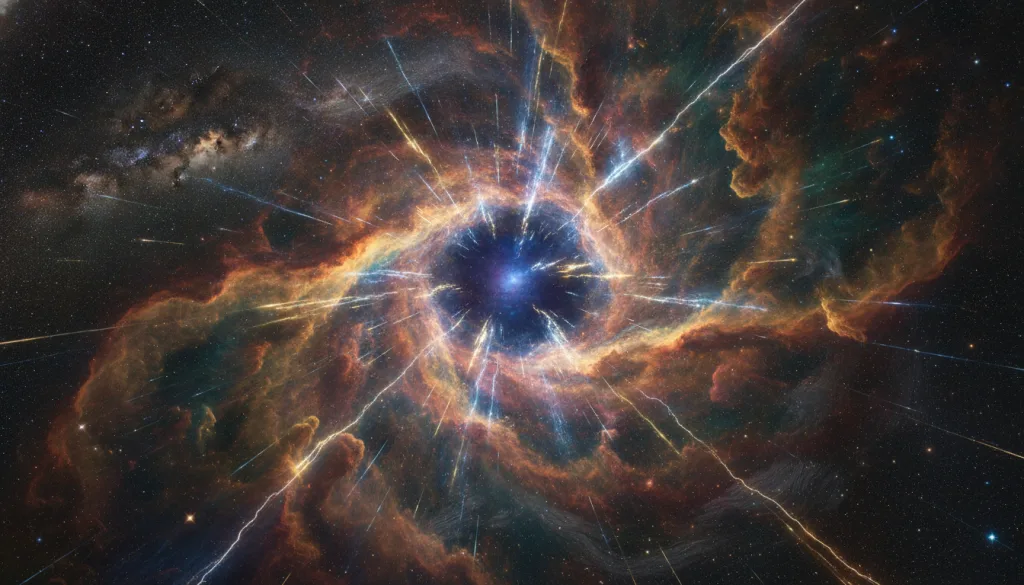
Outside of the supervoid explanation, other theories have emerged to account for the Cold Spot's existence. One intriguing possibility involves cosmic strings, hypothetical one-dimensional topological defects that could have formed in the early universe. If these strings exist, they might warp spacetime and produce detectable effects on the CMB. Theoretical physicist Dr. Alexander Vilenkin, a pioneer in this field, has suggested that "if cosmic strings exist, they could lead to temperature fluctuations that manifest as anomalies like the Cold Spot." Another more speculative possibility relates to the multiverse theory. In this framework, our universe might be just one of many, each with different physical constants and properties. If our universe had collided with another universe, such an event could leave behind detectable marks in the form of CMB anomalies. This hypothesis ventures into the realm of the esoteric, challenging the boundaries of our existing cosmological models.
The Implications for Cosmology
The implications of the Cold Spot transcend mere curiosity; they challenge the foundations of contemporary cosmology. With the standard model of cosmology, which relies heavily on the inflationary paradigm, finding anomalies like the Cold Spot invites a reassessment of our understanding of the universe's origin and evolution. The presence of the Cold Spot raises significant questions about the uniformity of the universe and the validity of the cosmological principle, which states that the universe is homogeneous and isotropic on large scales. As researchers continue to investigate the anomaly, there remains a pressing need for further observations and theoretical work to develop a coherent explanation. The Cold Spot is more than just an interesting feature; it is a focal point in the search for answers about dark matter, dark energy, and the fundamental structure of the cosmos.
Future Research Directions
Ongoing and future missions, such as the upcoming James Webb Space Telescope (JWST), are expected to provide new insights into the nature of the universe, perhaps shedding light on the enigmatic Cold Spot. Observations at different wavelengths can help clarify whether the anomaly is due to intrinsic properties of cosmic structures or represents an entirely new physics. Additionally, data from ground-based observatories like the Atacama Cosmology Telescope (ACT) and the South Pole Telescope (SPT) will offer complementary perspectives on this cosmic riddle. The interplay between observational data and theoretical models will be vital in the coming years. As physicists delve deeper into the nature of the Cold Spot, they will need to navigate the balance between established cosmological theories and emerging, perhaps revolutionary, ideas. The future of cosmology may hinge on how well we address these anomalies.
Our Analysis:
The evidence strongly indicates that the Cold Spot is not merely a statistical fluke or an artifact of observational bias; it represents a genuine anomaly that challenges our understanding of the universe. While the supervoid hypothesis is the most prominent explanation, it is not sufficient on its own to account for the Cold Spot's vastness and peculiar characteristics. The continued investigation of this anomaly is not just a matter of scientific curiosity; it is essential for the advancement of cosmology as a discipline.
As we confront this cosmic mystery, we must remain open to possibilities beyond traditional paradigms. The Cold Spot could signal the need for a more profound understanding of cosmic structures, dark energy, and perhaps even the nature of reality itself. In this light, the Cold Spot serves as a reminder: the universe is far more complex than our current models might suggest, and the quest to understand it continues.
Sources & References
Hinshaw, G., et al. "Nine-Year Wilkinson Microwave Anisotropy Probe (WMAP) Observations: Cosmological Parameter Results." 2013, The Astrophysical Journal Supplement Series.
Planck Collaboration. "Planck 2013 Results. XXV. Diffuse component separation: Methods and results." 2014, Astronomy & Astrophysics.
Szapudi, I., et al. "The Cold Spot in the CMB: Evidence for a Supervoid." 2015, The Astrophysical Journal.
Vilenkin, A. "Cosmic Strings and the Cold Spot." 2016, Physics Letters B.
Puget, J.-L., et al. "The Planck Satellite." 2014, Astronomy & Astrophysics.


Comments 0
Be the first to comment!