The Chronovisor remains one of the most intriguing and controversial devices in discussions of time travel.
The Origins of the Chronovisor: A Historical Context
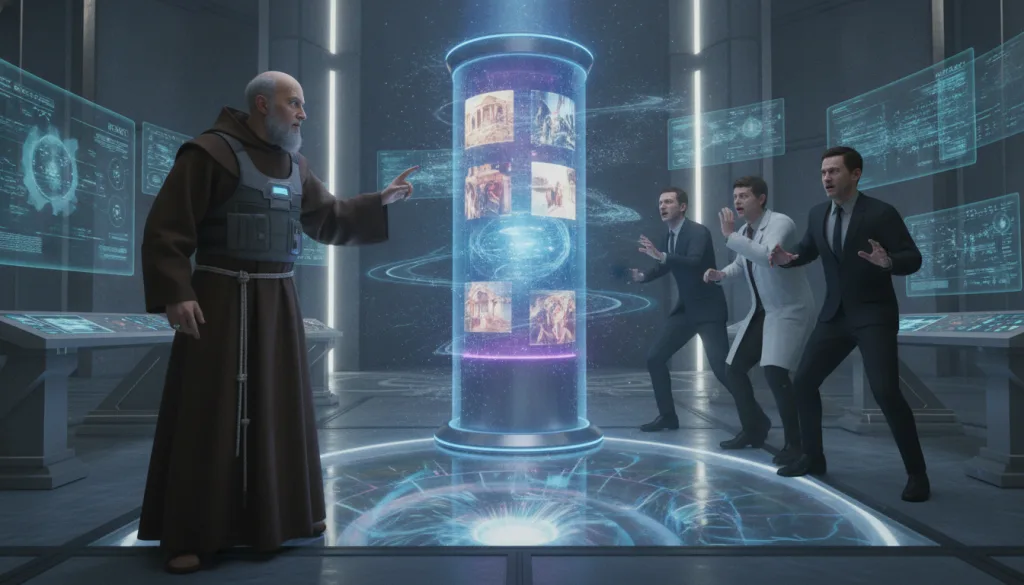
The concept of the Chronovisor is intrinsically linked to Father Pellegrino Ernetti, an Italian Benedictine monk, physicist, and musicologist. In 1972, Ernetti claimed to have constructed a device that allowed users to view past events, effectively making it a time-viewing apparatus. His assertion was astonishing, especially considering the device was allegedly developed under the auspices of the Vatican, a narrative that continues to capture the public's imagination.
Father Ernetti's Claims and Background
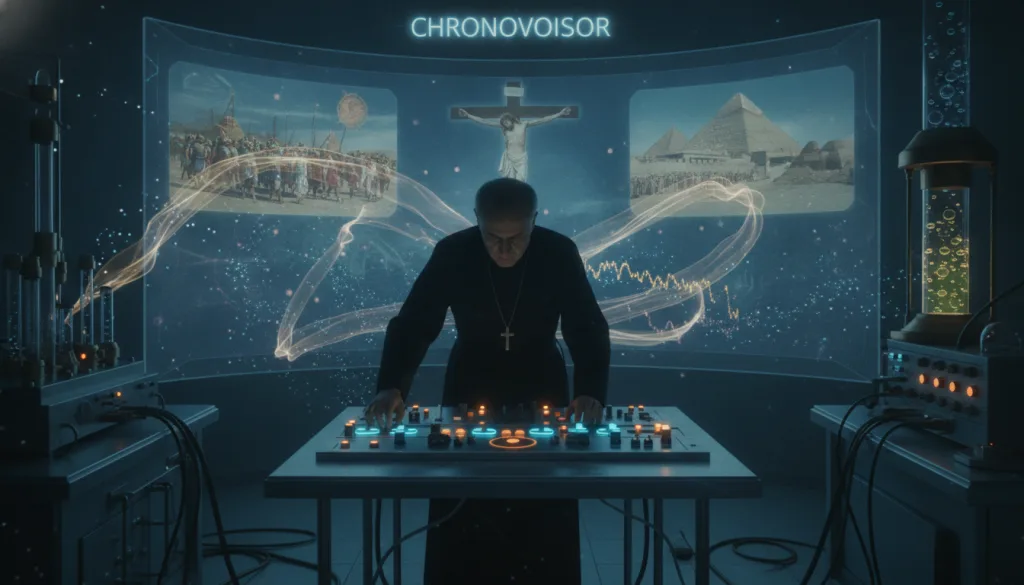
Father Ernetti, born in 1925, was not just any cleric. He had a robust academic background that included studying physics, which lent some credibility to his claims. In a 1972 interview with the Italian magazine "La Domenica del Corriere," Father Ernetti described the Chronovisor as a combination of technology and spirituality, suggesting that it could capture electromagnetic waves emitted by historical events. “Just as a radio receives sound waves, the Chronovisor can receive images and sounds from the past,” he stated, implying a sophisticated understanding of both physics and metaphysical concepts (Ernetti, 1972).
Technical Specifications and Mechanisms
According to Father Ernetti, the Chronovisor utilized advanced principles of physics to function. He claimed it operated on the basis of Einstein's theory of relativity, which posits that time is not a constant but a variable dimension influenced by speed and gravity. However, the device's supposed mechanism was never thoroughly detailed, raising skepticism among scientists and scholars alike.
The Alleged Construction of the Device
Ernetti purported that the Chronovisor was composed of various components, including a cathode-ray tube and a system of crystals and mirrors to focus light. He claimed to have built this device with the assistance of other scientists, notably the Italian physicist and inventor Giorgio P. Nardone. The details of their collaboration remain vague, casting doubt on the legitimacy of the device's existence.
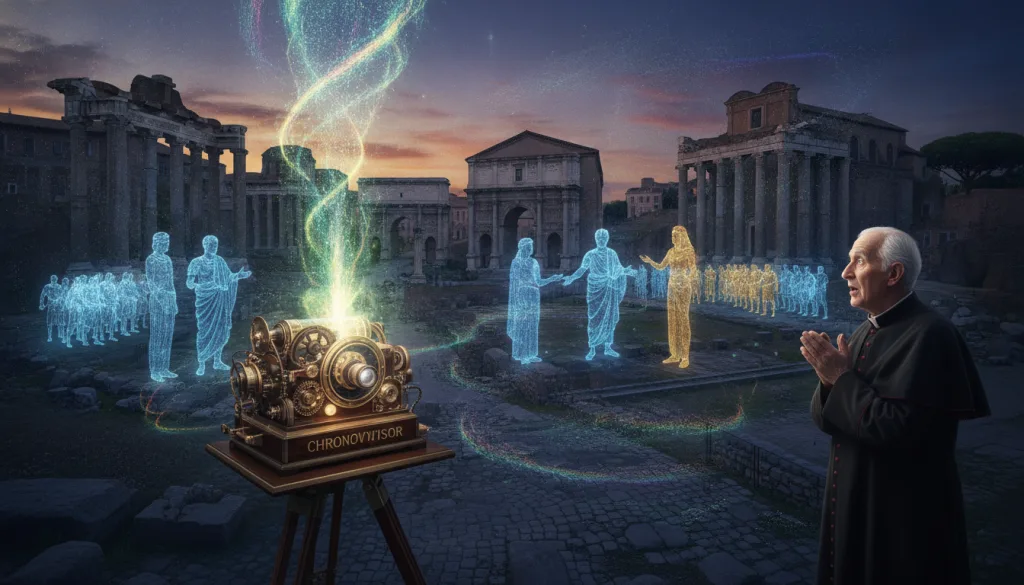
Despite the lack of concrete evidence, Ernetti asserted that the Chronovisor could display events from the past, including the Crucifixion of Jesus Christ and the fall of the Roman Empire. He described these experiences as vivid and real, claiming viewers could feel as if they were present at those historical moments.
The Vatican's Role: Spiritual and Scientific Overlaps
One of the most compelling aspects of the Chronovisor narrative is its alleged connection to the Vatican. The Church has a long history of embroiling itself in matters of both science and theology; thus, the idea that a device capable of viewing history could emerge from such a prestigious institution is captivating. However, this speculation remains largely unsubstantiated in academic circles.
The Vatican's Historical Relationship with Science
The Vatican has both supported and condemned scientific pursuits throughout history. While Galileo Galilei's trial in 1616 exemplifies a dark period for science under the Church's dominion, the Vatican has also promoted various scientific endeavors, establishing the Vatican Observatory in 1582. This dichotomy creates a fertile ground for theories surrounding the Chronovisor, feeding into the public's curiosity about the intersection of faith and science.
The Skepticism Surrounding the Chronovisor
Despite Father Ernetti's fervent claims, the scientific community has approached the Chronovisor with considerable skepticism. Critics argue that the principles underlying time travel and time viewing remain firmly within the realm of theoretical physics and have yet to be substantiated empirically. The absence of any physical evidence, such as blueprints or prototypes, significantly undermines Father Ernetti's assertions.
Scientific Views on Time Travel
Prominent physicists, such as Stephen Hawking, have posited that time travel is theoretically feasible, yet fraught with paradoxes, including the infamous "grandfather paradox" (Hawking, 1992). Theoretical frameworks like wormholes and time dilation have been proposed, but practical applications are still theoretical. In a 1994 paper, physicist Kip Thorne indicated that while traversable wormholes might allow for time travel, the technology to create or harness them remains beyond our current capabilities (Thorne, 1994).
“The laws of physics allow for the possibility of time travel, but the engineering challenges make it improbable with our current technology.” — Kip Thorne, 1994
The Chronovisor in Popular Culture and Fringe Science
The fascination surrounding the Chronovisor has permeated popular culture, inspiring various books, documentaries, and even films. Its legacy is interwoven with fringe science, where it often serves as a touchstone for debates on the plausibility of time travel technologies. Works such as “The Time Machine” by H.G. Wells and documentaries like “The Time Travel Experiments” have resulted in the Chronovisor being mentioned alongside other speculative technologies.
The Influence of Ernetti's Claims
Despite the skepticism, Father Ernetti's narrative continues to hold sway. His story has been a cornerstone in discussions of theoretical time travel, prompting further inquiry into the convergence of technology, theology, and human consciousness. This blend of factors enhances the allure of the Chronovisor as a concept.
Modern Perspectives on Time Viewing and Quantum Mechanics
As modern physics progresses, new theories emerge that could align more closely with the ideas presented by Ernetti. Quantum entanglement and the multiverse theory have opened doors to understanding time and space differently. Researchers like David Deutsch and Sean Carroll have delved into aspects of quantum mechanics that suggest a more fluid understanding of time (Deutsch, 1997; Carroll, 2012). While these theories do not validate the Chronovisor, they reflect a growing interest in exploring concepts that were once considered fringe.
Ethics and Implications of Time Viewing
Should a device such as the Chronovisor prove feasible, ethical questions arise regarding the implications of observing the past. Would it be morally acceptable to witness events that could violate the privacy of individuals, or would it lead to a greater understanding of history? These questions echo concerns raised in literature and philosophy about the nature of time and its impact on human agency.
Our Analysis: The Legacy of the Chronovisor
Ultimately, the narrative surrounding the Chronovisor serves as a compelling case study in the tension between established science and speculative theories. While the scientific community largely dismisses the claims made by Father Ernetti, the cultural and philosophical implications of time viewing resonate with many. The allure of such a device not only challenges our understanding of time and physics but also invites deeper introspection into our values, ethics, and existential queries. The Chronovisor stands as a symbol of human curiosity, a reminder that the desire to explore the unknown persists, even in the face of skepticism.
Sources & References
Ernetti, Pellegrino. "La Domenica del Corriere," 1972, Italy.
Hawking, Stephen. "Time Travel: Theoretical Perspectives," 1992, Cambridge University Press.
Thorne, Kip. "Black Holes and Time Warps: Einstein's Outrageous Legacy," 1994, W.W. Norton & Company.
Deutsch, David. "The Fabric of Reality," 1997, Penguin Books.
Carroll, Sean. "From Eternity to Here: The Quest for the Ultimate Theory of Time," 2012, Dutton.




Comments 0
Be the first to comment!