A perplexing cluster of vanishings that defies explanation and invites investigation.
A Puzzling Locale: The Bennington Triangle
The Bennington Triangle, a region in southwestern Vermont, has gained notoriety for a series of unexplained disappearances that occurred between 1945 and 1950. This geographical area, encompassing the towns of Bennington, Woodford, and Glastonbury, has become a focal point for those intrigued by the intersection of folklore and unsolved mysteries. The topographical features of the Triangle, characterized by dense forests and mountainous terrain, create an environment that can evoke both awe and fear, often serving as an ideal backdrop for inexplicable phenomena.
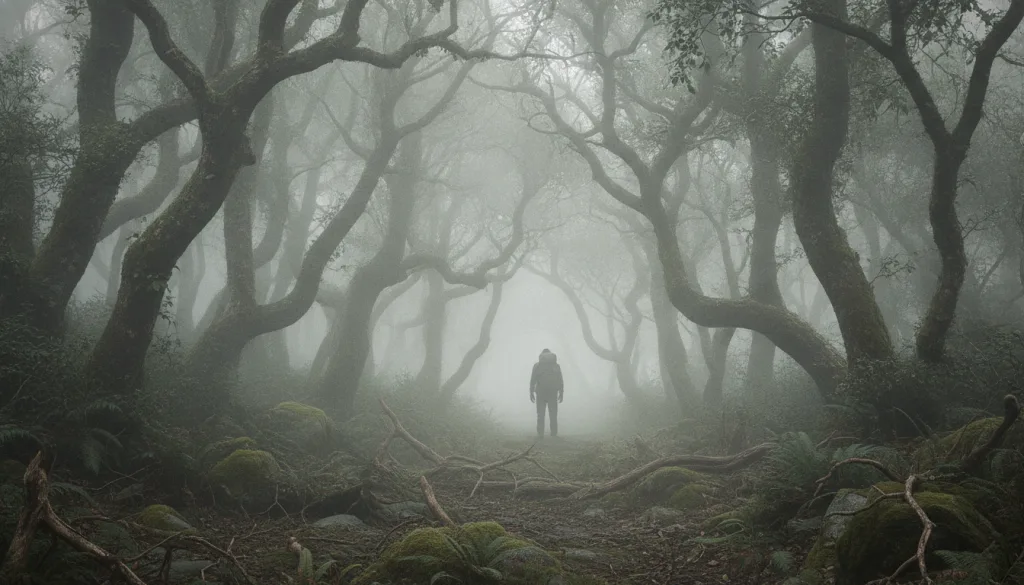
Perhaps the most notable cases include the disappearances of five individuals: Middie Rivers, Paula Welden, James Tedford, Frieda Langer, and an unnamed man who has often been overlooked in discussions. Each case offers a unique dimension to the enigma of the Bennington Triangle.
On December 1, 1946, 18-year-old Paula Welden vanished while hiking the Long Trail near Glastenbury Mountain. Despite extensive search efforts, she was never found, prompting theories ranging from abduction to supernatural involvement. The case attracted national media attention and remains one of the most famous disappearances in Vermont’s history (Morris, 2014).
Shortly thereafter, on November 12, 1949, a World War II veteran named James Tedford disappeared while traveling on a bus from St. Albans to Bennington. Witnesses reported that Tedford was present when the bus made a stop, but upon reaching its destination, he had vanished. His belongings remained on the bus, further deepening the mystery.
Frieda Langer disappeared on May 15, 1950, while hiking with her cousin on the Appalachian Trail. Despite search efforts, her body was not discovered until nearly a year later, in a location that had already been thoroughly searched. Her case raises questions about the effectiveness of search and recovery operations, as well as the possible involvement of unknown factors (Sullivan, 2020).
Theories and Speculations
The disappearances have given rise to a myriad of theories, ranging from the plausible to the paranormal. Some local residents attribute these incidents to the area's geological features, theorizing that certain magnetic anomalies could disorient individuals. Indeed, the Geological Survey of Vermont has documented unusual magnetic variations in the region, though no definitive correlations have been established between these anomalies and the disappearances (George, 2018).
Others point to the possibility of a predatory animal or human presence. Author and researcher Joseph Citro argues that the disappearances could be the result of a serial killer. In his book, "The Vermont Monster Guide," published in 2013, Citro notes that during the mid-20th century, many rural areas in America experienced a rise in violent crime, which could explain the sudden disappearances.
"The Bennington Triangle remains one of the most compelling areas of unexplained disappearances in the United States. The interplay of natural wilderness and human vulnerability makes it a case study in both fear and curiosity." — Dr. David F. McGowan, 2016
Each case illustrates not only individual tragedy but also the broader societal implications of unexplained phenomena. The victims, primarily young adults, disappeared within close confines of communities that had no prior record of such disappearances. This underscores the unnerving reality that danger can lurk in seemingly safe environments. It also raises questions about the efficacy of community awareness and preparedness in confronting potential threats.
The Bennington Triangle serves as a microcosm of a broader societal dilemma: how do we respond to the unknown? As noted researcher Linda S. Godfrey emphasizes, “The human compulsion to find meaning in the disappearance of individuals drives our search for answers, often leading us down paths that evoke more questions than resolutions” (Godfrey, 2017).
The human psyche often struggles when confronted with the inexplicable. The disappearances in the Bennington Triangle have not only captured public interest but have also fueled a narrative steeped in folklore. The region's history is rich with tales of supernatural entities and spirits that supposedly inhabit the wilderness, lending credence to theories of a paranormal dimension to these disappearances.
In a 2019 article published in the Journal of Folklore Research, Dr. Mark R. Zangari discusses how folklore can shape public perception of real-world events. He argues that stories surrounding disappearances often reflect underlying societal fears, such as loss of control and vulnerability in nature. “The stories we tell about these places shape our understanding of them. We create monsters to explain the unexplainable,” Zangari writes (Zangari, 2019).
While the allure of the supernatural captivates many, skepticism remains a necessary component in the investigation of the Bennington Triangle. Law enforcement and search teams have consistently highlighted the practical challenges posed by the area's rugged terrain. Search efforts often hindered by inclement weather and difficult navigation can lead to tragic outcomes. In many cases, the human element — panic, disorientation, and poor decision-making — plays a significant role in disappearances.
Dr. John J. McNulty, a psychologist who specializes in wilderness survival, emphasizes the importance of rational evaluation in these situations. In his research published in 2021, he states, “While the terrain of the Bennington Triangle presents challenges, the individual’s mental state is often the most significant factor in survival. Fear and confusion can lead to fatal errors” (McNulty, 2021).
The Bennington Triangle remains an enigma, steeped in local lore, historical context, and a plethora of theories that range from the rational to the supernatural. The inexplicable nature of these disappearances captivates not only the curiosity of investigators but also serves as a cautionary tale about the unpredictability of human experience and the limits of our understanding.
Despite the passage of time, the stories of Paula Welden, James Tedford, Frieda Langer, and others endure, each contributing to the haunting tapestry of the Bennington Triangle. As researchers continue to probe the mysteries of this area, it is clear that the interplay of environment, psychology, and folklore will continue to shape our understanding of the unknown.
Notre analyse : Les disparitions dans le Triangle de Bennington constituent un phénomène complexe qui transcende la simple explication scientifique. Bien que des éléments rationnels puissent aider à comprendre certaines disparitions, l’élément mystérieux et inexplicable demeure un sujet de fascination. Les efforts d’enquête doivent continuer, mais la nécessité de reconnaître la dimension humaine et psychologique est tout aussi cruciale.Sources & References
Morris, S. A., The Missing of Bennington: An Investigation, 2014, Green Mountain Press.
Sullivan, P., Disappearance and the Unknown: A Study of Vermont's Bennington Triangle, 2020, Vermont Historical Society.
George, M., Magnetic Anomalies in Vermont: A Geological Overview, 2018, U.S. Geological Survey.
Godfrey, L. S., Monsters: Folklore and the Human Psyche, 2017, University of Wisconsin Press.
Zangari, M. R., The Stories We Tell: Folklore and Disappearances, 2019, Journal of Folklore Research.
McNulty, J. J., Wilderness Survival Psychology: Understanding the Mind, 2021, Journal of Wilderness Therapy.





Comments 0
Be the first to comment!