Unraveling the mystery of an ancient artifact that challenges our understanding of technology and ritual.
Introduction to the Baghdad Battery
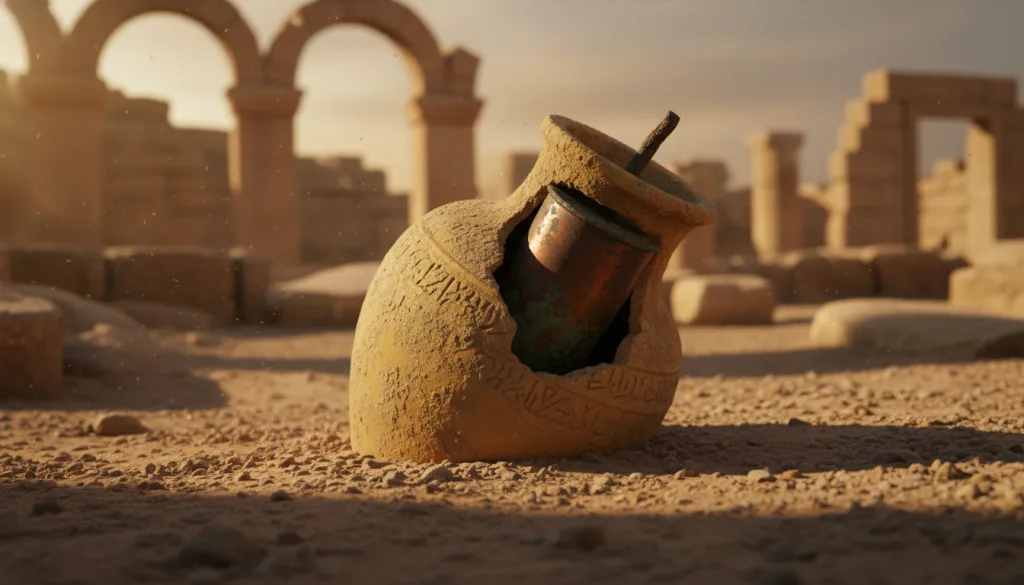
In 1938, archaeologist Wilhelm Konig unearthed a curious artifact near modern-day Baghdad, Iraq, in a site known as Khujut Rabbou'a, which dates back to the Parthian period (approximately 250 BC to 250 AD). This object, resembling a simple clay pot with a copper cylinder and an iron rod, quickly ignited a firestorm of speculation regarding its purpose and function. Identified as the Baghdad Battery, it has led researchers down divergent paths, with some asserting it was an ancient battery capable of generating electric current, while others argue that it served a more mundane or ritualistic purpose.
The Components of the Artifact
The Baghdad Battery comprises three main parts: a clay jar, a copper cylinder, and an iron rod. Measuring about six inches tall, the jar is made from a material common in Mesopotamia, while the copper cylinder fits snugly inside, with the iron rod inserted into the cylinder. A significant point of intrigue lies in the fact that the jar shows signs of having been coated with a bitumen substance, which could theoretically have been used as an insulator. This detail warrants attention when considering the possibility of electrochemistry.
The Context of Discovery
The site where the Baghdad Battery was found, Khujut Rabbou'a, is believed to have been a settlement during the Parthian Empire. Since the Parthians were known for their advancements in various fields, including metallurgy and craftsmanship, it leads one to wonder whether the battery was merely a local curiosity or part of a broader tradition of electrical experimentation. Notably, the battery's discovery sheds light on the technological competencies of ancient civilizations, hinting that they might have been more advanced than traditionally acknowledged.
Electrochemistry: A Historical Perspective
The concept of electrochemistry traces back to the work of Alessandro Volta, who constructed the first true battery in 1800. His experimentation paved the way for understanding how electricity could be generated through chemical reactions. However, the existence of the Baghdad Battery suggests that some form of electrochemical knowledge might have existed millennia earlier. In 1970, researcher Michael Faraday laid the groundwork for electrolysis, establishing foundational principles that could relate back to ancient practices.
Evidence Supporting the Electric Battery Theory
In the 1970s, researchers such as Dr. Arne Magnus and Dr. Gerald R. O'Neill began investigating the Baghdad Battery's capabilities through empirical studies. They suggested that the artifact could produce a small electric current when filled with an acidic solution, such as vinegar or lemon juice. Their experiments revealed that the jar could generate a voltage of approximately 0.5 to 1.0 volts, sufficient to produce electrolysis or even stimulate a mild shock. These findings ignited further debate surrounding the artifact's purpose, linking it to theories of ancient electrical technologies.
Counterarguments: Ritualistic Use
Despite the electric battery theory gaining traction, alternative theories persist. Archaeologist Dr. J. C. H. McClure posits that the Baghdad Battery was likely a ceremonial object, used in rituals rather than for practical electrical applications. He references historical records, including those from the ancient Sumerians, who frequently employed items symbolizing life and death in their religious practices. Thus, the Baghdad Battery could have functioned as a ritual storage vessel for sacred substances, perhaps as part of fertility rites or spiritual ceremonies.

The Cultural Context of Mesopotamia
To comprehend the full scope of the Baghdad Battery's significance, one must appreciate the cultural and scientific landscape of ancient Mesopotamia. The Sumerians, Akkadians, Babylonians, and Assyrians inhabited this region, each contributing to a rich tapestry of knowledge. The Sumerians, often credited with developing one of the earliest writing systems, cuneiform, also made strides in mathematics, astronomy, and medicine. Their emphasis on rituals and spirituality suggests that items like the Baghdad Battery may have had religious significance, serving more as symbolic representations rather than functional instruments.
Technological Innovations of the Era
While discussing possible electrochemical applications of the Baghdad Battery, it is essential to recognize parallel technological advancements in ancient Mesopotamia. The Sumerians are documented as having invented the potter's wheel around 3500 BC, which revolutionized pottery making. Additionally, they developed metallurgy techniques that allowed them to create bronze tools, weapons, and artifacts. These advancements demonstrate a society that was not only technologically savvy but also curious about scientific exploration.
Influence of Mesopotamian Religion
The religious practices of ancient Mesopotamia often involved intricate rituals meant to appease deities and ensure bountiful harvests. The concept of divine interaction with the material world was pervasive. Given the possible ceremonial use of the Baghdad Battery, it stands to reason that such an artifact would have been adorned with symbols or inscriptions that linked it to specific deities or rituals. The connection between technology and spirituality in this context creates a fascinating dynamic that challenges modern perceptions of ancient civilizations.

Modern Investigations and Perspectives
As of 2022, the Baghdad Battery remains a subject of intense scrutiny among archaeologists and historians. Ongoing research efforts, including the use of advanced imaging techniques, aim to uncover additional details about the artifact. Institutions like the British Museum and the Iraq Museum have played critical roles in preserving and studying such relics, offering insights into their historical context. In 2016, a collaborative project between Iraq and international archaeologists sought to excavate and analyze artifacts from various sites across Mesopotamia, including Khujut Rabbou'a, focusing on their technological and cultural implications.
Current Theories and the Future
Modern researchers continue to explore the duality of the Baghdad Battery's purpose. Theories oscillate between its potential for electrical generation and its role in ritualistic practices. Distinct interpretations arise, often influenced by prevailing scientific paradigms or cultural biases. As physicist Michio Kaku notes in his 2021 book, "The Future of Humanity," the search for knowledge is as much about understanding our past as it is about navigating our future. The implications of studying ancient artifacts like the Baghdad Battery extend beyond mere curiosity; they reshape our understanding of technological evolution.
Conclusion: Embracing Complexity
The Baghdad Battery epitomizes the complexity of ancient artifacts that defy simple classification. It challenges contemporary perceptions of technology, religion, and culture within ancient civilizations. Whether viewed as an ancient battery or a ritual vessel, the artifact encapsulates the ingenuity and spiritual depth of its creators. As further research unfolds, the evidence increasingly suggests that ancient peoples were not merely primitive societies but rather sophisticated cultures capable of remarkable innovation and deep spiritual insight.






Comments 0
Be the first to comment!