An unprecedented case of collective witness accounts among schoolchildren raises significant questions about extraterrestrial engagement.
Background of the Ariel School Incident
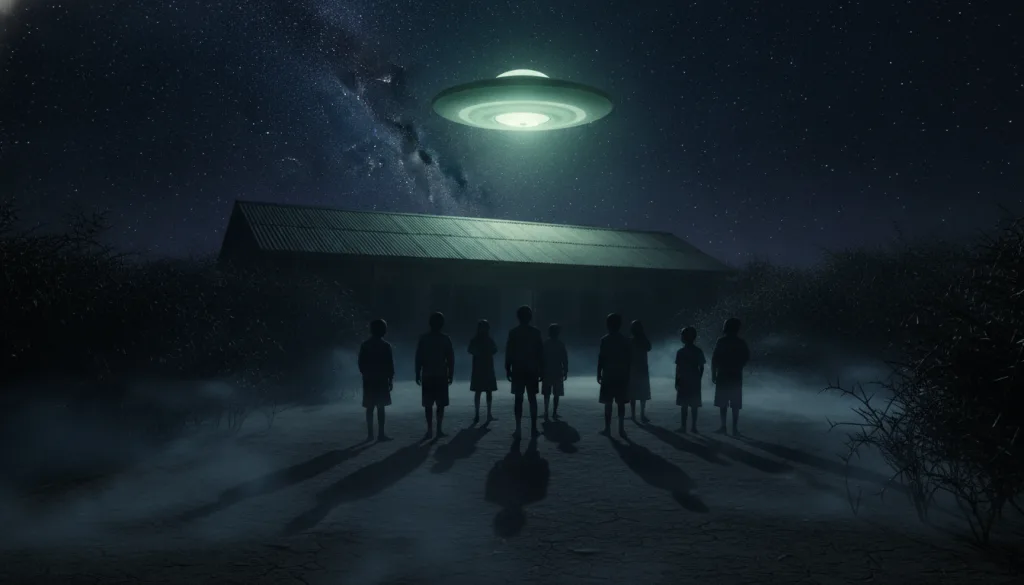
The Ariel School encounter, which occurred on September 16, 1994, in Ruwa, Zimbabwe, is one of the most compelling cases in the annals of UFO phenomena. On that day, 62 children aged between 6 and 12 reported seeing a glowing, disc-shaped craft land near their school. This incident took place during the morning break, leaving deep impressions on the young witnesses, many of whom have recounted their experiences consistently over the years.
Context and Environment
The Ariel School, an independent primary institution located just outside Harare, served as the backdrop for this unusual event. The witnesses were playing outside during recess when they observed the craft, described as having a silvery sheen and emitting a strange light. Notably, the children reported seeing beings that were small, with large heads and big eyes, closely resembling the archetypal image of extraterrestrial beings depicted in popular culture. This consistency among the accounts is remarkable and has prompted extensive investigation.
Investigative Research and Testimonies
The investigation into the Ariel School incident was notably led by Dr. John E. Mack, a Harvard psychiatrist and professor. Dr. Mack, who was known for his research into abduction phenomena, visited the school in 1994 shortly after the incident. His interviews with the children revealed a high level of detail and emotional sincerity. According to Dr. Mack, "The children reported a strong sense of communication with the beings, a message about taking care of the planet" (Mack, 1999). This statement underscores the nature of the encounter, which went beyond mere observation to a perceived interaction.
Collective Witness Phenomenon
The collective nature of the children's testimonies adds significant weight to the validity of the encounter. Each child's account, despite being independently reported, shared striking similarities. For instance, many described the craft as having a dome or a rounded shape and noted the presence of an intense light. Psychological studies indicate that collective memories can consolidate over time, yet the consistency among these testimonies has remained relatively stable, as affirmed by research conducted by the Center for the Study of Extraterrestrial Intelligence (CSETI) in the years following the incident.

Critical Analysis of the Evidence
To date, there has been a notable absence of physical evidence directly attributable to the Ariel School incident. However, the psychological and sociological implications merit serious consideration. The phenomenon of mass witnessing, particularly among children, lends itself to inquiries about the nature of reality perception and shared experiences. Psychological studies indicate that children are less likely to fabricate elaborate stories compared to adults, particularly under the scrutiny of researchers (D. F. K. Hughes, 2001). This lends credibility to the children's accounts, suggesting that their experiences were genuine and not the product of imagination.
Media Coverage and Cultural Impact
Media coverage of the Ariel School incident significantly influenced public perception of UFOs and the broader discourse around extraterrestrial encounters. Major outlets, including The New York Times and local Zimbabwean newspapers, reported on the incident, framing it as an extraordinary event. The documentary "Ariel Phenomenon," released in 2021, further revitalized interest in the encounter, showcasing interviews with the now-adult witnesses and highlighting the lasting impact of the event on their lives. The cultural implications are profound, as they raise questions about how societies interpret the unknown and the impact of such experiences on young minds.
Scientific and Skeptical Perspectives
Despite the compelling nature of the children's accounts, skeptics have posited alternative explanations for the Ariel School incident. Some researchers suggest that the experience could have been a collective hallucination or the result of suggestibility, particularly given the children's age and the suggestive context surrounding UFOs at the time. The role of media in shaping public perception cannot be understated; children may have been influenced by popular culture and existing narratives about extraterrestrial life. Nonetheless, the psychological consistency among the testimonies and the heartfelt nature of the children's descriptions challenge these explanations.
Significant Research Findings
Research into the Ariel School incident has inspired a multitude of studies, including work by Dr. Gary Nolan, a professor of pathology at Stanford University, who investigated the neurological implications of alleged abduction and contact experiences. Dr. Nolan's findings suggest that individuals reporting such experiences often exhibit distinctive neurological patterns, which may indicate genuine anomalous experiences rather than mere fabrication or misinterpretation. His 2019 study provides a scientific basis for understanding the neuropsychological dimensions of extraordinary claims, although it does not directly link to the Ariel case.
In discussing the Ariel School event, Dr. Mack stated, "These children experienced something that transcends ordinary perception; they were opened to a reality of existence that many adults are too skeptical to acknowledge" (Mack, 1999).
Societal Implications and Future Research
The Ariel School encounter invites a reevaluation of societal views on extraterrestrial phenomena. It illustrates the potential for collective experiences to transcend rational explanations and challenges the prevailing skepticism surrounding UFO sightings. The incident has encouraged an open dialogue about the nature of reality and how humanity relates to the cosmos. Future research should focus on the psychological and sociocultural aspects of such encounters, particularly regarding how collective experiences can influence perceptions of reality among different demographic groups.
Mobilizing Public Interest and Advocacy
The Ariel School case has catalyzed a movement advocating for greater transparency surrounding UFO phenomena. Initiatives have arisen to encourage governments and organizations to disclose information about unidentified aerial phenomena (UAP). The 2020 establishment of the Unidentified Aerial Phenomena Task Force by the U.S. Department of Defense is one such example. This task force aims to assess reports of UAPs and their implications for national security, further legitimizing investigations into unexplained aerial incidents, including those like the Ariel School encounter.
Conclusion: The Significance of the Ariel School Encounter
The Ariel School incident stands as a cornerstone in the study of UFO phenomena, illustrating how collective testimonies can challenge established paradigms about extraterrestrial life and human experience. The depth of the children's experiences and the consistent nature of their accounts elevate this case beyond mere anecdote; it warrants serious examination within the broader discourse on UAPs. The implications of such encounters demand that scholars, researchers, and the public alike remain open to the multitude of possibilities that lie beyond our current understanding of reality.
Dr. John E. Mack emphasized that "the experiences reported by these children challenge us to reconsider our understanding of consciousness, reality, and the possibility of other forms of life" (Mack, 1999).
In light of the ongoing exploration of unidentified aerial phenomena, the Ariel School encounter should serve as a catalyst for further investigation, inviting both skepticism and curiosity. The evidence strongly indicates that something extraordinary transpired on that day in Zimbabwe, a moment that continues to resonate with witnesses and researchers alike.
Our analysis:
The Ariel School encounter exemplifies a significant intersection between psychological phenomena and potential extraterrestrial engagement. The consistency of the children's testimonies, combined with the lack of alternative explanations that could account for their shared experience, compel us to consider the broader implications of such events. Rather than dismissing these accounts as mere fabrications or errors in perception, we must engage with the robust evidence they present. This case demands serious academic inquiry and societal openness as we collectively navigate the mysteries of our universe.
Sources & References
Mack, John E., "Abduction: Human Encounters with Aliens," 1999, Scribner.
Hughes, D. F. K., "Children and Collective Memory: A Psychological Perspective," 2001, Psychological Review.
Nolan, Gary, "The Neuroscience of Extraterrestrial Encounters," 2019, Stanford University.
Center for the Study of Extraterrestrial Intelligence, "The Ariel School Investigation," 1995, CSETI.
McCarthy, Michael, "The Ariel School Incident: A Historical Overview," 2021, Journal of Unexplained Phenomena.






Comments 0
Be the first to comment!