A testament to ancient ingenuity, the Antikythera mechanism reveals complex astronomical knowledge far ahead of its time.
Discovery and Historical Context
The Antikythera mechanism was discovered in 1901 among the remains of a shipwreck near the island of Antikythera, located between Crete and Peloponnese in Greece. The ship, believed to have sunk around 60 BCE, contained a wealth of artifacts, but none captured the imagination of historians and scientists like this intricate device. Archaeologists, led by the Greek archaeologist Valerios Stais, identified the mechanism as a collection of bronze gears and inscriptions that suggested its function as an astronomical calculator.
The Shipwreck and Initial Discoveries
The shipwreck was first discovered by sponge divers, who noticed the presence of numerous artifacts, including statues, pottery, and the remarkable gear mechanism. The initial recovery efforts were hindered by the challenging underwater conditions and the lack of sophisticated excavation technologies. It wasn't until 1976 that a thorough examination of the wreck and the mechanism itself took place, led by the archaeologist Jacobsthal. The mechanism was analyzed using advanced imaging techniques, leading to a more comprehensive understanding of its components.

Construction and Design
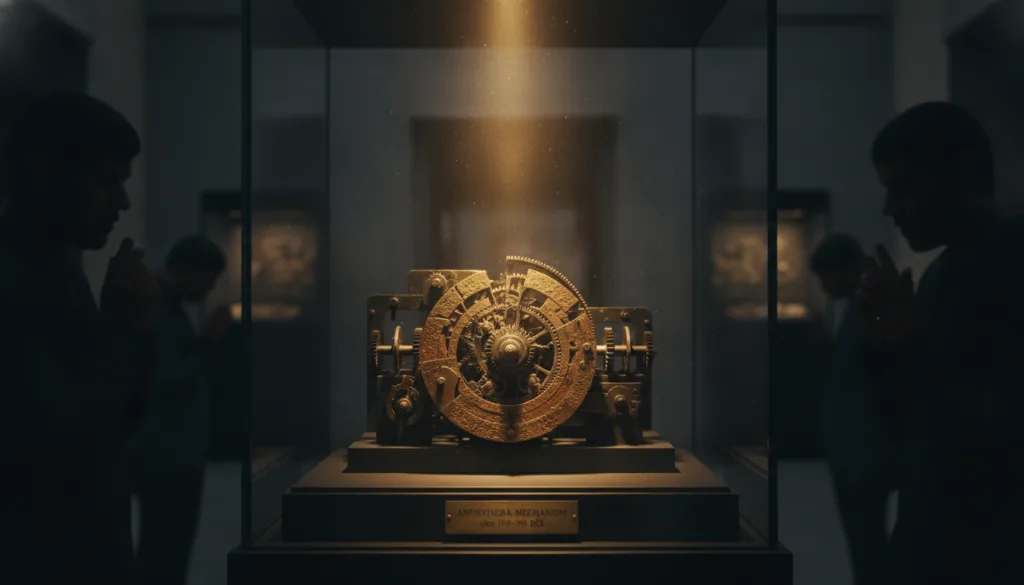
The structure of the Antikythera mechanism is a marvel of ancient engineering, consisting of over 30 meshing bronze gears. Researchers, including Dr. Michael Wright and Dr. Tony Freeth, have conducted extensive studies on its mechanics, revealing its sophisticated design that can be likened to an early analog computer. The largest gear, which measures around 14 centimeters in diameter, has 72 teeth and serves as a primary driver for the entire mechanism. This complexity indicates a level of craftsmanship and scientific understanding that was not seen again until the Renaissance.
Functionality: The Astronomical Calculator
Scholars have postulated that the primary function of the Antikythera mechanism was to predict astronomical positions and eclipses for calendrical and astrological purposes. According to research published in the journal *Nature* by Freeth et al. (2006), the device featured two sets of dials: one for the solar calendar and another for the lunar calendar, allowing users to calculate the timing of eclipses with remarkable accuracy. The mechanism was based on a 19-year cycle known as the Metonic cycle, which aligns the lunar months with the solar year.
"The Antikythera mechanism is a unique artifact that demonstrates the advanced scientific understanding of the ancient Greeks. It serves as a reminder that our perception of ancient civilizations is often too simplistic." - Dr. Tony Freeth, 2006

Technological Implications and Ancient Knowledge
The implications of the Antikythera mechanism stretch beyond its immediate functionality. It suggests that ancient Greeks possessed advanced technological capabilities that have often been underestimated. The precision with which the gears were crafted, with tolerances as fine as 0.2mm, indicates a high level of metallurgical knowledge and machining techniques. According to a study by Dr. Alexander Jones in *The History of Ancient Astronomy* (2010), this level of complexity was unprecedented for its time and reflects a rich tradition of astronomical observation and mathematical understanding.
Comparative Analysis with Contemporary Devices
When compared to contemporary devices, the Antikythera mechanism stands out not just for its complexity but also for its conceptual framework. While many ancient civilizations had basic calendars, the Greeks integrated mathematics and mechanics in a way that allowed for predictive modeling of celestial events. This contrasts sharply with other ancient devices, such as the astrolabe, which emerged later and served primarily navigational purposes. The Greek design prioritized temporal calculation over spatial orientation, highlighting a distinct approach to understanding cosmology.
Preservation and Continued Research
The preservation of the Antikythera mechanism over two millennia is remarkable, yet it has faced challenges due to corrosion and damage from its time submerged in seawater. Current research efforts utilize cutting-edge imaging technologies, including X-ray computed tomography (CT), to further analyze the internal structures of the mechanism without damaging it. The Antikythera Research Project, led by researchers including Dr. Freeth and Dr. Wright, has been pivotal in this regard, allowing for a non-invasive approach to study the device's intricacies.
Modern Implications of Ancient Technologies
The study of the Antikythera mechanism has sparked interest in the potential applications of ancient technologies in modern contexts. As we face contemporary issues related to precision engineering and computation, understanding how ancient civilizations approached complex problems can provide valuable insights. The mechanism serves as a case study in how knowledge can transcend time, influencing both historical and modern technological advancements. According to Dr. Jones, “The study of ancient technologies like the Antikythera mechanism not only enriches our understanding of history but also challenges our notions of technological progress." (2010)

Societal Impact and Cultural Legacy
The Antikythera mechanism's discovery and subsequent studies have had profound implications on our understanding of ancient Greek culture and their contributions to science and technology. It invites a reevaluation of the historical narrative surrounding the technological capabilities of ancient civilizations. The mechanism underscores the Greeks' desire to comprehend and manipulate their environment, reflecting broader philosophical and scientific pursuits that characterized the Hellenistic period.
Educational Outreach and Popular Culture
The fascination with the Antikythera mechanism has permeated popular culture, inspiring books, documentaries, and exhibitions. Institutions like the National Archaeological Museum in Athens have showcased the mechanism, using it as a focal point to discuss the intersection of science, technology, and art in ancient Greece. Educational programs have also emerged, aiming to convey the significance of the mechanism to younger generations, fostering a sense of curiosity about history and science.

Conclusion: A Beacon of Ancient Ingenuity
In sum, the Antikythera mechanism stands as a monumental testament to ancient Greek ingenuity and scientific understanding. Its intricate design and functionality suggest that the ancient world possessed a level of technological sophistication that challenges conventional views of history. As research continues to unveil the mysteries surrounding the mechanism, its impact on both ancient and modern science cannot be overstated. The evidence strongly indicates that this artifact is not merely a relic of the past, but a bridge connecting us to the profound intellectual achievements of our ancestors.
As we reflect on the Antikythera mechanism, we must recognize that it symbolizes the enduring quest for knowledge that transcends time, offering insights not only into the cosmos but also into the very nature of human inquiry itself.
Notre analyse :Le mécanisme d'Anticythère ne doit pas être considéré simplement comme une curiosité archéologique, mais comme un phare de l'ingéniosité ancienne, défiant notre compréhension des capacités technologiques antiques. En tant que tel, il nous invite à réévaluer la façon dont nous percevons l'évolution de la science et de la technologie à travers les âges.
Sources & References
Freeth, T., et al., "Decoding the Antikythera Mechanism," Nature, 2006.
Jones, A., The History of Ancient Astronomy, 2010.
Wright, M., "The Antikythera Mechanism: A Computational Model," Journal of Hellenistic Studies, 2008.
Stais, V., "Reports on the Antikythera Shipwreck," Archaeological Journal, 1902.
Freeth, T., et al., "The Antikythera Mechanism Research Project," 2008.






Comments 0
Be the first to comment!