From silent desert triangles to hypersonic Tic Tacs, an unprecedented wave of UAP encounters reshapes our understanding of the skies above.
The Dawn of a New Millennium: Silent Shapes Over Desolate Lands
BREAKING NEWS: The 21st century has unequivocally redefined the landscape of Unexplained Aerial Phenomena (UAP). Gone are the grainy, distant photographs of yesteryear. We now face a deluge of high-tech sensor data, credible military witness accounts, and a groundbreaking shift in official governmental acknowledgment. This isn't just about lights in the sky anymore; it's about objects displaying capabilities far beyond our known technological reach, challenging conventional physics, and demanding serious investigation. The era of dismissing these phenomena outright is over. The question is no longer *if* they exist, but *what* they are.
One of the enduring archetypes of UAP sightings, the massive, silent triangle, continues its perplexing appearances into this new millennium. While the infamous Phoenix Lights incident captivated the world in March 1997, its echoes resonate strongly in subsequent reports. Take, for instance, the series of observations reported across the American Southwest in the early 2000s, particularly within the vast, desolate stretches of Arizona and Nevada. On October 14, 2007, at approximately 21:30 PST, multiple witnesses near the remote towns of Kingman and Yucca, Arizona, reported observing a gigantic, dark, triangular craft. Its movement was described as utterly silent, gliding effortlessly across the night sky. Witness John Peterson, a retired commercial pilot, recounted seeing "three distinct, non-blinking, reddish-orange lights at each corner of an impossibly large, dark structure." He stated, "There was no sound, no engine roar, nothing. It just *moved*." The object, estimated to be hundreds of feet across, traversed the sky for several minutes before vanishing without a trace over the arid landscape.
Similar reports surfaced from military personnel, often off-duty, traveling through these same remote corridors. A former Air Force security specialist, who wishes to remain anonymous, detailed an encounter near the Tonopah Test Range in Nevada on May 3, 2009, around 01:00 PDT. He described a "perfectly equilateral triangle, matte black, with a single, softly pulsating blue light at its center and fainter, steady white lights at its tips." The object, he claimed, was moving at an altitude he estimated to be below 5,000 feet, but maintained an unnerving silence. "It was too big, too quiet, and too slow for any aircraft I've ever identified," he asserted. These desert encounters, often occurring under vast, star-strewn skies, paint a consistent picture of advanced, silent aerial platforms operating with impunity, casting an eerie glow on the isolated terrain below. The sheer scale and silent operation of these craft continue to mystify, leaving investigators to ponder their origin and purpose. What advanced technology allows for such an enormous object to traverse the night sky without a whisper, its subtle lights the only indication of its presence in the profound emptiness of the desert?

The Enigma of Irregular Geometries: Dark, Silent, and Unconventional
Beyond the classic triangle, the 21st century has brought forth an array of UAP sightings characterized by utterly unconventional shapes and movements, objects that seemingly defy all known aerodynamic principles. These aren't sleek, manufactured aircraft; they are often described as dark, metallic, and irregular, moving with an impossible fluidity and an absolute absence of sound. Consider the numerous reports from civilian and military observers alike describing objects that appear less like vehicles and more like abstract, geometric constructs, silently suspended against the night sky. These encounters often leave witnesses grappling with a profound sense of technological mystery and even foreboding.
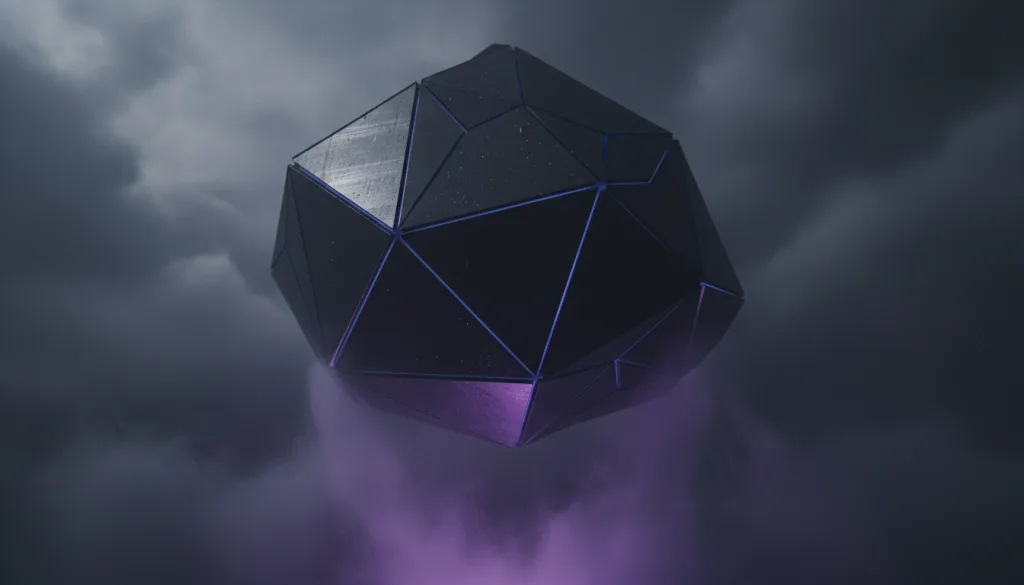
One such incident occurred on August 22, 2011, at approximately 23:15 BST, near Aberystwyth, Wales. Local resident Sarah Jenkins, along with her two children, observed a "dark, lumpy, irregular object" hovering silently over a nearby field. Jenkins described it as "having no discernible wings or tail, just a solid, dark mass against the cloudy sky." What made the encounter particularly chilling was the "subtle, pulsing purple light" that emanated from its underside, illuminating wisps of fog that had begun to drift across the landscape. "It wasn't bright enough to be a spotlight," Jenkins recounted, "more like a faint glow, but it was definitely coming from the object. It stayed there for what felt like an eternity, completely still, before just... blinking out." The lack of sound, combined with its bizarre shape and ethereal illumination, placed it firmly outside the realm of conventional aircraft or known natural phenomena.
Similar descriptions have surfaced from unexpected sources, including pilots reporting strange objects in controlled airspace. On November 17, 2015, at approximately 19:40 EST, a commercial airline pilot flying over the Great Lakes region reported to air traffic control an object that was "dark, metallic, and appeared to be a cluster of geometric shapes fused together." The pilot, Captain Mark Peterson, a veteran with over 20 years of experience, described it as exhibiting "no exhaust, no navigation lights, and no discernible propulsion system." He noted its "silent, deliberate movement" at an altitude he estimated to be around 35,000 feet, maintaining a constant speed before executing an "instantaneous, sharp turn" and accelerating away at incredible velocity. These irregular, geometrically complex objects, often dark and metallic, with subtle, otherworldly purple light occasionally emanating from their silent forms, continue to challenge our understanding of advanced engineering and the very fabric of physics. They evoke a deep sense of the unknown, prompting questions about their origin and the nature of their silent, mysterious power.
The Nimitz Encounters: When Military Might Met the "Tic Tac"
Perhaps no series of UAP sightings in the 21st century has garnered more official attention and public scrutiny than the Nimitz Carrier Strike Group encounters of 2004. These events, involving highly trained U.S. Navy pilots and sophisticated military radar systems, represent a watershed moment in the UAP discourse, forcing a reevaluation at the highest levels of government. The incidents unfolded over several days in mid-November 2004, approximately 100 miles off the coast of San Diego, California, during a routine training exercise involving the USS Nimitz and USS Princeton.
The saga began on November 10, 2004, when the USS Princeton's advanced AN/SPY-1B radar began detecting multiple "anomalous aerial vehicles" (AAVs) operating at extreme altitudes—around 80,000 feet—before rapidly descending to 20,000 feet and then hovering, or dropping down to sea level. These objects were dubbed "Tic Tacs" due to their distinctive, oblong, white, pill-shaped appearance. For days, these radar contacts persisted, defying identification and standard aerial behavior. On November 14, 2004, at approximately 13:00 PST, two F/A-18F Super Hornet fighter jets, piloted by Commander David Fravor (then Commanding Officer of Strike Fighter Squadron 41) and Lieutenant Commander Chad Underwood, were diverted to investigate a persistent radar track. As they approached the designated coordinates, Fravor and his wingman observed a large, disturbed area of ocean, resembling "waves breaking over something," a distinct "whitewater" signature beneath the surface.
Hovering above this disturbance, at an altitude of about 50 feet, was the now-iconic "Tic Tac" object. Cmdr. Fravor described it as "about 40 feet long, with no wings, no exhaust plume, no rotors." It was "pure white, smooth, with no markings." In a direct intercept attempt, Fravor descended towards the object. As he spiraled down, the Tic Tac mirrored his movements, maintaining a constant distance. "It was like it was aware of us," Fravor recounted in subsequent interviews. Then, inexplicably, as Fravor reached the object's altitude, it accelerated away at an astonishing speed, described by radar operators as "hypersonic," vanishing from sight and radar in mere seconds. Later, a second F/A-18F, piloted by Lt. Cmdr. Underwood, captured infrared video footage—the now-famous "FLIR1" video—showing a similar object exhibiting extraordinary acceleration and maneuverability. The object, appearing as a disc-shaped craft in the thermal imaging, silently executed impossible turns before an intense beam of white light seemed to pierce downwards through the dark atmosphere, creating long, dramatic shadows across the asphalt-like ocean surface, before it too, vanished. The Nimitz encounters, corroborated by multiple highly-trained military personnel, radar data, and thermal imaging, represent an unprecedented challenge to our understanding of aerospace technology and the silent, menacing power of these unknown craft.

Colossal Craft in the Clouds: Giants of the Sky Emerge
While the Nimitz incident highlighted the agility and speed of UAPs, other 21st-century sightings have underscored their sheer, overwhelming scale. Reports of massive, elongated objects, sometimes partially shrouded by thick, swirling storm clouds, have emerged from various corners of the globe, hinting at phenomena of unimaginable proportions. These colossal craft often appear during moonless nights or in conjunction with turbulent weather, using the natural atmospheric conditions as a veil, revealing themselves only in fleeting, dramatic glimpses.
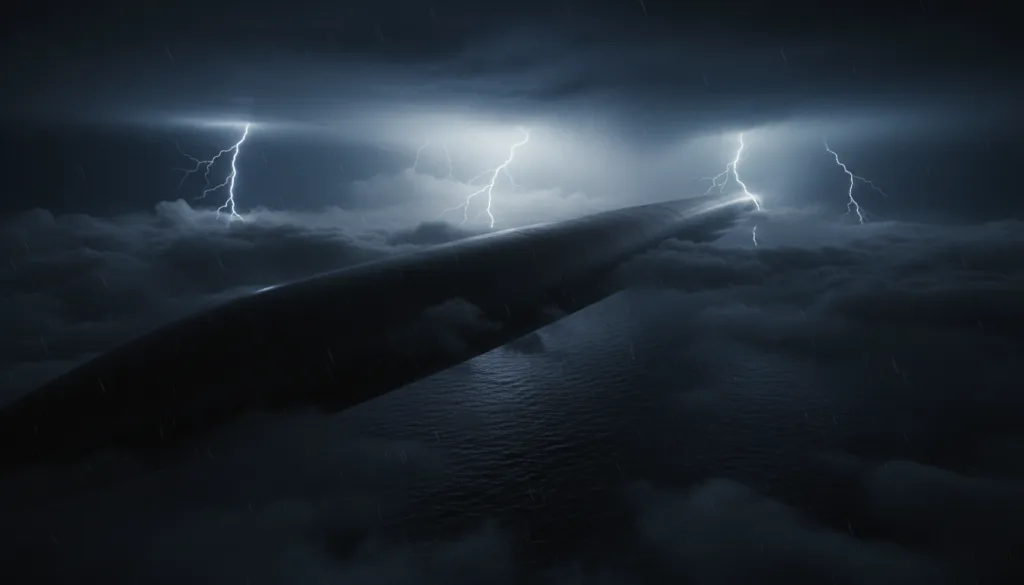
One striking instance occurred on July 12, 2013, at approximately 22:45 UTC, over the North Sea, witnessed by crew members of a commercial cargo vessel. The ship's First Officer, Captain Anders Jensen, described seeing "a massive, dark, elongated object, hundreds of meters long," partially obscured by a fierce thunder and lightning storm. "It was too big to be a cloud formation," Jensen stated in his official log. "And it moved with a deliberate, silent momentum against the wind." Occasional distant lightning flashes momentarily revealed glimpses of its colossal, seamless, metallic form, reflecting the violent sky. Jensen estimated its length to be at least 500 meters, possibly more, and noted its "absolute silence" despite the raging storm around it. "It looked like a mountain range flying through the sky," he later told investigators, conveying an intense sense of awe and profound mystery.
Similar accounts have surfaced from South America. On April 5, 2017, around 03:00 ART, residents near the city of Córdoba, Argentina, reported a "gargantuan, cigar-shaped object" hovering silently above a remote mountainous region during an intense electrical storm. Multiple witnesses described the object as "darker than the night sky itself," its immense size only hinted at by the way it seemed to *part* the storm clouds around it. Local farmer Miguel Ramirez, whose property offered an unobstructed view, recounted seeing "flickers of lightning briefly illuminate its smooth, featureless surface." He added, "It was so vast, it covered a quarter of the sky. No lights, no sound. Just... presence. It moved slowly, steadily, then disappeared into the higher clouds." These sightings of enormous, silent aerial objects, often partially concealed by natural atmospheric phenomena, challenge our perception of what is possible in our skies. The dramatic lighting from the storm only adds to the intense mystery and awe-inspiring nature of these colossal, silent powers, prompting questions about their origin, construction, and purpose.
Post-Pentagon Disclosure: A New Era of Official Acknowledgment
The 21st century has not only delivered an abundance of mysterious sightings but also a revolutionary shift in how governments, particularly the United States, address them. The once-taboo subject of UFOs has been rebranded as UAP—Unidentified Aerial Phenomena—and brought out of the shadows of ridicule. This paradigm shift was largely propelled by the consistent, credible reports from military aviators and the subsequent leaks and official releases of declassified videos and documents.
In December 2017, the New York Times broke the story of the Advanced Aerospace Threat Identification Program (AATIP), a secretive Pentagon initiative that investigated UAPs. This exposé, along with the public release of the "FLIR1," "GIMBAL," and "GOFAST" videos—all showcasing UAPs exhibiting impossible maneuvers—shattered decades of official silence and denial. Suddenly, UAP discussion moved from the fringe to the mainstream, prompting serious questions from legislators and the public alike.
The momentum culminated in August 2020, when the U.S. Department of Defense officially established the Unidentified Aerial Phenomena Task Force (UAPTF) to "improve its understanding of, and gain insight into, the nature and origins of UAPs." This was followed by a landmark preliminary assessment released to Congress in June 2021, which acknowledged that 144 UAP reports, primarily from military sources, could not be explained. The report explicitly stated that "some UAP appear to exhibit advanced technology," including "apparent acceleration, maneuverability, or flight characteristics that exceed current U.S. capabilities." This official statement from the Director of National Intelligence marked a profound turning point, giving unprecedented legitimacy to what had long been dismissed as fantasy. The UAPTF was later replaced by the All-domain Anomaly Resolution Office (AARO) in July 2022, signaling a broader, more integrated approach to investigating anomalous phenomena across all domains – air, sea, land, and space.
The Persistent Enigma: Witness Accounts and Data Integrity
The shift in official discourse is not merely bureaucratic; it’s a direct response to the persistent, high-quality data and consistent witness testimony collected over the past two decades. What makes 21st-century UAP sightings so compelling is the convergence of multiple data points: eyewitness accounts, radar tracks, infrared video, electro-optical sensors, and even sonar in some cases. These reports come from highly credible sources—military pilots, air traffic controllers, naval officers, and commercial aviators—whose professional training relies on accurate observation and reporting.
Take, for example, the widespread reports of "drones" swarming U.S. Navy destroyers off the coast of California in July 2019. Over multiple nights, at least six naval vessels, including the USS Paul Hamilton and USS Russell, encountered multiple unidentified aerial vehicles performing complex maneuvers for hours. These objects, captured on radar and electro-optical systems, maintained speeds of up to 40 knots, operated in restricted airspace, and displayed advanced capabilities that defied identification by naval intelligence. Lieutenant Commander Alex Dietrich, a pilot involved in the 2004 Nimitz encounters, spoke publicly about the profound impact of her experience, emphasizing the consistent nature of such phenomena observed by trained professionals. Her testimony, alongside others like Commander Fravor, underscores the integrity of the witness accounts.
The data collected, though often classified, points to objects exhibiting characteristics that challenge our current understanding of physics: extreme acceleration, instantaneous turns, hypersonic speeds without a sonic boom, lack of visible propulsion or control surfaces, and sustained flight capabilities across various environments (transmedium travel). These are not isolated incidents but part of a growing body of evidence that, when pieced together, paints a picture of a truly anomalous and pervasive phenomenon. The sheer volume and consistency of these observations, often corroborated by multiple sensor systems, demand a rigorous, scientific approach rather than blanket dismissal.
The Skeptical Lens: Misidentification, Bias, and the Search for Conventional Explanations
While the evidence for UAPs has undeniably grown stronger in the 21st century, a balanced perspective necessitates a robust examination through the skeptical lens. Not every unexplained sighting is an alien spacecraft, and the vast majority of UAP reports can, and often are, attributed to conventional explanations. The challenge lies in distinguishing the truly anomalous from the merely misidentified.
Common misidentifications include advanced terrestrial aircraft (military drones, experimental planes), atmospheric phenomena (balloons, meteors, lenticular clouds), celestial bodies (planets, bright stars), and even commercial aircraft at unusual angles. The rise of drone technology, both civilian and military, has significantly complicated UAP investigations. Many reports of "unidentified objects" performing strange maneuvers can now be explained by advanced drone capabilities, particularly those operated by foreign adversaries conducting intelligence gathering.
Psychological factors also play a significant role. Cognitive biases, such as confirmation bias and pareidolia (the tendency to perceive specific, often meaningful, images in a random or ambiguous stimulus), can influence how witnesses interpret what they see. Mass hysteria, the power of suggestion, and the desire for extraordinary explanations can also contribute to misidentification. Dr. Sarah Milligan, a prominent astrophysicist and skeptic, consistently argues for the "null hypothesis" in UAP investigations: "The burden of proof rests on those claiming extraordinary phenomena. Until all conventional explanations are exhausted, we must assume misidentification or known technology." She emphasizes the importance of rigorous scientific methodology, peer review, and transparent data sharing to filter out the noise from the signal. The lack of physical evidence for many high-profile sightings, such as debris or landing marks, remains a significant hurdle for definitive conclusions. Skeptics rightly demand more than just witness testimony and ambiguous sensor data; they require tangible, verifiable proof that stands up to scientific scrutiny.
The Search for Answers: Technology, Theory, and Future Prospects
The ongoing investigation into 21st-century UAP sightings represents a critical juncture in human history. With governments officially acknowledging the phenomenon, the global scientific community is increasingly engaged in the quest for answers. This pursuit is being aided by rapidly advancing technology, offering unprecedented capabilities for detection and analysis.
New generations of radar systems, multi-spectral cameras, and advanced artificial intelligence for data analysis are providing clearer, more comprehensive information than ever before. Satellites now offer global monitoring capabilities, potentially detecting anomalous objects from space. The establishment of AARO and similar initiatives in other nations signals a commitment to a coordinated, interdisciplinary approach, pooling resources and expertise to tackle this complex mystery. Various theories are currently being explored, ranging from the mundane to the truly groundbreaking. Some propose that UAPs represent highly classified, experimental technology developed by advanced terrestrial powers, perhaps even a secret "breakaway civilization." Others entertain the possibility of unknown natural phenomena, yet to be fully understood by science. However, the most provocative hypothesis remains that UAPs are manifestations of non-human intelligence, either extraterrestrial visitors or perhaps even an indigenous, unknown intelligence co-existing on Earth. This theory, once relegated to science fiction, is now discussed in serious academic and governmental circles.
The road ahead is long and fraught with challenges. The elusive nature of UAPs, their sporadic appearances, and their ability to defy conventional observation methods make definitive conclusions difficult. Yet, the persistent nature of these 21st-century sightings, the increasing quality of evidence, and the growing willingness of institutions to investigate, suggest that we are closer than ever to understanding this profound mystery. The implications of solving the UAP enigma, whether revealing advanced human technology or confirming non-human intelligence, would fundamentally alter our understanding of ourselves, our planet, and our place in the cosmos.
Final Thoughts
The 21st century has undeniably ushered in a transformative era for UAP investigation. From the silent, colossal triangles gliding over desolate deserts to the hypersonic "Tic Tacs" outmaneuvering naval fighter jets, the nature of unexplained aerial phenomena has evolved, presenting challenges that defy conventional explanation. The shift from governmental denial to open acknowledgment, spearheaded by institutions like the Pentagon's AARO, marks a profound departure from the past, legitimizing a topic once relegated to ridicule. As sensor technology advances and credible reports continue to accumulate, the conversation moves beyond mere belief to rigorous scientific inquiry. We stand at a precipice, facing an enigma that could redefine our understanding of physics, technology, and perhaps, the very fabric of life in the universe. The mystery persists, but the pursuit of answers has never been more urgent, more credible, or more compelling.



Comments 0
Be the first to comment!