A confluence of military technology and firsthand experience sheds light on one of the most compelling UFO encounters in history.
A Day Like No Other in the Pacific
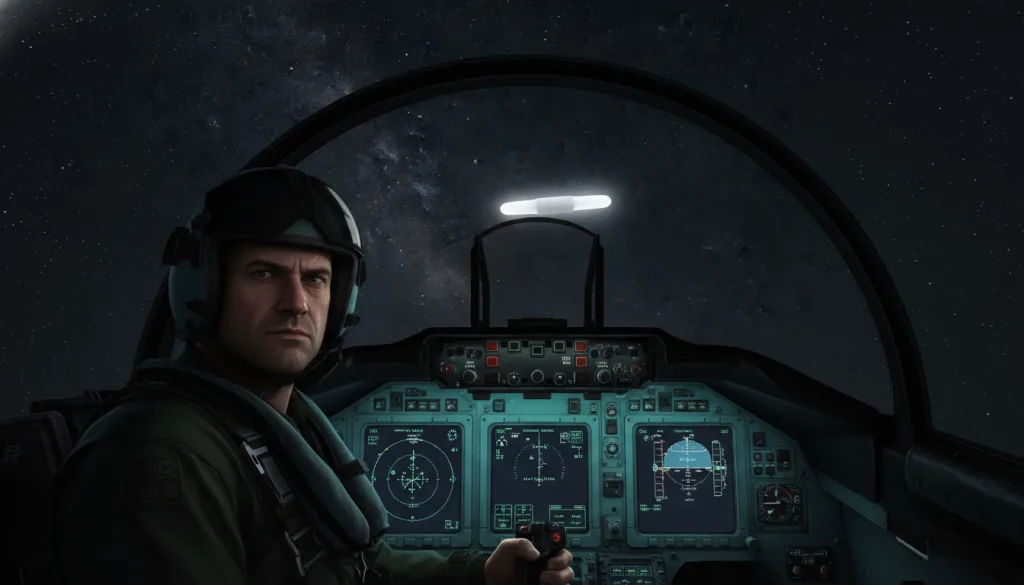
On November 14, 2004, the USS Nimitz Carrier Strike Group was conducting routine training exercises off the coast of Southern California when an incident occurred that would ignite intense interest in unidentified aerial phenomena (UAP). The pilot of a F/A-18 Super Hornet, Commander David Fravor, took to the sky on what he believed would be an ordinary mission. Little did he know, he was about to encounter something inexplicable.
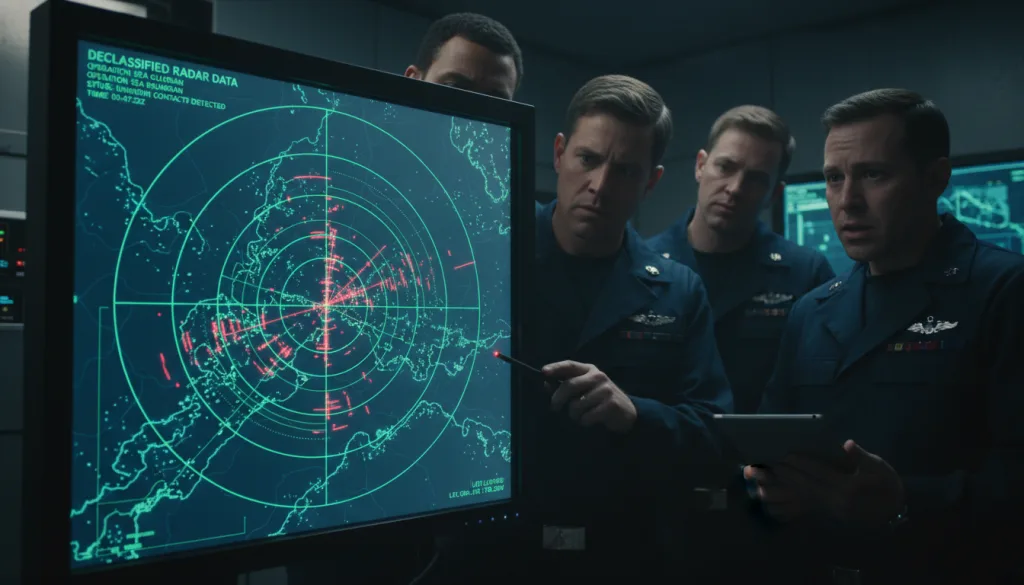
The encounter began when Fravor and his wingman were diverted from their training mission to investigate unknown radar contacts detected by the USS Princeton, a radar picket ship stationed nearby. The radar had picked up objects exhibiting unusual flight patterns—high speeds and sudden changes in direction that far exceeded the capability of any known military or civilian aircraft.
Unraveling the Encounter
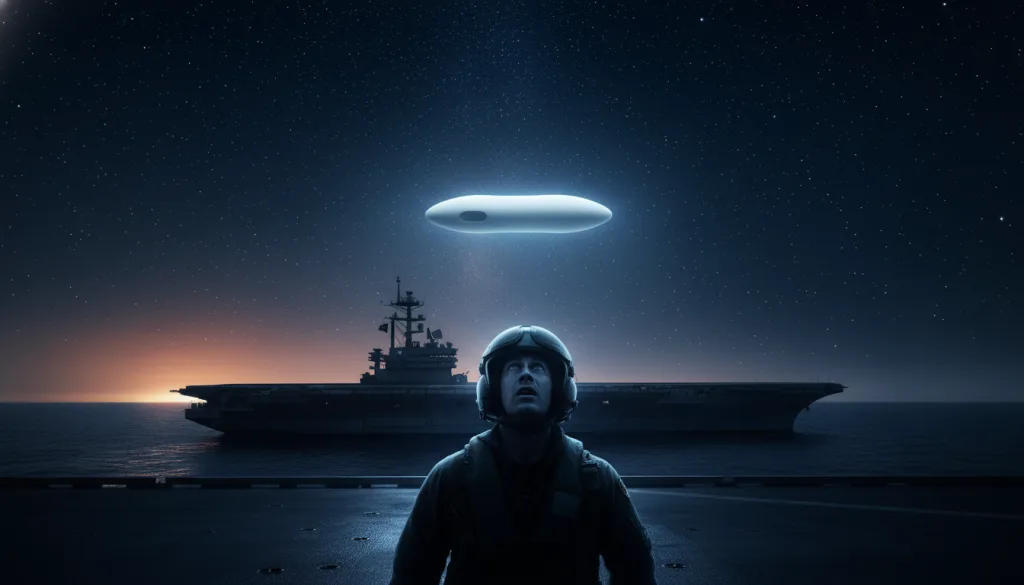
Upon locating one of the objects, Fravor described a white, oblong shape that resembled a Tic Tac mint. It hovered silently above the ocean, displaying remarkable agility as it darted across the sky. The encounter lasted approximately five minutes, during which Fravor and his wingman observed the object performing maneuvers that defied the laws of physics as we understand them. Fravor’s description of the object emphasizes not just its shape, but its behavior—a stark contrast to any conventional aircraft:
“I’ve been flying for 18 years. I know what I’m looking at. This thing was not from this world.” – Commander David Fravor, 2004
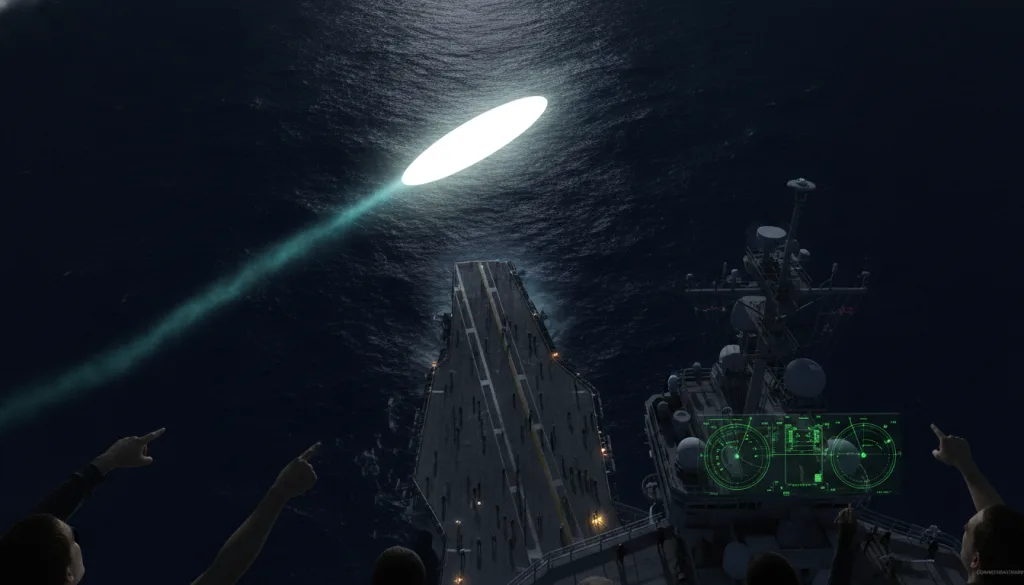
The F/A-18's Advanced Targeting Forward-Looking Infrared (ATFLIR) pod captured video footage of the encounter, which would later be declassified and released to the public. This video not only provided visual evidence but also illustrated the technology that enabled military personnel to document such phenomena.
The Technical Aspects of the Encounter
Following the incident, detailed assessments were conducted by military personnel and analysts. The data from the USS Princeton indicated that the radar had tracked the object at high altitudes and extreme speeds, peaking at over 20,000 feet. This level of performance is well beyond the capabilities of conventional aircraft, which typically operate within much more predictable parameters.
In 2020, the Department of Defense (DoD) officially released the video footage, now known as “FLIR1,” prompting renewed interest from both the public and scientists. This was not merely a fleeting moment but a significant data point reinforcing the case for UAP phenomena. The Pentagon's acknowledgment of the footage validated the experiences of the pilots involved and the data collected at the time.
Radar Data Analysis
Radar data from the USS Princeton that day displayed not just a single object but multiple unidentified contacts. The Navy’s systems reported these objects moving against the wind at a speed of 120 knots, an impossibility for conventional aircraft that would require significant aerodynamic lift and propulsion capabilities. The Nimitz incident has led many experts to reconsider what we know about advanced technology and the limitations of our current aerospace capabilities.
Dr. Eric W. Davis, a physicist who has worked with the Pentagon’s Advanced Aerospace Threat Identification Program (AATIP), stated, “The performance characteristics of these UAPs strongly indicate an advanced technology that remains unexplained.” His insights highlight the serious implications of such encounters and the need for further investigation.
Witness Accounts and Their Implications
Commander Fravor’s account is just one of several testimonies from military personnel involved in the incident. Lieutenant Commander Alex Dietrich, who was also in the air during the encounter, corroborated Fravor's observations. In interviews, she emphasized the profound impact the experience had on her understanding of aerial phenomena:
“It was just something that was not in our training, not in our realm of experience. It’s the kind of thing that makes you rethink everything.” – Lieutenant Commander Alex Dietrich, 2020
The consistency of these accounts is crucial. The credibility of military personnel, particularly those with extensive flight experience and training, lends weight to these observations. As more accounts emerge, the pattern begins to form a clearer image of the unexplained.
The Broader Context of UAP Research
The 2004 Nimitz encounter is part of a larger narrative concerning UAPs that has evolved over decades. In 1966, the U.S. government initiated Project Blue Book, a program tasked with investigating UFO sightings and determining their origins. Although Project Blue Book concluded in 1969, the phenomenon was far from over. The Navy’s response to the Nimitz incident has led to increased transparency in how military encounters with UAPs are documented and reported.
In recent years, the Pentagon has restructured its approach to UAP incidents, culminating in the establishment of a UAP Task Force in 2020. This task force aims to systematically study encounters, utilizing technology and methodologies that were unavailable during earlier investigations. The establishment of this task force indicates a governmental acknowledgment of the potential significance of UAPs.
Legislative Developments
The renewed interest in UAP phenomena gained traction in Congress, with notable hearings held in June 2021 and May 2022. These sessions provided an official platform for military officials and experts to discuss their findings and concerns regarding unidentified aerial threats. The acknowledgment of these phenomena at the highest levels of government signifies a shift in how UAPs are perceived, moving from fringe theories to legitimate national security concerns.
Notre analyse :
The evidence strongly indicates that the 2004 USS Nimitz encounter is far more than mere pilot error or misidentified phenomena. The convergence of radar data, multiple eyewitness accounts, and the subsequent release of video footage creates a compelling case for the existence of advanced aerial technology that remains unexplained. The consistency of the reports from credible military personnel, coupled with the technologies involved, points toward a need for a serious, transparent investigation into the implications of UAPs.
As we move forward, it is crucial to maintain a reasoned approach, balancing skepticism with an openness to understanding what these phenomena represent. The military’s current stance indicates an acknowledgment of the unknown, and with it, the responsibility to pursue answers for not just the military community but for society as a whole. The phenomena observed by Commander Fravor and his colleagues could signify a technological leap beyond our current comprehension, or perhaps something much more complex that challenges our understanding of the universe itself.
Sources & References
Blumenthal, David. "The Pentagon's UFO Task Force." 2020. Washington Post.
Davis, Eric W. "Unidentified Aerial Phenomena: A New Perspective." 2021. Scientific American.
U.S. Department of Defense. "AATIP Report on Unidentified Aerial Phenomena." 2020. Department of Defense.
U.S. Navy. "Navy Pilot Reports of Unidentified Aerial Phenomena." 2004. United States Navy.
U.S. Government Accountability Office. "UAPs: Preliminary Assessment Report." 2021. GAO.



Comments 0
Be the first to comment!