The successful quantum communication experiment marks a pivotal advancement in understanding teleportation.
First of Its Kind: The Micius Satellite
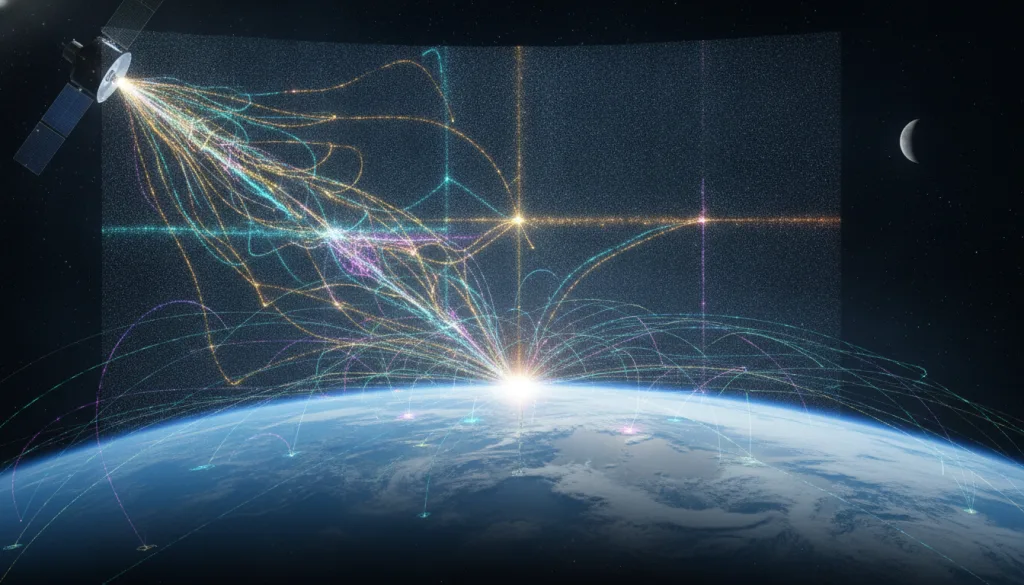
The world of quantum physics witnessed a groundbreaking event on August 16, 2017, when Chinese scientists successfully achieved quantum state teleportation over 1,400 kilometers using the Micius satellite. This satellite, named after the ancient Chinese philosopher and scientist Mozi, was launched on August 16, 2016, and has since been a beacon for cutting-edge quantum communication research. The team at the University of Science and Technology of China (USTC), led by Professor Pan Jianwei, conducted the experiment that involved the transfer of quantum states between two ground-based stations via the Micius satellite.
This remarkable feat involved entangled photons, a phenomenon predicted by quantum mechanics. The experiment showcased the potential applications of quantum communication in secure data transmission, with implications for fields ranging from telecommunications to quantum computing.
What Is Quantum Teleportation?
Quantum teleportation is a process by which the quantum state of a particle is transferred from one location to another without moving the physical particle itself. According to quantum mechanics, this intriguing phenomenon relies on entanglement, where two particles are linked in such a way that the state of one immediately influences the state of the other, regardless of the distance separating them. The research conducted by Professor Pan and his team demonstrated that such teleportation could be achieved over vast distances, defying traditional notions of physical distance.

Technical Overview: The Mechanics of the Experiment
In the 2017 experiment, the researchers utilized the Micius satellite to send entangled photons between two ground stations located in the cities of Delingha and Lijiang in China. This setup involved a series of complex steps that began with generating pairs of entangled photons. One photon of each pair was sent to the receiving station, while the other was retained at the sending station.
To perform the teleportation, the researchers conducted a Bell-state measurement on the photon at the sending station. This measurement entangled the photon with the photon from the sending station. Consequently, they employed classical communication methods to relay the measurement results to the receiving station, allowing it to reconstruct the original quantum state of the photon.
The successful transfer over 1,400 kilometers confirmed that quantum state teleportation is not merely a theoretical exercise but a viable process that can be applied practically.
Key Results and Significance
The results were staggering. The researchers achieved a teleportation fidelity greater than 90%, which is exceptionally high for such long-distance quantum communication. This fidelity level is crucial for real-world applications, particularly in building a robust quantum internet that can facilitate secure communications. Professor Pan expressed the importance of their findings by stating:
“Teleportation is not just a tool for quantum computation; it is the key to building a quantum internet.” – Pan Jianwei, 2017
This experiment has laid the groundwork for future endeavors in quantum networking, paving the way for quantum repeaters that can extend quantum communication capabilities across even greater distances.
Implications for Quantum Communication and Cryptography
The successful demonstration of teleportation over such a distance heralds a new era for quantum communication. One of the immediate implications is the potential for ultra-secure communications. Quantum mechanics ensures that any attempt to intercept or eavesdrop on the quantum states will invariably alter them, alerting the communicating parties to the presence of an intruder.
This security feature is what makes quantum key distribution (QKD) particularly appealing. With the Micius satellite acting as a quantum relay, it may soon be possible to implement QKD on a global scale. The ramifications for cybersecurity are immense, as the traditional encryption methods would be rendered obsolete in favor of quantum-safe techniques.
The Global Race for Quantum Supremacy
The experiment also places China in a leading position in the global race for quantum supremacy. The U.S., European Union, and other nations have made significant investments in quantum research, but China's commitment has positioned it firmly at the forefront. The Micius satellite is just one part of China’s broader quantum research initiative, which has seen substantial government funding and collaboration among various institutions.
In 2021, the Chinese government announced plans to expand its quantum communication network, aiming to connect cities across the country and potentially create a global quantum internet. This ambition shows no signs of slowing down, as the nation pushes to integrate quantum technology into various sectors, from finance to national defense.

Challenges and Future Directions
Despite the remarkable achievements, significant challenges remain in the field of quantum teleportation. One of the primary obstacles is the degradation of entangled states over long distances due to environmental factors. The quantum states can easily lose coherence, leading to errors in transmission. Researchers are actively seeking solutions to overcome this issue, including the development of quantum repeaters and error correction techniques.
Another critical aspect is scalability. While the teleportation experiment was successful over 1,400 km, extending these distances further requires advancements in satellite technology and ground-based infrastructure. The deployment of a satellite network that can facilitate continuous quantum communication is a complex task that necessitates collaboration across various scientific disciplines.
The Path Ahead: A Quantum Internet
The ultimate goal of these quantum technologies is to create a quantum internet. Researchers such as Professor Hoi-Shun Co and his team at the University of Science and Technology of China are already working on the next generation of quantum satellites. Their focus is on improving the efficiency and reliability of quantum state transmission.
In addition, the establishment of international standards for quantum communication is essential for ensuring interoperability between different quantum networks. The International Telecommunication Union (ITU) has begun discussions on creating a framework for quantum communication protocols, which could facilitate the global expansion of quantum technologies.

Conclusion
The achievements surrounding the Micius satellite have firmly placed quantum teleportation not just within the realm of theoretical physics but also as a promising reality. The successful transfer of quantum states over 1,400 kilometers is more than a scientific milestone; it represents a paradigm shift in how we understand communication and data security.
As nations race to integrate quantum technologies into their infrastructures, the implications for national security, economic growth, and technological advancement are profound. The evidence strongly indicates that quantum teleportation will be a cornerstone of the future, ushering in an age of secure, instantaneous communication across vast distances.
Our analysis: The experiment using the Micius satellite exemplifies the intersection of science fiction and reality. Teleportation, once thought to be a mere concept of science fiction, is becoming a reality through rigorous scientific exploration. Institutions like USTC are leading the charge, and the global implications of their work are only beginning to unfold. As such, the conversation around quantum teleportation should not only focus on its scientific merits but also on the ethical implications of such powerful technologies. The world must prepare for the transformative effects of quantum communication on society as a whole.
Sources & References
Pan, Jianwei, et al., “Experimental quantum teleportation over 1,400 kilometers through quantum entanglement,” 2017, Nature.
Co, Hoi-Shun, “Quantum Communication: Current Developments,” 2020, University of Science and Technology of China.
International Telecommunication Union, “Standardization of Quantum Communication Standards,” 2021, ITU.
Wang, Jian, “Quantum Key Distribution: Fundamentals and Applications,” 2019, Springer.






Comments 0
Be the first to comment!