Examining the scientific intrigue surrounding KIC 8462852 and its anomalous light patterns.
Introduction to Tabby Star
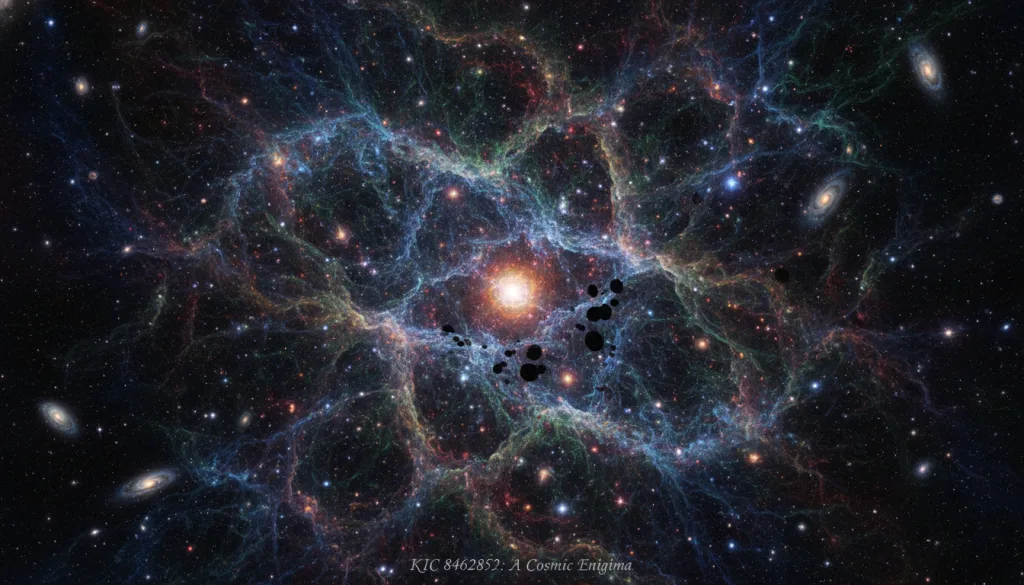
KIC 8462852, commonly referred to as Tabby Star, was designated in the Kepler Input Catalogue following the Kepler Space Telescope's mission that began in 2009. Discovered by astronomer Tabetha Boyajian and her team at Yale University in 2015, this star is located approximately 1,480 light-years away in the constellation Cygnus. Its light curve exhibited irregular dimming, which defied conventional astrophysical explanations, leading to a spectrum of theories, including the possibility of an advanced alien megastructure.
Initial Observations and Anomalies
During its observation period, KIC 8462852 displayed a remarkable dimming pattern characterized by a drop in brightness of up to 22% over several days, as recorded between 2009 and 2013. These observations were cataloged in a paper published by Boyajian et al. in the Astrophysical Journal in 2016. The stark and unexplained nature of the dimming set the stage for extensive analysis and interpretation within the scientific community.
Historical Context of Stellar Anomalies
To understand KIC 8462852's unique characteristics, it is essential to acknowledge the historical context concerning stellar anomalies. The first recorded instance of unexplained stellar dimming dates back to the early 20th century with the observation of the variable star Algol (Beta Persei). However, the frequency and scale of dimming events were significantly lower compared to Tabby Star.
The Role of Citizen Science
The unusual behavior of Tabby Star drew the attention of amateur astronomers and citizen scientists alike, particularly through the Planet Hunters project launched in 2010. Participants analyzed Kepler data, leading to the identification of the star's irregular dimming. Notably, a citizen scientist named Jason Wright proposed the alien megastructure hypothesis, suggesting that the observed dimming could be the result of a Dyson sphere or similar structure harnessing energy from the star.

Analysis of the Alien Megastructure Hypothesis
The alien megastructure hypothesis contends that the light fluctuations observed from KIC 8462852 may not be due to natural celestial phenomena but instead indicate the presence of an artificial construct. This theory gained traction within both academic and popular realms, leading to a surge of interest in the potential for extraterrestrial intelligence.
Examining the Evidence
Supporters of the hypothesis often reference the rapid and significant dimming events, particularly the notable 22% drop in brightness recorded in 2015. Furthermore, the star's unusual light curve contrasts sharply with that of other stars within the Kepler catalogue, prompting questions about its physical characteristics. In 2017, astronomer Frank J. Tipler posited that the data was consistent with a large structure that could potentially be a megastructure.
Alternative Explanations
Despite the intrigue surrounding the alien megastructure hypothesis, numerous astrophysical explanations have emerged. One prominent alternative is the presence of a swarm of comets. In 2016, researchers led by astronomer Eric Mamajek suggested that the observed dimming could be attributed to a cloud of cometary debris passing in front of the star. This model was further elaborated upon in a study published in 2018 by astronomers from the University of California, Berkeley, who created simulations indicating that a swarm of comets could adequately account for the dimming patterns.
Dust and Other Celestial Phenomena
Another potential explanation involves the presence of interstellar dust. In 2019, a study led by researchers at the University of California, Berkeley, proposed that circumstellar dust clouds may obscure the star's light, resulting in the fluctuations. This theory aligns with various observations of other stars exhibiting similar dimming patterns attributed to dust, although the scale and abruptness of KIC 8462852’s dimming remain unprecedented.
Recent Developments and Ongoing Research
Research on KIC 8462852 has continued, with observations from various astronomical facilities, including the Spitzer Space Telescope and the European Southern Observatory’s Very Large Telescope. In 2020, a team of astronomers utilizing the Transiting Exoplanet Survey Satellite (TESS) initiated efforts to monitor the star for new dimming events. While no definitive new data has emerged, the ongoing observations aim to corroborate or refute previous hypotheses.
Public Interest and Cultural Impact
The fascination with Tabby Star transcends scientific discourse, permeating popular culture and media. In 2017, the star was featured prominently in the Netflix documentary series "The Universe," which examined the possibility of alien life and technology. The public's intrigue was fueled by the search for extraterrestrial intelligence (SETI), exemplified by the work of researchers like Seth Shostak, who have advocated for continued surveillance of unusual astronomical phenomena.
Technological Implications of Detection
If the alien megastructure hypothesis were validated, the implications for technology and energy consumption would be profound. The concept of a Dyson sphere, theorized by physicist Freeman Dyson in 1960, suggests a megastructure capable of harnessing the total energy output of a star. Such technology, if real, would represent a monumental leap in our understanding of intelligence and engineering capabilities within the universe.
Ethical and Philosophical Questions
The confirmation of extraterrestrial technology raises significant ethical and philosophical questions regarding humanity's role in the cosmos. In 2021, astrobiologist Sara Walker from the Beyond Center for Fundamental Concepts in Science argued that the discovery of advanced civilizations would necessitate a reevaluation of human identity and our stewardship of Earth. Ethical considerations surrounding communication with extraterrestrial intelligences could dictate future actions in space exploration.
Conclusion: The Future of Tabby Star Research
The ongoing study of KIC 8462852 represents a confluence of scientific inquiry, technological advancement, and public fascination. While the alien megastructure hypothesis remains one of many interpretations of the star's anomalous behavior, it serves as a catalyst for broader discussions regarding the search for extraterrestrial life and the parameters defining intelligence in the universe.
Prospects for Future Discovery
As observational technology improves, the potential for discovering further anomalies akin to those exhibited by Tabby Star becomes increasingly feasible. The launch of next-generation telescopes, such as the James Webb Space Telescope in December 2021, promises to enhance our observational capacity, allowing for a deeper understanding of distant stars and the phenomena surrounding them. The evidence strongly suggests that KIC 8462852, while enigmatic, will continue to inspire scientific exploration and debate well into the future.





Comments 0
Be the first to comment!