Unraveling the truth behind secret programs and classified materials.
Historical Context of Reverse Engineering
Reverse engineering has long been a tactic employed by governments to extract and understand advanced technologies. The most notorious case occurred in Roswell, New Mexico, in July 1947. An unidentified object reportedly crashed on a ranch, sparking decades of speculation. Official reports from the U.S. military labeled it a “weather balloon.” However, witnesses, including rancher Mac Brazel, later described metallic debris and strange materials that were not consistent with any known technology.
The U.S. Air Force initiated Project Mogul in response to the Roswell incident. This program focused on high-altitude balloon technology for detecting nuclear tests by the Soviet Union. However, the debris found was never adequately explained. It raises the question: Was the government covering up a far more advanced technology?
Project Blue Book: Investigating the Unexplainable
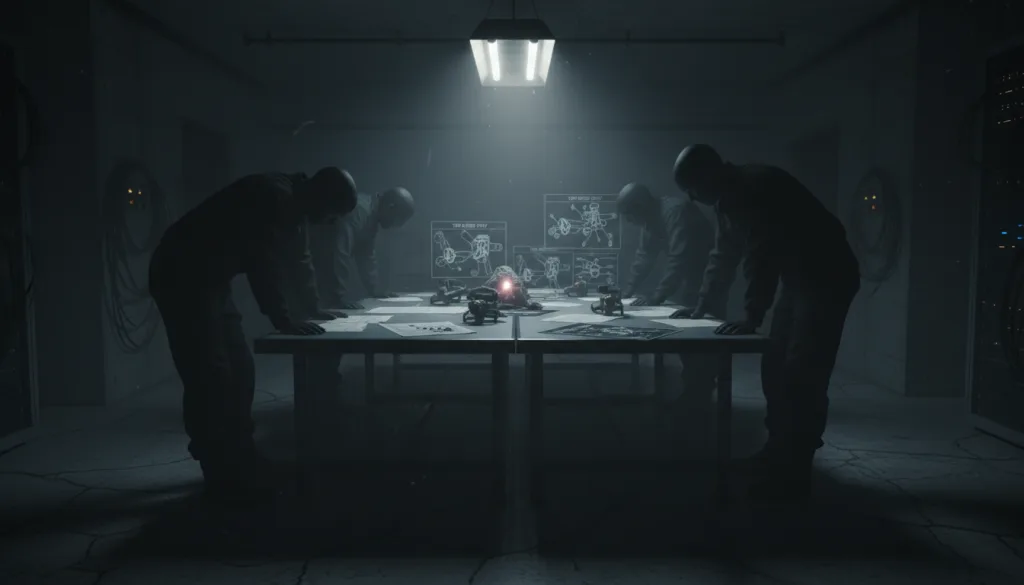
From 1952 until 1969, the U.S. Air Force operated Project Blue Book, a systematic study of UFO sightings and incidents. The project amassed 12,618 reports. Of these, 701 remained unexplained, leading to further speculation about reverse engineering efforts. Major Hector Quintanilla, who led the project from 1963 to 1969, acknowledged the potential for advanced technology in these unidentified aerial phenomena.
In 1966, the University of Michigan conducted a study under Dr. J. Allen Hynek, a consultant to Project Blue Book. His findings suggested that many sightings involved materials or technologies that were not readily identifiable. The implications of these reports hinted at the possibility that the U.S. government had access to technology beyond current scientific understanding.
Whistleblower Accounts: Voices from the Inside
Numerous whistleblowers have emerged over the years, claiming insider knowledge of reverse engineering programs. Notable among them is Bob Lazar, who in 1989 claimed to have worked on extraterrestrial technology at a site near Area 51, designated S-4, in Nevada. Lazar asserted that the U.S. government was reverse engineering anti-gravity propulsion systems from recovered alien spacecraft.
In a 1996 interview with George Knapp, Lazar alleged that the craft utilized an element called “Element 115” for propulsion, which was not known to exist at that time. In 2003, physicists finally synthesized a stable isotope of Element 115, known as Moscovium, though it is still not capable of the properties Lazar described. Despite skepticism, Lazar's claims resonate within certain investigative circles and have prompted further examination of government technologies.

Recent Developments and Classified Programs
The Pentagon's Advanced Aerospace Threat Identification Program (AATIP), initiated in 2007, further validates the ongoing investigation of unidentified aerial phenomena. According to a 2019 report by The New York Times, AATIP was tasked with evaluating advanced technologies and potential threats, including those possibly derived from non-human sources. The report indicated that AATIP had evaluated materials and incidents that appeared to defy the laws of physics.
One prominent figure in AATIP, Luis Elizondo, has publicly stated that the government possesses materials from unidentified aerial phenomena. His remarks in various interviews reveal a belief that the U.S. has acquired technology that could be of extraterrestrial origin. Elizondo's testimony demands scrutiny, as it aligns with decades of speculation regarding government concealment of advanced technology.
Scientific Community's Perspective
Scientific inquiry into reverse engineering of potential alien technology remains scant due to the classified nature of the subject. Notable physicist Michio Kaku, in his 2018 book “The Future of Humanity,” discusses the implications of reverse engineering advanced technologies. Kaku posits that if such technologies exist and can be understood, they could fundamentally alter human civilization. The need for transparency in government dealings cannot be overstated.
In 2021, a report by the Office of the Director of National Intelligence (ODNI) was released, summarizing findings of AATIP and other related investigations. This report highlighted 144 sightings between 2004 and 2021 that could not be easily explained, fueling interest in scientific study and potential reverse engineering of materials associated with these sightings.

Conclusion: The Path Forward
The evidence strongly suggests that the government is involved in reverse engineering initiatives related to unidentified technological artifacts. The history of classified programs, whistleblower accounts, and recent assessments paint a picture of a complex web of secrecy surrounding advanced technologies, potentially of extraterrestrial origin.
Moving forward, the need for transparency is paramount. Continued public interest and pressure will likely influence future government disclosures about reverse engineering activities. The implications of these technologies could be transformative, ushering in a new era of scientific understanding and technological advancement.






Comments 0
Be the first to comment!