A meticulous dissection of the Rendlesham incident reveals government complicity and a chilling lack of transparency.
The Incident Unfolds: A Timeline of Events
In December 1980, the haunting woods of Rendlesham Forest, adjacent to the Royal Air Force (RAF) base at Bentwaters in Suffolk, England, became the site of a series of unexplained events that remain one of the most significant UFO encounters in history. From the initial sightings to the eventual fallout, this incident warrants a detailed examination.
The Initial Sightings
On the night of December 26, 1980, U.S. Air Force personnel stationed at RAF Bentwaters reported a strange light in the forest. Staff Sergeant Jim Penniston and Airman John Burroughs were among the first to approach the glowing object, encountering a triangular craft approximately ten feet in width, which emitted a soft light, appeared to be metallic, and had strange symbols etched on its surface. This encounter would be classified as a legitimate close encounter of the third kind by many researchers and remains unmatched in its detail.
Subsequent Events and Official Reports
The following night, December 27, the situation escalated. A second group of military personnel, including Lieutenant Colonel Charles Halt, ventured into the forest to investigate the phenomenon. During their exploration, they witnessed additional lights and reported strange readings on their Geiger counters, which indicated an abnormal level of radiation in the area. These readings were later documented in the infamous Halt Memo. Halt recorded the entire incident, establishing a chronological narrative that remains pivotal to any discussion of this event.

The Halt Memo: A Governmental Confession?
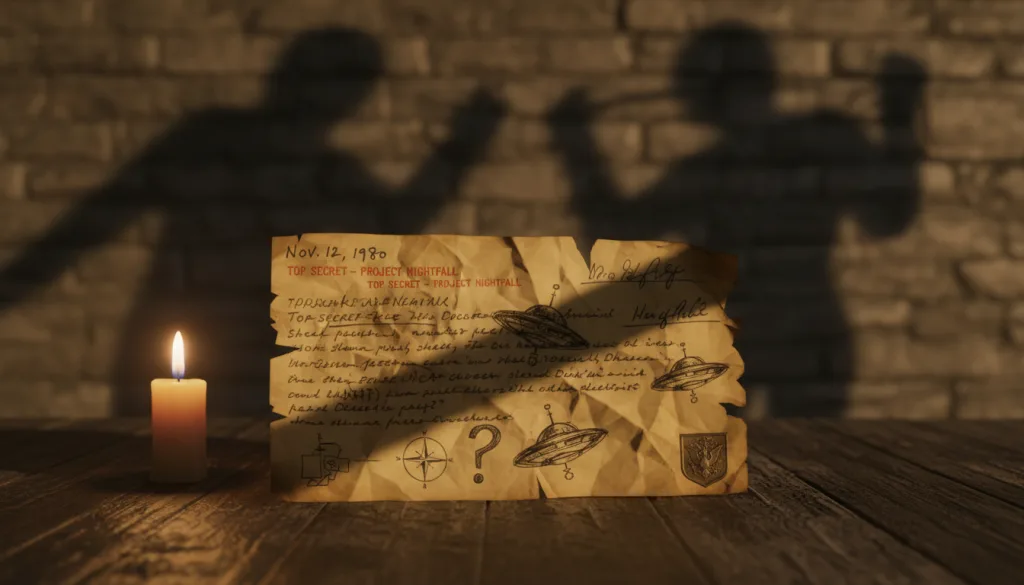
Charles Halt's memorandum, dated January 13, 1981, contains detailed accounts of the sightings and the subsequent investigations. This document not only serves as a crucial piece of evidence but also raises questions about the military's willingness to acknowledge the reality of unidentified aerial phenomena (UAP).
Key Elements of the Memo
The Halt Memo describes the personnel's encounter with the strange lights, the temperature increases near the site, and the discovery of landing marks on the ground. Specifically, Halt noted: “The object was described as being shaped like an eye and was emitting a red and blue light.” He also presented evidence of three distinct sightings that were all corroborated by multiple witnesses, lending credence to the claim that something extraordinary occurred during those fateful nights.
Government Response and Cover-up
Despite the specificity contained in the Halt Memo, the British government, along with the U.S. military, opted to downplay these incidents, labeling them as mere “misidentifications.” According to a 1983 report by the Ministry of Defence, “no further investigation is warranted.” However, skeptics argue that the dismissal of such a significant sighting reflects a deeper governmental reluctance to investigate the phenomenon seriously.
The Physical Evidence: Soil Samples and Radiation
In the days following the sightings, soil samples were collected from the landing site. The results, analyzed later, showed anomalous readings, including elevated radiation levels, which some researchers believe may correlate with the UFO’s presence. This lends further credence to the idea that an extraterrestrial craft may have interacted with the Earth.
The Studies and Analyses
Dr. David Clarke, a leading UFO investigator, conducted an extensive analysis in 2002. He reported that the soil samples exhibited radiation levels three times greater than the surrounding area. This spike raises critical questions: What could have caused such an anomaly? Was it simply a natural phenomenon, or does it suggest an extraterrestrial presence? Clarke’s findings align with those presented in the Halt Memo, further solidifying the connection between the observed phenomena and the physical evidence collected.
Military Testing or Alien Encounter?
One theory posits that the incident was a cover for a secret military project, potentially involving experimental technology that the U.S. military had kept under wraps. However, the level of detail and the corroborating testimony from multiple witnesses lend weight to the extraterrestrial hypothesis. The weight of evidence suggests that while the military may have been experimenting with advanced technology, the characteristics of the observed craft and resulting radiation levels cannot easily be explained away.
The Witnesses: Voices from Rendlesham
The Rendlesham Forest incident is supported by dozens of credible witnesses, many of whom were military personnel with no history of psychological issues or delusions. Their accounts have been consistent and compelling over the decades.
Airman John Burroughs, who reported the initial sightings alongside Jim Penniston, has become a significant figure in the aftermath of Rendlesham Forest. His experiences have shaped his perspectives on the military’s handling of UFO phenomena, and he remains adamant about the truth of what occurred. Burroughs stated, “We were treated like we were crazy. There was a definite attempt to downplay the entire situation.” His comments echo the sentiments of many involved, who feel that their experiences have been marginalized or ignored.
Media Coverage and Public Perception
The notoriety of the Rendlesham incident has been fueled by various documentaries and articles, including the 1984 BBC documentary “Out of This World,” which further entrenched its status as the British equivalent of Roswell. Even in 2020, the incident was featured in a comprehensive account by journalist Nick Pope, underscoring the continued public interest and the demand for transparency regarding military involvement in UAP phenomena.
The Larger Context: UAPs and Military Secrecy
Rendlesham Forest operates within a broader narrative surrounding UAPs and military secrecy. The official government response, a calculated dismissal of the incident, remains emblematic of a larger pattern of obfuscation and denial surrounding UFO sightings and government investigations.
U.S. Military's Evolving Stance on UAPs
Recent developments, including the 2020 establishment of the Unidentified Aerial Phenomena Task Force (UAPTF), signal a shift in the military’s approach. According to a June 2021 report from the Office of the Director of National Intelligence (ODNI), “In 144 of 144 encounters, we could not determine an explanation.” This represents an admission that the military cannot ignore the reality of UAPs, despite decades of cover-ups and ridicule.
Echoes of Rendlesham: Similar Incidents Around the Globe
Other unexplained sightings, such as the 1980 Val Johnson incident in Minnesota and the 1994 Ariel School encounter in Zimbabwe, share striking similarities with Rendlesham. These incidents collectively underscore a pattern that suggests a phenomenon worthy of serious investigation rather than dismissal.
The Continuing Legacy of Rendlesham Forest
The Rendlesham Forest incident remains paramount in the study of UFOs and governmental transparency. The ongoing interest and debate highlight the gap between military secrecy and public curiosity. Despite decades of disinformation, the voices of the witnesses and the physical evidence cannot be silenced.
The time has come for the British government and the military to confront the Rendlesham incident with honesty. The evidence strongly suggests that something extraordinary occurred in those woods, and the reluctance to engage with this reality only perpetuates distrust. As Burroughs points out, “The truth is out there, and we deserve to know it.”
Rendlesham as a Deterrent
The legacy of Rendlesham Forest should serve as a warning to all governments—attempting to suppress evidence of UAPs will only breed skepticism. The public is demanding answers, not just in the U.K. but worldwide. The Rendlesham incident stands as a monument to what is at stake when governmental secrecy undermines public trust.



Comments 0
Be the first to comment!