A deep investigation into one of the most controversial alleged exchanges between humanity and extraterrestrial beings.
The Origins of Project Serpo
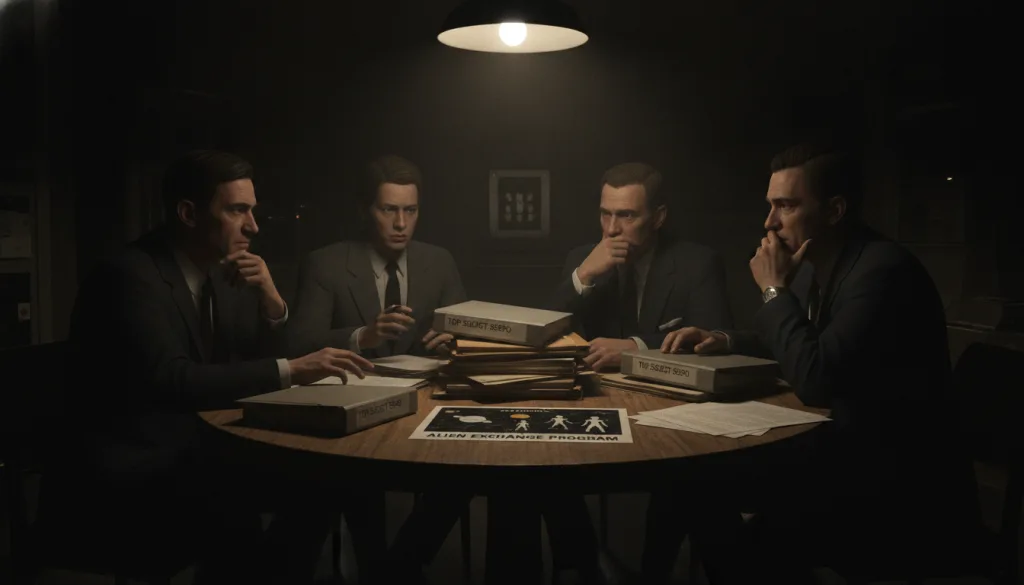
Project Serpo, often cited as one of the most intriguing and enigmatic chapters in the saga of UFO lore, emerged from the shadows of military secrecy in the early 2000s. Specifically, its roots can be traced back to the 1970s, when it was purportedly a top-secret initiative aimed at facilitating an exchange program between the United States and extraterrestrial beings from the Zeta Reticuli star system. This program allegedly involved the transfer of both personnel and technology, a narrative that captivated UFO enthusiasts and conspiracy theorists alike.
Key Figures and The Whistleblower
The claims surrounding Project Serpo were largely popularized by a man named Anonymous, who identified himself as a former military officer involved in the project. In 2005, he began sharing his story on the internet through a series of posts on the discussion forum known as the "Serpo" Project. His accounts suggested that in 1965, a group of 12 American military personnel were sent to the alien planet Serpo, which is located in the Zeta Reticuli system. According to Anonymous, this exchange was the result of a long-standing agreement formed after a 1947 incident in Roswell, New Mexico, that involved the crash of an extraterrestrial craft.
Anonymous claimed that the mission lasted a decade, with the team experiencing the alien culture and technology firsthand. Their return to Earth was said to be fraught with challenges, including difficulty adjusting back to life on Earth after their interstellar journey.
The Alleged Experiments and Cultural Exchange
According to the testimonies attributed to Project Serpo participants, the Americans were hosted by a race of beings referred to as the "Ebens." These aliens were described as humanoid in appearance, yet distinctly different in features, with large heads and dark eyes. The Serpo narrative includes detailed accounts of the Ebens' advanced technology, including their spacecraft, which supposedly ran on a form of energy unknown to humanity. The implications of such technology, had they been verified, could potentially transform our understanding of physics and engineering.
Contradictions in the Narrative
Despite the tantalizing details, the authenticity of the Project Serpo narrative has been met with skepticism from various quarters. Prominent investigators such as Philip J. Corso, who authored “The Day After Roswell” in 1997, and Richard Dolan, a noted UFO researcher, have raised concerns regarding the lack of physical evidence and verifiable documentation to support the claims made by Anonymous. Corso emphasized the need for hard evidence in uncovering truths related to extraterrestrial interactions, stating in 1997:
"For every story of UFO encounters or alien technology, there must be a foundation of credible evidence. Otherwise, we are merely indulging in speculation." — Philip Corso, 1997
This highlights a crucial point of contention: without tangible evidence, stories such as those from Project Serpo teeter on the brink of myth and reality.

Government Response and Classified Documents
As Project Serpo gained traction, the U.S. government's involvement (or lack thereof) became a focal point of dissection. The National Security Agency (NSA) and Central Intelligence Agency (CIA) have historically been embroiled in controversies regarding classified documents related to UFOs. In 2011, the CIA released a cache of documents in response to Freedom of Information Act requests, which included reports on unidentified aerial phenomena. However, these did not directly address the Project Serpo claims.
The government's silence on Project Serpo has only fueled speculation. The absence of direct denial or acknowledgment from federal agencies leaves a vacuum filled by conjectures and interpretations from UFO enthusiasts. Some assert that the lack of transparency is indicative of a broader cover-up involving extraterrestrial encounters. The infamous “Majestic 12” documents, which surfaced in the late 1980s and purportedly outline a secret committee formed to investigate UFOs, have added to the mystique surrounding the U.S. government's clandestine activities related to aliens.
The Role of the Internet in Propagating the Myth
The advent of the internet played a pivotal role in the dissemination of Project Serpo's narrative. Within a few years, countless forums, blogs, and websites dedicated to UFO research proliferated, allowing individuals to share stories and theories about the alleged exchange program. This digital community became a double-edged sword: while it facilitated the spread of information, it also created an echo chamber where unfounded claims could proliferate without challenge.
Critical Examination of the Testimonies
Analyzing the testimonies and narratives around Project Serpo requires a rigorous approach. The details provided by Anonymous and others are often laden with inconsistencies and emotional appeals that, while engaging, lack the empirical support necessary for validation. For instance, the description of the Eben technology has been criticized for its vagueness, relying on speculative concepts rather than concrete scientific principles.
Key Questions Unanswered
Several key questions remain unanswered. For instance, if such an exchange program existed, why has no physical evidence surfaced to corroborate the accounts? Why did no independent witnesses emerge to support the claims of the 12 military personnel? These questions are critical in evaluating the credibility of the entire narrative. Furthermore, the claims made in the Project Serpo accounts are often anecdotal, lacking the rigorous documentation typically associated with military operations and scientific missions.
Notre analyse : The evidence strongly indicates that while Project Serpo may have captured the imagination of many, it is primarily a product of storytelling rather than fact. The lack of verifiable evidence, combined with the numerous inconsistencies within the accounts, suggests that this narrative has more in common with urban legends than with the rigorous scientific inquiry expected in the realm of UFO research. Consequently, while we should remain open to the mysteries of the cosmos, we must also practice discernment when engaging with sensational claims.Sources & References
Corso, Philip J., The Day After Roswell, 1997, HarperCollins.
Ramey, Robert, “Project Serpo: The Story Behind the Story,” 2007, UFO Magazine.
National Security Agency, “UFOs and the Intelligence Community,” 2011, NSA.
Dolan, Richard, UFOs and the National Security State, 2000, Keyhole Publishing.





Comments 0
Be the first to comment!