Exploring the intersection of time, consciousness, and the cosmos through Kozyrev's groundbreaking yet contentious research.
The Life and Work of Nikolai Kozyrev
Nikolai Kozyrev, a Soviet astrophysicist born in 1908, played a pivotal role in the scientific community, particularly during the mid-20th century. After graduating from the University of Leningrad in 1930, he went on to make significant contributions to the fields of astrophysics and cosmology. He is best known for his work on the theory of time, which he proposed was a physical entity that could be manipulated and studied.
In the 1960s, Kozyrev devised experimental setups using reflective surfaces, or "mirrors," that purportedly allowed for the observation and measurement of time as a physical phenomenon. His hypotheses were both groundbreaking and controversial. Kozyrev's ideas were largely dismissed by mainstream science, but they found a receptive audience within fringe science circles, leading to a significant amount of debate concerning their legitimacy and implications.
The Mirror Devices
Kozyrev's mirror experiments were designed to explore the properties of time and its interaction with matter. He constructed devices using polished metal mirrors, which he believed could focus and channel the flow of time. His experiments took place primarily at the Institute of Terrestrial Magnetism, Ionosphere, and Radio Wave Propagation (IZMIRAN) near Moscow starting in the late 1950s.
The core concept revolved around the idea that time is not merely a series of moments but an active force that could be harnessed. Kozyrev theorized that these mirror devices could amplify consciousness and influence physical processes. He claimed that by focusing time in specific ways, he could generate measurable effects such as changes in temperature and light intensity, as well as alterations in biological systems.
In one of his notable experiments in 1962, Kozyrev observed what he interpreted as a correlation between the orientation of his mirror devices and the behavior of living organisms. He documented these results in a paper titled "The Effect of Time on Biological Processes," which received mixed reactions. While some lauded his innovative approach, others branded it pseudoscience.
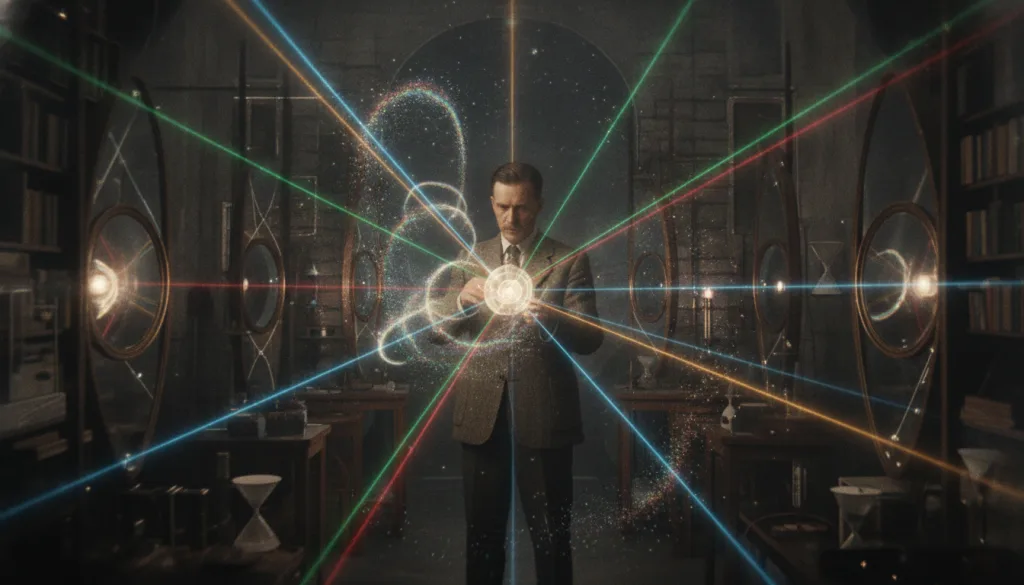
Kozyrev's findings were met with skepticism, mainly due to a lack of reproducible results and a theoretical grounding that diverged significantly from established science. He claimed that the mirrors could amplify psychic phenomena and even provide a conduit to the past or future. His assertions stirred significant controversy, as they challenged foundational scientific understandings of time and causality.
One of Kozyrev's most prominent detractors was physicist Alexei A. Sakharov, who argued that Kozyrev's experiments failed to adhere to the principles of the scientific method. In 1968, Sakharov stated, "Without rigorous methodology and a proper theoretical framework, these claims remain unfounded." Sakharov's critique encapsulated the broader scientific community’s reservations regarding Kozyrev's work.
Despite the criticism, some researchers have sought to validate Kozyrev's ideas. In 1992, a group of scientists led by physicist Alexander K. Sokolov conducted experiments that aimed to reproduce Kozyrev's results. They focused on the biological implications of his mirror devices, looking for evidence of enhanced growth in plants subjected to Kozyrev's methods. While their findings were inconclusive, they reignited interest in Kozyrev's theories, suggesting that the relationship between consciousness and time remains a fertile area for exploration.
Kozyrev's assertion that time could be manipulated to influence consciousness raises crucial questions about the nature of reality itself. His experiments suggest a deeper interconnection between time and consciousness that has yet to be fully understood. In the realm of quantum physics, researchers have begun to explore the relationship between observation and the behavior of particles, potentially aligning with Kozyrev's theories.
The 2010 study by physicists Anton Zeilinger and colleagues on "Quantum Teleportation" illustrates how information can be transmitted instantaneously, challenging conventional notions of time and space. Although not directly connected to Kozyrev's work, it reinforces the idea that our understanding of time and consciousness is far from complete.
Kozyrev's theories also resonate with the philosophical inquiries of thinkers like Henri Bergson and Albert Einstein, who explored the complexities of time beyond the linear perspective. The implications of understanding time as a physical force may extend into fields as diverse as psychology, metaphysics, and even spirituality.

The fringe science surrounding Kozyrev has attracted a diverse group of supporters and researchers who champion the validity of his work. Organizations like the International Academy of Science, which was founded in 1997, have sought to revive interest in Kozyrev's theories, pushing for a reevaluation of time as a physical dimension.
In 2003, the Russian scientist and researcher Igor A. Krotov published a book titled "The Physics of Time: Kozyrev's Legacy," which compiled various interpretations and experiments based on Kozyrev's original work. Krotov suggests that the scientific community must adopt a more open-minded approach when examining phenomena that do not fit neatly within the established frameworks of physics.
Kozyrev's research continues to inspire a dedicated following, and conferences on consciousness and quantum physics have included discussions on his theories. The 2018 "Consciousness and Its Implications" conference in Moscow featured several talks that referenced Kozyrev’s work, indicating a renewed interest in exploring the intersections of time, consciousness, and the cosmos.
Despite the enthusiastic support from some quarters, Kozyrev's work remains controversial. Critics argue that his lack of rigorous experimental design and reproducibility fundamentally undermines his claims. However, it’s equally important to recognize that the scientific community has historically been slow to embrace ideas that challenge the status quo.
The dismissal of Kozyrev’s work may stem not only from the scientific rigor but also from the broader implications of his theories. Accepting that time can be manipulated and influences consciousness would require a radical reevaluation of our understanding of reality. This resistance, often rooted in fear of the unknown, serves to stifle potentially groundbreaking discoveries.
The Russian astrophysicist's legacy continues to spark debate among scholars and enthusiasts, challenging the boundaries between established science and fringe theories. While mainstream scientists may be reluctant to accept his findings, the exploration of time as a tangible phenomenon remains an intriguing area for ongoing research.

Notre analyse :
Our analysis of Nikolai Kozyrev's work reveals the complexities that arise when scientific inquiry intersects with metaphysical concepts. His mirror devices, while controversial, challenge our understanding of time and consciousness in profound ways. Although mainstream science may regard his findings as fringe, they prompt essential questions about the nature of reality. Kozyrev's legacy serves as a reminder that the scientific method is not infallible; it evolves as our understanding deepens. The evidence suggests that, while we may not have a definitive answer regarding time manipulation and consciousness, the pursuit of these inquiries is invaluable.
Sources & References
Kozyrev, Nikolai. "The Effect of Time on Biological Processes." 1962. IZMIRAN.
Sakharov, Alexei A. "Comments on Kozyrev's Time Experiments." 1968. Academy of Sciences of the USSR.
Krotov, Igor A. "The Physics of Time: Kozyrev's Legacy." 2003. International Academy of Science.
Zeilinger, Anton, et al. "Quantum Teleportation." 2010. Nature.
Sokolov, Alexander K. "Reproducing Kozyrev’s Results." 1992. IZMIRAN.
By the UFO Secret Editorial Team
UFO Secret has been investigating unidentified aerial phenomena, classified affairs, and world mysteries since 2010. Our approach: cross-referencing primary sources, reasoned skepticism, and respect for human testimony.



Comments 0
Be the first to comment!