From Tic Tacs to Ghosts: Deconstructing the Eyewitness Accounts that Changed the UAP Conversation
For decades, reports of unidentified flying objects (UFOs) were often relegated to the fringes of public discourse, frequently met with skepticism, ridicule, or outright dismissal. Witnesses, no matter how credible, often faced the dilemma of speaking out and risking their professional reputations. However, in recent years, a significant shift has occurred, largely driven by the compelling, consistent, and remarkably candid testimonies of military pilots and radar operators. These highly trained observers, operating sophisticated equipment, have brought a new level of credibility to the discussion of what are now more commonly referred to as Unidentified Aerial Phenomena (UAPs). Their accounts, often corroborated by multiple sensors and personnel, have forced governments and scientific institutions to take a closer, more serious look at objects exhibiting performance characteristics beyond any known conventional technology.
The history of military encounters with unexplained aerial phenomena is not new. From the "Foo Fighters" reported by Allied pilots during World War II to the numerous incidents documented during Project Blue Book, military personnel have consistently been at the forefront of such sightings. Yet, these historical cases often lacked the multi-sensor corroboration and the willingness of high-ranking personnel to speak openly that characterize the modern era. The recent wave of revelations began gaining significant traction in 2017, when the New York Times published an article detailing a secretive Pentagon program investigating UAPs and featuring the testimonies of naval aviators. This marked a watershed moment, pulling the topic from the shadows of conspiracy theories into the realm of legitimate national security concern.
The Nimitz Incident: A Defining Moment
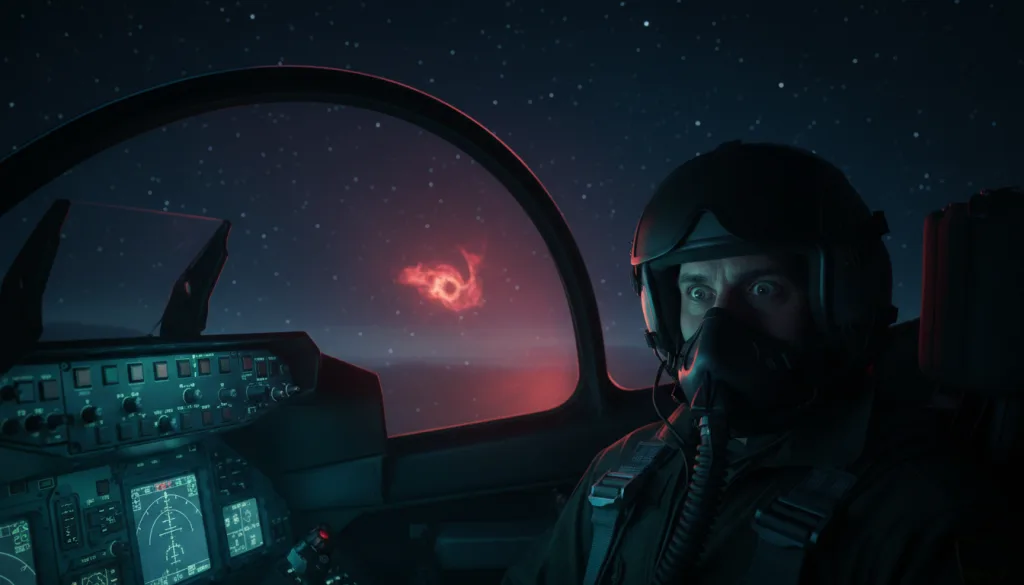
Perhaps the most prominent and widely discussed military encounter involves the USS Nimitz Carrier Strike Group off the coast of Baja California in November 2004. Multiple F/A-18 Super Hornet pilots, including Commander David Fravor and Lieutenant Commander Alex Dietrich, encountered an object described as a "Tic Tac" – a white, oblong, wingless vehicle, approximately 40 feet long, with no visible propulsion or exhaust plume. These encounters were not fleeting glimpses; they involved sustained observation, attempts at interception, and corroboration across multiple platforms.
Commander Fravor, a seasoned pilot with extensive combat experience, described the object's erratic movements: "It accelerated like nothing I've ever seen." During one intercept attempt, as Fravor descended towards the object, it mirrored his movements before rapidly accelerating away, disappearing in an instant. This maneuverability, coupled with the lack of conventional propulsion, defied known aerodynamic principles. Lieutenant Commander Dietrich, flying in Fravor's wing, corroborated his account, emphasizing the object's ability to demonstrate "impossible physics." The encounter was further supported by radar operators on the USS Princeton, who had been tracking multiple "anomalous aerial vehicles" for days, descending from 80,000 feet to hover just above the ocean surface before ascending again at incredible speeds.
Crucially, the Nimitz incident also involved the FLIR (Forward-Looking Infrared) video, captured by Commander Chad Underwood, another pilot from the Nimitz group. While Underwood did not visually see the "Tic Tac," his ATFLIR pod locked onto a heat signature that moved in ways inconsistent with any known aircraft. This video, along with the "Gimbal" and "GoFast" videos released by the Pentagon, became iconic representations of the UAP phenomenon, demonstrating that these were not merely visual illusions but objects detected by advanced military sensors.
More Testimonies and the East Coast Encounters
The Nimitz encounter was not an isolated incident. Following the increased openness, other pilots began to share their experiences. Lieutenant Ryan Graves, a former F/A-18 Super Hornet pilot, along with other pilots from VFA-11 "Red Rippers" squadron, reported consistent sightings of UAPs off the East Coast of the United States between 2014 and 2015. These objects, often described as dark cubes inside clear spheres, were observed daily, operating in restricted airspace near Virginia Beach. They would fly against prevailing winds, hover motionless for hours, and accelerate to hypersonic speeds, all without any visible means of propulsion or flight surfaces.
Graves emphasized the sheer duration and frequency of these sightings. "We were seeing these things on a daily basis for over two years," he stated, highlighting the national security implications of unknown craft operating with impunity in sensitive training areas. These accounts were supported by radar data and corroborated by multiple pilots and intelligence personnel. The objects were sometimes detected on radar at altitudes up to 30,000 feet, performing maneuvers impossible for conventional aircraft.
What unites these military testimonies is a consistent description of UAPs exhibiting characteristics that challenge our current understanding of physics and aerospace engineering. Pilots frequently report:
- Extreme Maneuverability: Instantaneous acceleration, sudden stops, turns at angles and G-forces that would disintegrate conventional aircraft or their occupants.
- Hypersonic Speeds: Traveling at speeds far exceeding modern jet fighters, often transitioning from stationary to extreme velocity in seconds.
- Lack of Visible Propulsion: No wings, rotors, exhaust plumes, or any discernible means of lift or thrust.
- Trans-Medium Travel: Some accounts suggest objects seamlessly transitioning from air to water, moving underwater at incredible speeds without cavitation.
- Operating at Extreme Altitudes: From sea level to the edge of space, demonstrating superior altitude capabilities.
- Signature Suppression: Often difficult to track on radar, sometimes appearing and disappearing from sensors without explanation.
The Shift in Official Stance and De-Stigmatization
The weight of these testimonies, combined with the release of declassified videos and official reports, has led to a dramatic shift in how governments approach UAPs. The Pentagon established the Unidentified Aerial Phenomena Task Force (UAPTF) in 2020, later replaced by the All-domain Anomaly Resolution Office (AARO) in 2022. These initiatives are designed to standardize the collection, analysis, and reporting of UAP incidents across the U.S. military and intelligence communities. The emphasis has moved from proving or disproving extraterrestrial origins to identifying potential threats to national security and aviation safety.
This institutional shift has been crucial in de-stigmatizing the topic. Military personnel are now encouraged, rather than discouraged, to report UAP sightings. This official recognition has given pilots the confidence to speak more openly, contributing to a growing body of credible, firsthand accounts. Senator Marco Rubio, among others, has stressed the importance of taking these reports seriously, not for sensationalism, but for genuine national security concerns. The focus is no longer on "little green men" but on "what's flying in our airspace that we don't know about."
Skeptical Considerations and Alternative Explanations
While the pilots' testimonies are compelling, a balanced perspective requires acknowledging the inherent difficulties in interpreting fleeting, high-stress encounters. Skeptical analyses offer several alternative explanations that warrant consideration:
- Sensor Anomalies: Camera artifacts, reflections, atmospheric conditions, or even equipment malfunctions can sometimes create deceptive images on radar or infrared systems. The "Gimbal" video, for instance, has been analyzed by some as a jet engine exhaust plume creating an optical illusion.
- Misidentification of Known Objects: Pilots, even highly trained ones, can misidentify conventional aircraft, drones, weather balloons, or natural phenomena under certain conditions, especially at high speeds or unusual angles.
- Atmospheric Phenomena: Unusual weather patterns, mirages, or unique lighting conditions can create bizarre visual effects that might be misinterpreted as solid objects.
- Advanced Adversary Technology: While many pilots dismiss this due to the objects' performance characteristics, some UAPs could theoretically represent highly classified, experimental aircraft or drones from foreign powers. However, the consistent "impossible physics" described often makes this explanation difficult to reconcile.
- Cognitive Biases: Human perception is fallible. Stress, expectations, and the limitations of the human eye can influence how an event is perceived and recalled.
It is important to note that "unidentified" does not automatically equate to "extraterrestrial." The term simply signifies that the object or phenomenon cannot be immediately identified or explained using available data. Many military UAP reports are eventually resolved as balloons, drones, or other conventional objects. However, a significant percentage remains unexplained, and it is these truly anomalous cases that continue to baffle and intrigue.
The Undeniable Impact of Pilot Testimony
Despite the valid skeptical considerations, the collective testimony of military pilots has undeniably been a game-changer. These individuals are not only highly trained observers but also operate within a rigorous chain of command where precision and accuracy are paramount. Their willingness to come forward, often at risk to their careers, lends significant weight to their accounts. Furthermore, many of these incidents involve multi-sensor corroboration—visual, radar, infrared—making it harder to dismiss them as isolated perceptual errors.
The fact that the U.S. government, through entities like AARO, is now actively collecting and analyzing this data underscores the seriousness of these reports. The conversation has shifted from speculation to data collection and analysis, driven by the credible experiences of those who operate at the forefront of national defense. What military pilots really saw in the skies remains, in many cases, a profound mystery. But their courage in speaking out has ensured that these mysteries are no longer ignored, but instead are now subject to legitimate inquiry, opening a new chapter in our understanding of what might be operating in our shared airspace.
The journey from ridicule to legitimate investigation has been long, but the consistent, detailed, and often bewildering accounts from military aviators have been the primary engine of this change. As more data is collected and analyzed, the hope is that these "unidentified" phenomena will eventually yield their secrets, whether they prove to be advanced human technology, natural phenomena yet to be fully understood, or something far more extraordinary.



Comments 0
Be the first to comment!