Exploring the potential for life forms that challenge our water-centric understanding of biology.
The Limitations of Carbon-Based Life
For decades, the search for extraterrestrial life has centered around the assumption that water is the primary solvent for biological processes. This water-centric view, while grounded in our own experiences on Earth, may inhibit the potential discovery of alien life forms that do not conform to terrestrial standards. Professor Steven Benner from the Westheimer Institute of Science and Technology has been a vocal advocate for expanding our understanding of potential biochemistries. In a 2017 paper published in the journal Astrobiology, he posited that life could just as easily be based on silicon, ammonia, or methane instead of carbon, challenging the prevailing dogma that has dominated astrobiology for centuries.
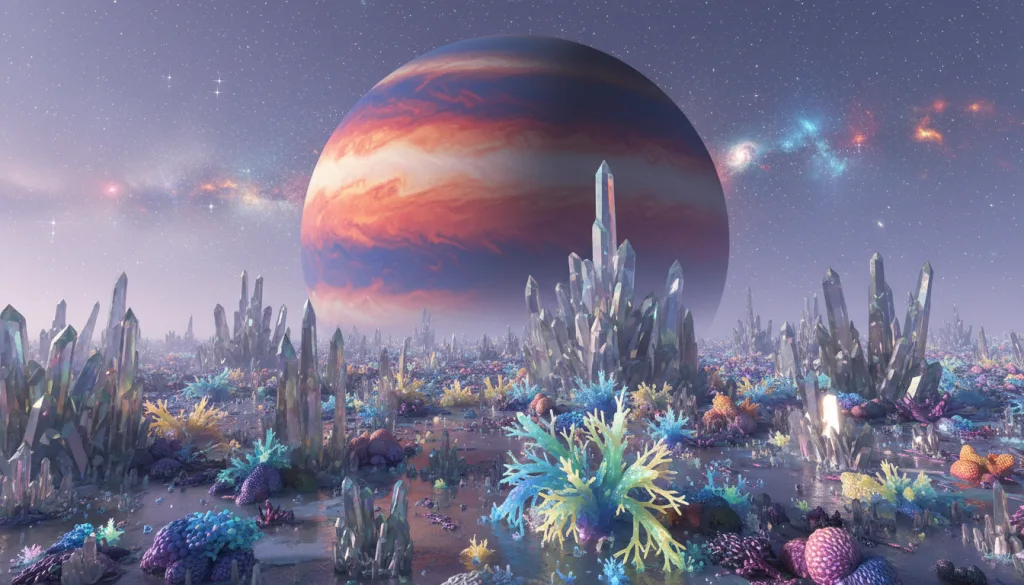
Carbon has long been the backbone of terrestrial life due to its unparalleled ability to form stable bonds with a variety of elements, facilitating complex molecules like proteins and nucleic acids. Yet, silicon, the second most abundant element in the universe, offers a compelling alternative. In 2018, a team led by chemist Alexandra Cousteau at the European Space Agency proposed that silicon-based life forms could thrive in environments where carbon-based life would struggle to survive, such as the high-temperature atmospheres of gas giants.
The Case for Silicon Life
Silicon, with its four valence electrons, can form complex molecules similar to carbon. It can create silanes that could potentially serve as the structural components of hypothetical silicon-based life. In a 2019 study by astrobiologist Dr. Lisa Kaltenegger at Cornell University, she explored the implications of silicon-based organisms existing in high-silica environments, such as the crusts of rocky exoplanets. Kaltenegger’s research suggests that silicon-based life forms might operate under different metabolic processes, utilizing silicon dioxide as a primary energy source, akin to how plants use photosynthesis.
However, silicon's ability to form stable compounds diminishes in the presence of water, which poses challenges for the types of environments where silicon-dominated life could thrive. For instance, the planet Venus, with its high surface temperatures and sulfuric acid clouds, becomes a prime candidate for hosting silicon-based organisms. The extreme conditions may allow for unique biochemical processes that differ vastly from those on Earth. Findings from the 2020 Parker Solar Probe mission indicated that Venus's atmosphere contains phosphine, a potential biosignature that could hint at life based on non-carbon biochemistry, further complicating the narrative of Venus as a barren world.

Ammonia as a Solvent for Life
Another solvent that has ignited the imagination of scientists is ammonia. Ammonia remains in a liquid state at lower temperatures compared to water, expanding the potential for life to exist in colder environments. A seminal study conducted by physicist Richard B. Setlow in 1974 examined the biochemical properties of ammonia as a solvent for biochemical reactions. Setlow suggested that ammonia could support complex organic chemistry, including the formation of nitrogen-rich biopolymers in cold environments like the icy moons of Jupiter and Saturn.
Enceladus, one of Saturn's moons, has shown evidence of a subsurface ocean rich in ammonia and is often cited as a candidate for extraterrestrial life. NASA's Cassini spacecraft, which studied Enceladus from 2004 to 2017, discovered geysers of water vapor and organic compounds erupting from the moon's south pole. These findings, published in the journal Science in 2015, stirred discussions about potential ammonia-based organisms thriving in the moon's ocean, highlighting how diverse the concept of life can be beyond our carbon and water model.
The implications of ammonia-based life remind us of the limits of our understanding. Ammonia, while a poorer solvent than water, could enable biochemical reactions at lower temperatures and pressures, suggesting that life could exist in environments previously considered uninhabitable. Researchers such as astrobiologist Dr. Chris McKay at NASA Ames Research Center have proposed experiments to explore the viability of ammonia-based biochemistry, seeking to test how biological processes differ in ammonia-rich environments.

Methane Worlds and Their Potential
Methane, particularly in its liquid form, also holds promise for hosting life. Titan, Saturn's largest moon, has long fascinated scientists with its dense atmosphere and lakes of liquid methane and ethane. In 2016, the European Space Agency's results from the Huygens probe confirmed the existence of liquid methane lakes on Titan. The data collected suggested the possibility of an exotic form of life that could utilize methane as a solvent for biochemical processes.
Research by astrobiologist Dr. Jason D. Wright from Penn State University indicates that if microbial life exists on Titan, it would have to adapt to extreme temperatures, as the surface temperature hovers around -290 degrees Fahrenheit. In a 2020 study published in The Astrophysical Journal, Wright emphasized that life on Titan would require biochemical adaptations vastly different from Earth’s life forms, possibly leading to methane-based metabolic pathways.
The implications of potential methane-based life expand our understanding of habitability. This research suggests that life might not only exist on the fringes of our solar system but could also thrive in the thick atmospheres of exoplanets orbiting distant stars. A 2021 study by Dr. Sara Seager at MIT examined exoplanet atmospheres, proposing that worlds with methane-rich environments could harbor ecosystems that rely on complex methane biochemistry, fundamentally altering our perceptions of life's requirements.
Astrobiological Implications and the Search for Extraterrestrial Life
The search for extraterrestrial life must evolve as our understanding of possible biochemistries expands. The current focus on planets within the "habitable zone"—where water can exist in liquid form—has dominated astrobiology, limiting the scope of potential discoveries. As highlighted by Dr. David Grinspoon, an astrobiologist at the Planetary Science Institute, the findings surrounding silicon, ammonia, and methane-based life challenge us to consider a wider array of environments where life might emerge.
For instance, the upcoming James Webb Space Telescope, set to launch in December 2021, aims to analyze the atmospheres of exoplanets for biosignatures. In a paper published in Astronomy & Astrophysics in 2020, scientists outlined potential strategies for detecting ammonia and methane in exoplanet atmospheres, which could yield signs of non-water-based life. The telescope's ability to analyze light absorption signatures will open new avenues for identifying chemical markers that hint at alien biology.
The implications of these studies are profound. By broadening our criteria for habitability, humanity prepares itself for the surprising realities that await in the cosmos. The discovery of life, whether silicon, ammonia, or methane-based, would challenge existing scientific paradigms and offer a glimpse into the myriad possibilities that exist beyond our planet.
Conclusion: Broadening the Search for Life
The evidence strongly suggests that life may not exclusively depend on carbon or water. The exploration of alternative biochemical pathways, including silicon, ammonia, and methane-based organisms, allows for a richer understanding of the cosmos. As researchers like Dr. Kaltenegger and Dr. Wright continue to investigate the potential for life in extreme environments, our quest for understanding the universe’s biological diversity is only beginning.
As our technologies and methodologies advance, humanity stands at the precipice of discovering life forms that defy our current imagination. The very essence of what it means to be alive, the biochemical frameworks that underpin existence, may be far more diverse than we can currently comprehend. The search for extraterrestrial life has only just begun, and the potential for uncovering alien organisms based on silicon, ammonia, or methane could finally reveal the complex tapestry of life that exists beyond the confines of Earth.





Comments 0
Be the first to comment!