Exploring the complex interplay between time, quantum physics, and the tantalizing concept of time travel.
Theoretical Foundations of Time Travel
Time travel has captivated the human imagination for centuries, transcending the realms of science fiction into the discussions of leading physicists. Albert Einstein’s theories of relativity have served as the bedrock for these explorations. His 1915 General Theory of Relativity introduced the concept that time is not a constant but rather a flexible dimension that can be affected by velocity and gravitational fields. According to Einstein, time can stretch or contract based on an object's speed and proximity to massive celestial bodies.
In 1970, physicist Kip Thorne proposed the concept of wormholes, theoretical passages through spacetime. These wormholes could potentially allow for shortcuts between distant points in time and space. Thorne's work, highly influenced by Einstein's equations, detailed mechanisms that might allow for a traveler's journey to the past or future. His research, published in various journals, laid the groundwork for serious scientific inquiry into time travel, moving it beyond mere speculation.
Quantum Mechanics and Time Travel Paradoxes
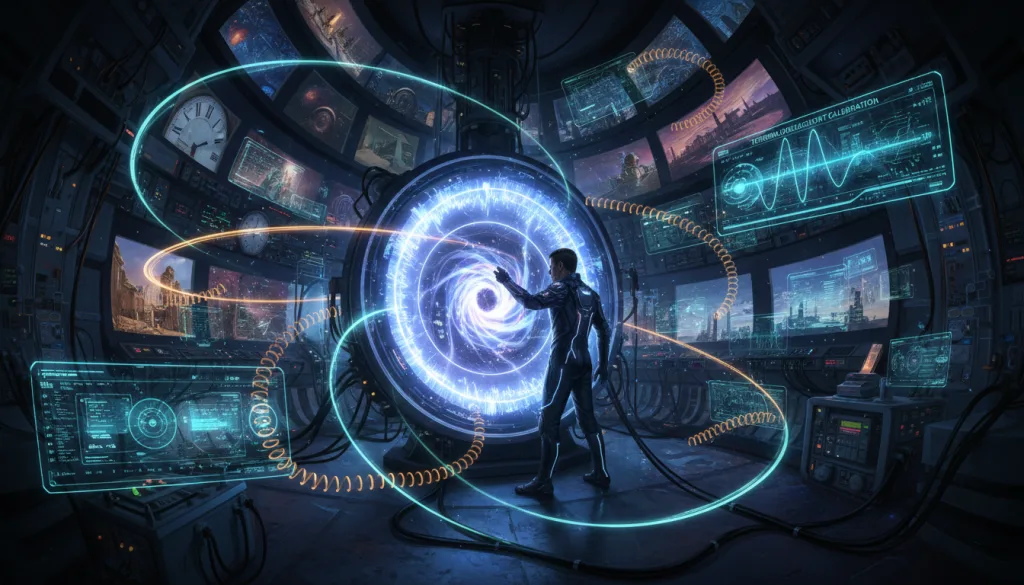
The implications of quantum mechanics further complicate the discussion of time travel. In 1982, Alain Aspect conducted experiments in Paris that tested the principles of quantum entanglement, revealing that particles can be interconnected even at vast distances. This raised questions about the flow of time at a quantum level. The famous "grandfather paradox," where a time traveler could potentially prevent their grandfather from meeting their grandmother, challenges our understanding of causality. If time is not linear and can branch into alternate timelines, as suggested by some interpretations of quantum mechanics, time travel could theoretically exist without paradoxes.
In the early 1990s, physicist David Deutsch, a pioneer in the field of quantum computing, proposed the idea of a multiverse, suggesting that every decision creates a new universe. According to this theory, time travelers could navigate to alternate realities, avoiding the paradoxes that plague traditional time travel theories. Deutsch's work at the University of Oxford sparked further research into how quantum mechanics might permit time travel under the right conditions.
Experimental Evidence and Technological Prospects
While the theoretical foundations for time travel are compelling, the experimental evidence is limited. However, advancements in technology have begun to push the boundaries of what might be possible. Recent developments in particle physics, particularly at CERN’s Large Hadron Collider, have allowed scientists to investigate exotic particles known as tachyons, which, according to theoretical physics, could travel faster than light. In 2011, researchers at CERN reported the first evidence of neutrinos traveling faster than light, although subsequent investigations revealed that this result was due to a measurement error. Nevertheless, the pursuit of understanding exotic particles continues to inspire interest in time-related phenomena.
Additionally, in 2021, researchers from the University of Massachusetts Amherst revealed a method to create time crystals, structures that maintain a stable state over time by moving in a periodic motion. This groundbreaking experiment, published in *Nature*, offers a glimpse into how temporal concepts can manifest physically. Time crystals open new avenues for understanding the relationship between time and thermodynamics, potentially leading to future innovations in computing and energy that could reshape our understanding of time itself.
The Philosophical Implications of Time Travel
Time travel does not merely rest on the shoulders of physics; it also invites philosophical inquiry. The discussions surrounding time travel intersect with concepts of consciousness and existence. The late physicist Stephen Hawking famously proposed the "chronology protection conjecture" in 1992, suggesting that the laws of physics prevent paradoxes associated with time travel. Essentially, Hawking posited that time travel to the past would be impossible, preserving the integrity of cause and effect within the universe.
Philosopher David Lewis expanded the discussion by suggesting the existence of branching timelines where every possible event occurs in a different universe. His 1976 work “On the Plurality of Worlds” offered a lens through which to view time travel not just as a physical journey but as a metaphysical exploration of reality. This raises profound questions about identity, morality, and the nature of existence itself. If one could journey back in time, who would they be? Would choices made in a different timeline affect the original timeline? These inquiries reveal that time travel is as much about understanding the self as it is about understanding physics.
Consciousness and Time Perception
Adding another layer to this intricate tapestry is the role of human consciousness in perceiving time. Cognitive scientists like Barbara Tversky have examined how humans construct mental models of time and space. Tversky’s findings emphasize that our perception of time can differ based on context, activity, and even emotions. The relationship between consciousness and time is a significant area of exploration in both neuroscience and philosophy.
In 2017, a groundbreaking study published in *Nature Neuroscience* by researchers at the University of California, Berkeley, demonstrated that the brain encodes time in a way that may allow for subjective “time travel” through memories. Participants in the study reported vivid recollections that felt temporally displaced, suggesting that within our minds, we can revisit experiences, effectively moving backward in time. This psychological aspect of time travel emphasizes that while physical time travel remains theoretical, our consciousness often traverses timelines, blurring the lines between past, present, and future.
The Future of Time Travel Research
As we stand on the brink of the unknown, the future of time travel research is as uncertain as it is exhilarating. Theoretical and experimental physicists continue to probe the edges of our understanding, seeking answers to age-old questions that challenge both science and philosophy. The ongoing research into wormholes, quantum entanglement, and the intricacies of consciousness suggests that while practical time travel may still reside within the realm of speculation, the pursuit of knowledge in this area is far from over.
Institutions like the Massachusetts Institute of Technology and Stanford University are leading cutting-edge research in quantum physics, with scholars like Seth Lloyd and Leonard Susskind contributing to our understanding of time within quantum mechanics. Their collaborative efforts seek to unravel the complexities of time while simultaneously challenging traditional conceptions of reality.
The evidence strongly suggests that while time travel as depicted in popular culture may remain elusive, the underlying theories and ongoing research provide a rich tapestry of inquiry. As scientists unravel the mysteries of the universe, they inch closer to understanding not only the nature of time but also our relationship with it. The vastness of what we have yet to explore invites further investigation into one of science's most profound questions.



Comments 0
Be the first to comment!