Unraveling the mysteries of advanced ancient technologies that challenge our understanding of history.
The Antikythera Mechanism: A Glimpse into Ancient Genius
The Antikythera Mechanism, discovered in 1901 in a shipwreck off the coast of the Greek island of Antikythera, stands as a testament to the advanced technological capabilities of the ancient Greeks. With its intricate gear system, this device is often referred to as the world’s first analog computer. Dated to around 150-100 BC, its purpose was to predict astronomical positions and eclipses for calendrical and astrological purposes.
Technical Specifications and Implications
Comprising at least 30 meshing bronze gears, the Antikythera Mechanism is not only a marvel of engineering but also a symbol of lost knowledge. The complexity of these gears—some measuring just a few millimeters—indicates a level of craftsmanship that was previously thought to be unattainable until the Renaissance. Recent studies, including a detailed analysis conducted by researchers from Cardiff University in 2006, have shown that the mechanism operated with a precision that would not be replicated until the development of clockwork technology in medieval Europe.
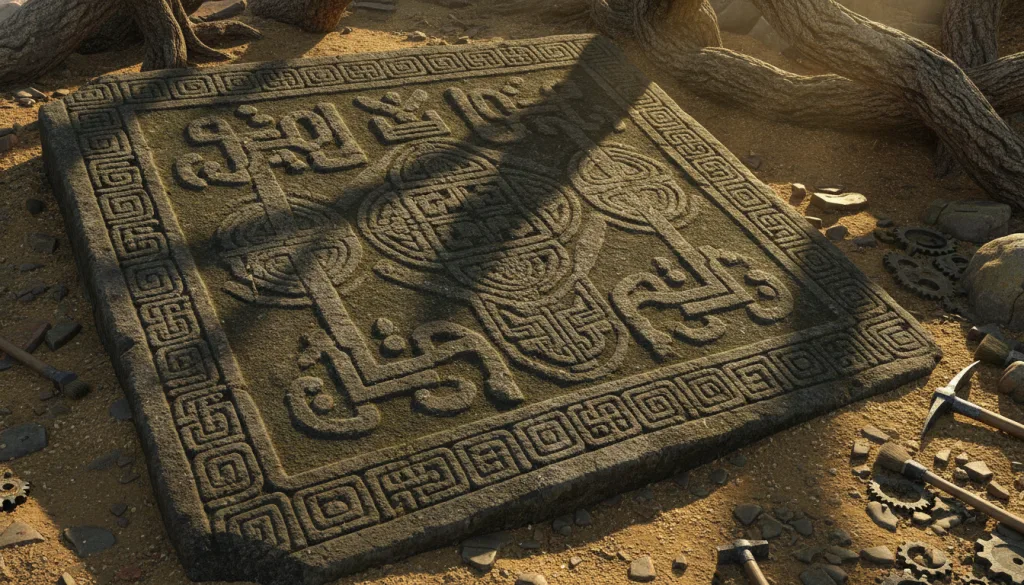
“The Antikythera Mechanism reveals that ancient civilizations possessed knowledge of celestial mechanics that we are only beginning to understand.” — Dr. Tony Freeth, 2006
As such, the Antikythera Mechanism forces us to reconsider the capabilities of ancient societies. They were not the primitive cultures often depicted in mainstream narratives but were instead advanced societies with complex understanding of the world around them. This artifact raises critical questions: What other technologies have been lost to time? And how did such advanced knowledge vanish from human history?
Ancient Egyptian Tools: Precision Beyond Their Time
In their construction of the Great Pyramid of Giza around 2560 BC, the ancient Egyptians exhibited engineering prowess that continues to astound scholars. The pyramid, originally standing at 146.6 meters, utilized an estimated 2.3 million blocks of stone, many weighing more than 2.5 tons each. The precision with which these stones were cut and fitted together—many with tolerances of just a fraction of a millimeter—is a clear indication of sophisticated tools and techniques.
Theories on Tool Usage
While Egyptologists primarily suggest the use of copper tools and basic levers for construction, evidence points toward the possibility of advanced tools that remain undiscovered. The existence of granite quarries in Aswan, located over 800 kilometers away, raises the question of how the ancient Egyptians transported such massive stones. Some researchers, such as Dr. Mark Lehner, suggest that advanced hydraulic techniques might have been employed to move the stones across the desert.

Moreover, recent discoveries of ancient Egyptian drilling tools in the Valley of the Kings, dated to around 1500 BC, indicate the use of diamond-tipped drills. These findings, published in a 2015 report by the Journal of Archaeological Science, demonstrate that ancient Egyptians possessed technology centuries ahead of their time. Fortunately, many tools have been rediscovered through modern archaeology, but others remain hidden, waiting to be unearthed.
The Baghdad Batteries: Ancient Power Sources?
In 1938, a collection of artifacts was discovered near Baghdad, Iraq, believed to date back to the Parthian period (approximately 250 BC to 250 AD). Referred to as the "Baghdad Batteries," these clay pots contained a copper cylinder and an iron rod, leading many to speculate that they served as galvanic cells—an early form of battery. The implications are profound: if these artifacts were indeed batteries, they would suggest a level of electrical knowledge and application that defies conventional timelines.
Scientific Investigations and Controversy
The theory gained traction with researchers like Dr. Wilhelm Konig, who proposed in 1938 that they could have been used for electroplating techniques. However, much of the scientific community remains skeptical, arguing that their function is unclear and lacks conclusive evidence. Despite this, the 2000 study by Dr. David H. Levy in the journal ‘Electrochemical Society Transactions’ provides experimental validation of the battery hypothesis, demonstrating that similar constructions can indeed produce an electrical charge.

The controversy surrounding the Baghdad Batteries illustrates a critical point: the danger of dismissing ancient technologies as mere artifacts of superstition or primitive engineering. If these were indeed tools for harnessing electricity, what other forgotten technologies lie buried beneath the sands of time, waiting for rediscovery?
Stonehenge: More Than Just a Megalithic Structure
Stonehenge, located on the Salisbury Plain in Wiltshire, England, has captured the imagination of historians and archaeologists since its construction during the Neolithic period, around 3000-2000 BC. The arrangement of massive stone blocks, some weighing up to 25 tons, raises questions about the methods used for their transportation and erection. This site is not merely a monument but a complex array of astronomical alignments and possibly advanced engineering principles.
Advanced Tools or Lost Knowledge?
Recent research, such as the work by Professor Timothy Darvill and his team in 2021, suggests that the builders of Stonehenge possessed a sophisticated understanding of acoustics, geometry, and even basic physics. The precision with which the stones are arranged aligns perfectly with solstices and lunar events, indicating a purpose far beyond mere ritualistic significance. It is speculated that the construction techniques required tools that have yet to be discovered.

Furthermore, the presence of bluestones—originating from the Preseli Hills in Wales, over 200 kilometers away—raises the question of how ancient people transported these massive stones. Theories suggest that they may have employed sledges, water transport, and perhaps even some form of primitive cranes, although no definitive tools have been unearthed to support this hypothesis.
“Stonehenge represents a fusion of art and science, reflecting a sophisticated understanding of the natural world that we are still striving to understand.” — Professor Timothy Darvill, 2021
Ancient Chinese Technologies: The Compass and Beyond
China's ancient innovations have long been acknowledged; however, the extent of their technological advancements is often underestimated. The invention of the compass during the Han Dynasty (around 206 BC - 220 AD) revolutionized navigation, allowing explorers to travel vast distances across unpredictable seas. Further studies reveal that ancient Chinese texts hint at even more advanced technologies that are rarely discussed.
Possibilities of Advanced Tools
Among these innovations, the use of seismographs is particularly noteworthy. The first known seismoscope was invented by Zhang Heng in 132 AD, capable of detecting earthquakes hundreds of kilometers away. This device employed a bronze mechanism with a pendulum, and while the technology was crude by today’s standards, it demonstrated an advanced understanding of physics.

However, other potential tools and technologies mentioned in ancient texts remain unverified. For example, the ancient Chinese writings reference machines for lifting heavy objects and complex mechanisms for irrigation that could rival the tools we consider modern. These tantalizing glimpses into the past suggest that many of the technologies we attribute to later historical figures may have roots in ancient China.
Notre analyse :
The evidence presented here strongly indicates that ancient civilizations possessed a level of technological sophistication that has been largely overlooked or underestimated. Artifacts such as the Antikythera Mechanism and the Baghdad Batteries challenge the linear narrative of technological advancement, suggesting that knowledge is cyclical, often lost to the sands of time or deliberately obscured by prevailing cultural narratives. The implications of these revelations are significant: if our ancestors were capable of such innovations, what does that say about our understanding of history and our place within it?
Furthermore, the ongoing discoveries of ancient tools and potential technologies compel us to reconsider the sources of knowledge we often take for granted. As researchers continue to unearth artifacts that defy conventional explanations, the narrative of human achievement is ripe for reevaluation, suggesting that the echoes of our past may still resonate in the advanced technologies of our present.
Sources & References
Freeth, Tony, "The Antikythera Mechanism: The Story Behind the World's First Computer," 2006, Cardiff University.
Lehner, Mark, "The Complete Pyramids: Solutions to the Ancient Mysteries," 1997, Thames & Hudson.
Levy, David H., "Ancient Galvanic Cells: Evidence from Baghdad," 2000, Electrochemical Society Transactions.
Darvill, Timothy, "Stonehenge: The Story of a Sacred Site," 2021, Oxbow Books.
Konig, Wilhelm, "The Use of Batteries in Antiquity," 1938, Baghdad Museum Reports.






Comments 0
Be the first to comment!