Harnessing the sun's gravitational field opens new frontiers in exoplanet observation.
The Concept of Gravitational Lensing
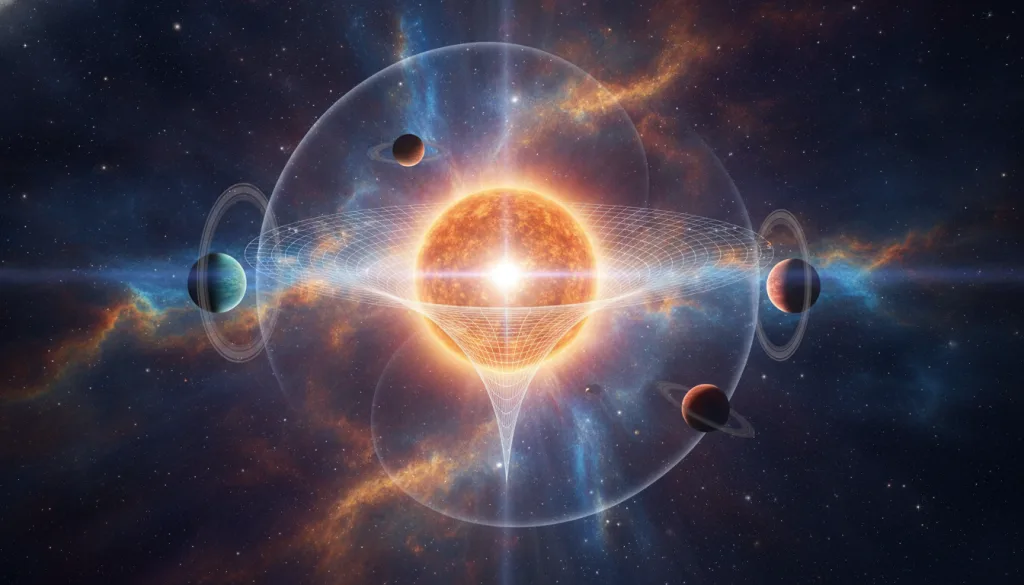
Gravitational lensing, a phenomenon predicted by Albert Einstein's General Theory of Relativity in 1915, occurs when a massive object, such as a galaxy or a star, distorts the space around it, causing light from more distant objects to bend around it. This bending effect can magnify and distort images of those distant objects, making them appear brighter and allowing astronomers to gather more detailed information than would otherwise be possible.
The Role of the Sun in Gravitational Lensing
The sun, as the closest massive object to Earth, offers a unique opportunity for gravitational lensing studies. By positioning an observatory far from the sun, astronomers can utilize its gravitational field to observe exoplanets that would otherwise remain undetectable. This technique could allow scientists to glimpse the atmospheres, compositions, and potential habitability of these distant worlds.
The Historical Context of Gravitational Lensing Observations
While the concept of gravitational lensing has been understood for over a century, its practical application for exoplanet observation is relatively recent. One landmark event occurred in 1979 when astronomers first confirmed the existence of gravitational lensing through the observation of a quasar, 2237+030, which appeared as a double image due to the gravitational field of a foreground galaxy.
However, the most significant strides toward using gravitational lensing for exoplanet detection began in the late 1990s. A pivotal moment was the announcement in 1996 of the discovery of the first exoplanet orbiting a sun-like star, 51 Pegasi b, by Michel Mayor and Didier Queloz. This discovery ignited a frenzy of research into various methods of exoplanet detection, including the application of gravitational lensing.
Key Studies and Current Techniques
In 2003, a study led by an international team that included renowned astrophysicists like Masaru Kato and David Spergel highlighted the potential of using gravitational lensing to observe distant exoplanets. The researchers proposed a method that involved strategically positioning a spacecraft in a location far from the gravitational pull of Earth, such as the L2 Lagrange point, approximately 1.5 million kilometers from our planet. At this point, the gravitational effects of the sun could act as a giant lens.
Their findings indicated that such a setup could significantly boost the visibility of Earth-like exoplanets in the habitable zones of distant stars. They argued that this method could afford scientists the ability to analyze the atmospheric conditions of these planets, a feat that traditional detection methods could not achieve.
Recent Advances in Technology and Methodology
One of the most exciting developments in this field occurred in 2019 when the European Space Agency (ESA) proposed the "Lynx" mission, designed to utilize gravitational lensing for deep-space observations. The Lynx mission aims to detect and study exoplanets by leveraging the sun's gravitational field, employing highly sensitive instruments developed at the Max Planck Institute for Astronomy in Heidelberg, Germany.
This mission is set to specifically target Earth-like exoplanets. The concept is to use the sun as a natural telescope, employing advanced optics to capture and analyze the light that has been distorted by the gravitational lensing effect. According to ESA astrophysicist Dr. Jürgen Knapp, "The sun offers an unparalleled opportunity for deep-field observations that can yield new insights into the formation and composition of distant worlds." (Knapp, 2019)
Challenges in Gravitational Lensing Observations
Despite the promising prospects of using gravitational lensing, several challenges remain. The primary obstacle is the need for precise alignment. The spacecraft must be perfectly positioned in relation to the sun and the target exoplanets. Any deviation could result in blurred images or, worse, a complete loss of the observational opportunity.
Additionally, the distances involved are staggering. For example, Proxima Centauri b, the nearest known exoplanet, is located approximately 4.24 light-years away. Achieving the necessary positional accuracy at such distances requires advancements in guidance systems and control algorithms. Furthermore, the faint light from exoplanets requires highly sensitive instrumentation capable of detecting minute variations in light, presenting yet another technical hurdle.
Case Study: The Hubble Space Telescope and Beyond
The Hubble Space Telescope (HST), launched in 1990, has made significant contributions to our understanding of gravitational lensing. HST has observed numerous gravitationally lensed objects, including galaxies and quasars, providing valuable insights into the nature of dark matter and the expansion of the universe. However, its capabilities are limited when it comes to directly imaging exoplanets.
In a groundbreaking study published in 2016, astronomers employed HST to observe the lensed exoplanet system WASP-121b. This hot Jupiter orbits a star located 850 light-years away and was imaged using gravitational lensing techniques. The results provided vital information about the planet's atmosphere, demonstrating that HST could indirectly study exoplanets via gravitational lensing, even if it couldn't capture direct images.
The Future of Gravitational Lensing Missions
The James Webb Space Telescope (JWST), launched in December 2021, further pushes the boundaries of exoplanet research. Although not primarily designed for gravitational lensing, its exceptional sensitivity and infrared capabilities pave the way for future studies that could exploit lensing phenomena. Astronomers expect JWST to contribute significantly to the characterization of atmospheres of exoplanets, potentially using lensing as one of several observational strategies.
However, a dedicated gravitational lensing mission could yield even more remarkable results. The proposed "Sun-Earth Lensing Observatory" plans to utilize the sun's enormous mass to deliver unprecedented images of Earth-like exoplanets. The mission aims to identify biosignatures in exoplanetary atmospheres, exploring the crucial question: Are we alone in the universe?
Dr. Jürgen Knapp, 2019: "The sun offers an unparalleled opportunity for deep-field observations that can yield new insights into the formation and composition of distant worlds."
Implications for Astrobiology
Gravitational lensing not only opens a window into the physical attributes of exoplanets, but it also has profound implications for astrobiology. The capability to detect biosignatures—chemical indicators of life—on distant planets is a primary goal of contemporary astrobiological research.
In a seminal paper published in 2021, researchers from the Massachusetts Institute of Technology (MIT) outlined the potential for using gravitational lensing to identify biosignatures in the atmospheres of exoplanets. They emphasized that the ability to analyze light spectra from these planets could reveal the presence of gases like oxygen and methane, which are often associated with biological processes. This research underscores the value of gravitational lensing not just as a tool for direct imaging, but as a critical mechanism in the search for extraterrestrial life.
Ethical Considerations in Exoplanet Observation
As we advance our capabilities in exoplanet observation, ethical considerations come to the forefront. The potential discovery of extraterrestrial life raises questions about humanity's responsibility towards these distant worlds. The search for life, fueled by technological advancements in gravitational lensing, may prompt discussions about planetary protection and our role in the cosmos.
Space agencies worldwide, including NASA and ESA, have begun addressing these concerns. A notable conference in 2022 focused on the ethical implications of searching for extraterrestrial life, featuring distinguished scientists and ethicists. The consensus that emerged was clear: if we find evidence of life on other planets, we must approach it with caution and consideration for its sovereignty.
Conclusion: The Path Ahead
The future of gravitational lensing as a tool for exoplanet observation is rife with potential. The convergence of advanced technology, ambitious missions, and a growing body of research indicates that we are on the brink of unprecedented discoveries. The application of gravitational lensing through the sun's gravitational field offers a vantage point that could revolutionize our understanding of distant worlds.
As we stand at this crucial juncture, the excitement surrounding the potential for new discoveries is palpable. The evidence strongly indicates that gravitational lensing could do more than simply image distant exoplanets; it may also unlock the mysteries of life's existence beyond Earth. The sun, our closest star, may serve not only as a life-giving force but also as a cosmic lens through which we can glimpse the universe's secrets.
Notre analyse: The evidence indicates that harnessing the sun's gravitational field for exoplanet observation is not a distant dream but an imminent reality. As we refine our technological approach and align our ethical considerations with our exploratory desires, the universe may soon yield its secrets, revealing whether we are truly alone in the vast cosmos.Sources & References
Knapp, Jürgen, "Gravitational Lensing and Exoplanet Observations," European Space Agency, 2019.
Kato, Masaru, and Spergel, David, "Prospects for Gravitational Lensing Observations of Earth-like Exoplanets," Astrophysical Journal, 2003.
Mayor, Michel, and Queloz, Didier, "A Jupiter-mass Companion to a Solar-type Star," Nature, 1996.
MIT Astrobiology Research Center, "Biosignatures in Exoplanetary Atmospheres," 2021.
Hubble Space Telescope Science Institute, "Observations of Gravitational Lenses," 2016.




Comments 0
Be the first to comment!