Ancient society's complexity is unveiled through the enigmatic site of Göbekli Tepe.
An Archaeological Anomaly
The discovery of Göbekli Tepe has forced historians and archaeologists to rethink the evolution of human civilization. Located in the Southeastern Anatolia Region of Turkey, this archaeological site, dating back to approximately 9600 BCE, predates Stonehenge by 6,000 years and the Great Pyramids by 7,000 years. Its monumental stone pillars, intricately carved with a variety of animal motifs, raise profound questions about the capabilities and social structures of prehistoric humans.

The Pillars of Göbekli Tepe
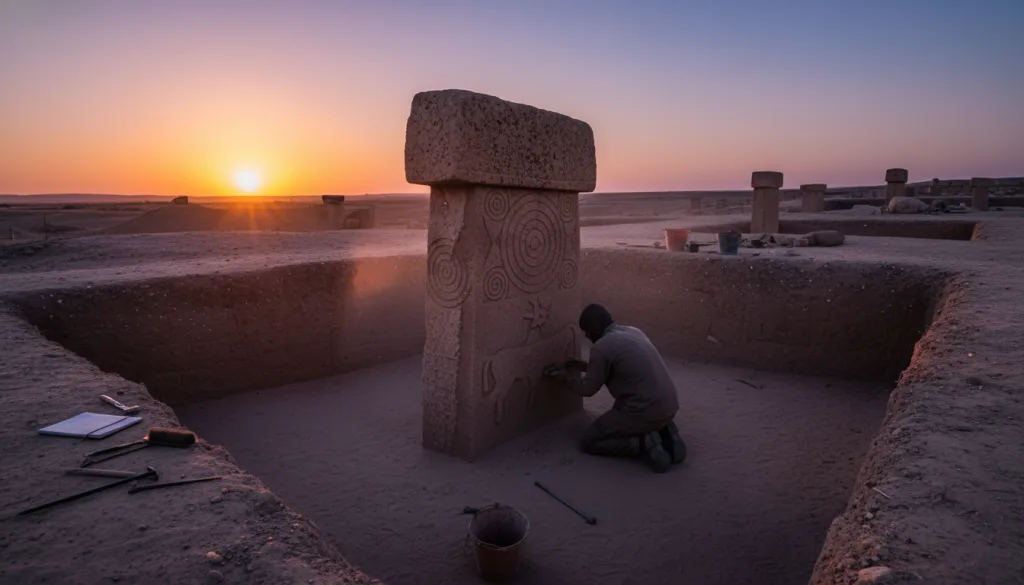
The site's most remarkable features are the massive T-shaped limestone pillars, many of which stand over 5.5 meters tall and weigh up to 20 tons. These pillars are not only architecturally significant but are also adorned with bas-reliefs of animals such as lions, snakes, and birds. According to Klaus Schmidt, the lead excavator at Göbekli Tepe from 1995 until his death in 2014, “Göbekli Tepe is the oldest known monumental architecture in the world, and it challenges our understanding of the history of human society” (Schmidt, 2013).
The Shift from Hunter-Gatherer to Settled Societies
Traditionally, anthropologists believed that the construction of complex societies and monumental buildings was a product of agricultural development. However, Göbekli Tepe suggests an alternative narrative. The inhabitants of this site were hunter-gatherers who engaged in the construction of large public works without the benefits of permanent settlement or agriculture.
Research by archaeologist David Lewis-Williams suggests that the carvings at Göbekli Tepe may have been part of a ritualistic practice, pointing to early forms of social organization and communal effort among groups of hunter-gatherers. This evidence indicates that the complexity of human society began evolving long before the advent of agriculture, contradicting long-held beliefs.

Date and Context of Discovery
The site was first noted in 1963 by a team led by the late Professor Hogarth, but it remained largely overlooked until Schmidt’s excavations began in 1995. The significance of Göbekli Tepe became clearer as more of the site was uncovered, revealing multiple layers of construction and usage spanning several millennia. The cultural implications of this complex site have led researchers to rethink the timeline of human civilization and the development of social hierarchies.
Göbekli Tepe's dating to the Pre-Pottery Neolithic period suggests it was a focal point for the social and possibly religious life of the people who built it. The subsequent agricultural revolution may have been influenced by the social structures developed around such monumental sites, implying a feedback loop between social complexity and agricultural practices.

Religious and Cultural Significance
The interpretations of Göbekli Tepe lean heavily toward its role as a religious center rather than a mere settlement. The arrangement of the pillars in circular formations suggests a place of gathering rather than domestic or utilitarian space. Ritualistic behavior is implied by the arrangement and the diverse symbolic carvings which evince a sophisticated belief system.
“Göbekli Tepe forces us to reconsider the origins of human society. It suggests that the development of spiritual life might have predated agriculture, rather than following it.” – Ian Hodder, 2016

Societal Implications
The findings at Göbekli Tepe are not just about architecture; they reveal a significant leap in cognitive complexity. These hunter-gatherers, who engaged in the construction of monumental architecture, likely had developed complex social networks and cooperative behaviors. This supports a model where societies engaged in large-scale cooperation for religious or social purposes long before the establishment of permanent agricultural settlements.
Furthermore, this challenges the traditional hierarchical models of societal evolution, which often prioritize the agricultural revolution as a prerequisite for complex societal structures. Instead, Göbekli Tepe suggests that the impetus for social cooperation and complex organization may have stemmed from shared beliefs and communal rituals.

Controversies and Skepticism in Interpretation
Despite the compelling evidence from Göbekli Tepe, the site has not been without its detractors. Some archaeologists argue that the interpretations surrounding its use have been exaggerated to fit a narrative that challenges established theories. Critics maintain that while the site is important, it should not be overstated in the context of human evolution.
For example, the anthropologist Brian Fagan, in his 2018 book “The Intimate Bond: How Animals Shaped Human Behavior,” cautions against over-interpretation of the artifacts found at Göbekli Tepe. He suggests more research is necessary to fully understand the site's role within a broader archaeological context. Fagan emphasizes that while Göbekli Tepe is groundbreaking, it is essential to view it within the continuum of human history without drawing definitive conclusions based solely on one site.
Technological Insights
The construction techniques used at Göbekli Tepe have also been a point of contention. The technology required to transport and erect the massive stone pillars raises questions about the organization and resource management of these early societies. Scholars like Timothy Darvill have postulated that the prehistoric builders utilized rudimentary tools and methods that were advanced for their time.
Further analysis of the tools found at the site, predominantly flint tools, indicates a combination of knowledge and skill that would have been necessary for both the construction of the site and the intricate carvings. This sheds light on the technological capabilities of hunter-gatherers and their adaptability in a time preceding widespread agriculture.
Global Impact and Legacy
Göbekli Tepe's influence extends beyond its immediate geographic location. It has sparked a reevaluation of ancient sites worldwide and has encouraged a broader examination of early human ingenuity. The implications of Göbekli Tepe touch on subjects as varied as religious evolution, social organization, and technological innovation.
Its discovery has prompted numerous academic papers, documentaries, and public interest, highlighting the importance of understanding our collective past. Researchers continue to explore the site, contributing to a growing body of literature focused on the role of early humans in shaping civilization.
Future Research Directions
The ongoing excavations at Göbekli Tepe promise to reveal more about the prehistoric peoples who constructed this site. Archaeological methods are constantly evolving, and future research may employ advanced technologies such as ground-penetrating radar and 3D modeling to uncover further layers of history.
As understanding deepens, researchers hope to draw connections between Göbekli Tepe and other contemporary sites across the region, exploring how these early societies interacted and influenced one another. The potential for new discoveries at Göbekli Tepe remains high, suggesting that our understanding of human history may continue to shift in significant ways.
Our Analysis:
The evidence strongly indicates that Göbekli Tepe represents a monumental cultural and technological milestone that challenges previous notions about the timeline of human civilization. The site illustrates that complex social structures, communal rituals, and advanced construction practices existed among hunter-gatherers long before the transition to agriculture. As ongoing research unfolds, it will be crucial to maintain a critical perspective, balancing excitement about new interpretations with the need for rigorous academic scrutiny. Ultimately, Göbekli Tepe stands not just as a relic of human achievement but as a testament to the intricate web of factors that have shaped our history.
Sources & References
Schmidt, Klaus, "Göbekli Tepe: The World’s First Temple," 2013, German Archaeological Institute.
Hodder, Ian, "Entangled: An Archaeology of the Relationships Between Humans and Things," 2016, Wiley.
Fagan, Brian, "The Intimate Bond: How Animals Shaped Human Behavior," 2018, Bloomsbury.
Darvill, Timothy, "The Archaeology of the Neolithic," 2016, Cambridge University Press.
Lewis-Williams, David, "The Mind in the Cave: Consciousness and the Origins of Art," 2002, Thames & Hudson.






Comments 0
Be the first to comment!