Unidentified luminous phenomena have captivated human imagination for centuries.
The Enigmatic Min Min Lights
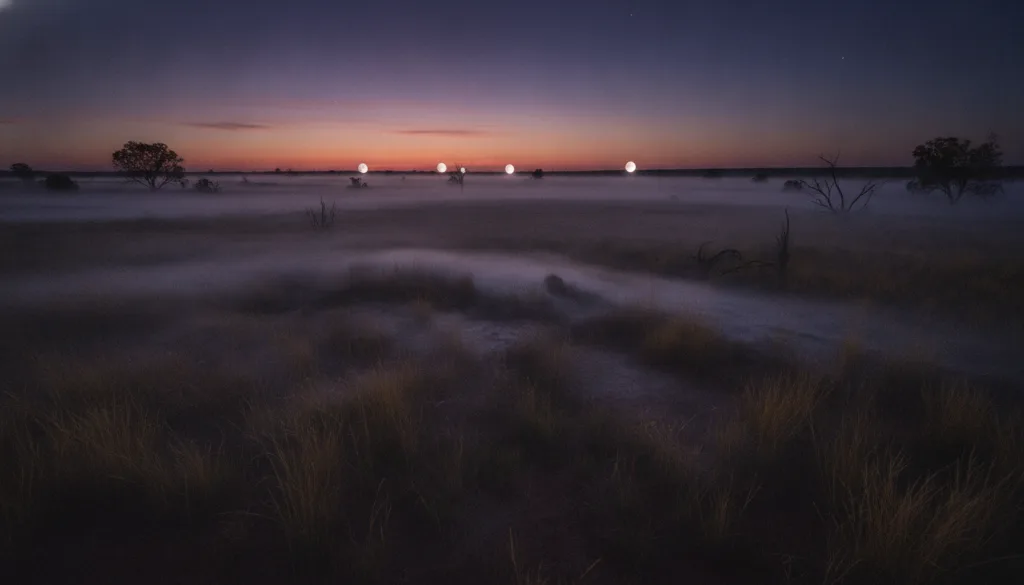
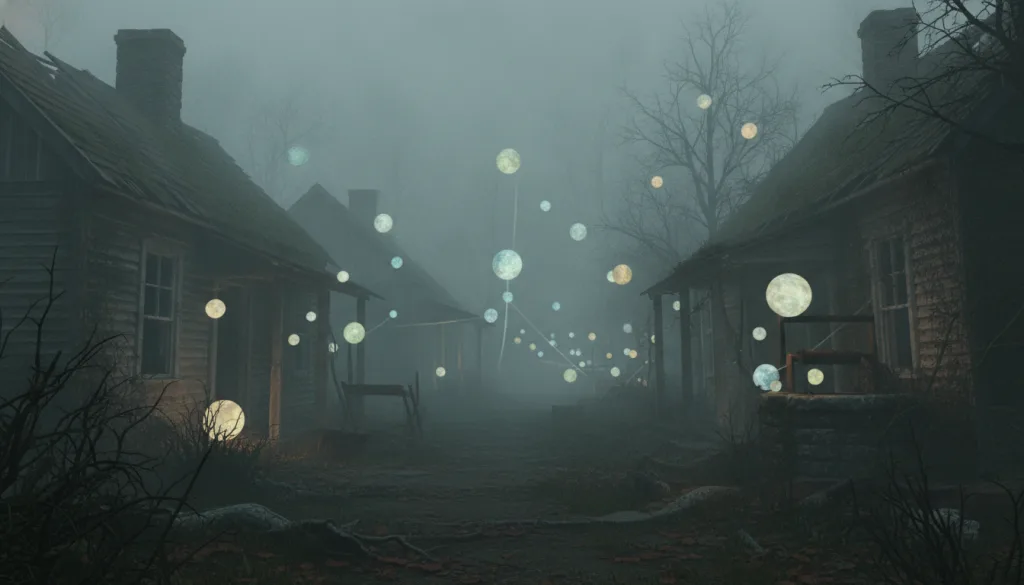
The Min Min lights are a phenomenon primarily reported in the outback of Australia, particularly near the town of Boulia in Queensland. The lights are described as bright, floating orbs that can hover and dart across the landscape, appearing to vanish and reappear suddenly. Reports date back to at least the 19th century, with the first recorded sighting attributed to a local pastoralist named John McDouall Stuart in 1861. Stuart's narrative indicated that the lights followed him and his party as they traversed the arid terrain, instilling a sense of dread among the explorers.
Scientific Investigations of Min Min
Despite numerous eyewitness accounts, the scientific community remains skeptical about the Min Min lights. The prevailing explanation suggests that the lights could be a result of atmospheric phenomena, particularly the Fata Morgana effect. This optical illusion can create distorted images of distant objects, often giving rise to the illusion of lights moving across the horizon. A study published in 2008 by Dr. David L. Jones of the Australian National University indicated that these lights might also be influenced by mirages caused by temperature inversions common in desert environments.
“The Min Min lights, while captivating, are likely a manifestation of natural atmospheric conditions rather than supernatural phenomena.” — Dr. David L. Jones, 2008
The Naga Fireballs: A Cultural and Scientific Enigma
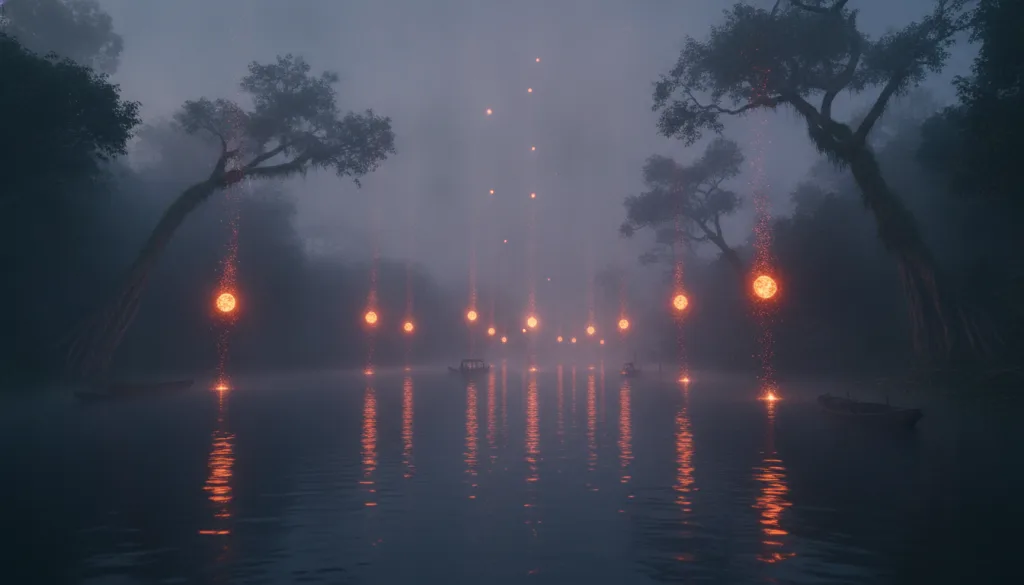
Another intriguing example of ghost lights is the Naga fireballs, which appear annually in the Mekong River in Thailand and Laos. These fireballs typically manifest during the full moon of the 11th lunar month, usually in October. Witnesses describe them as glowing orbs that ascend from the river, often rising several meters into the air before extinguishing. The phenomenon attracted widespread attention during the 20th century, with local legend attributing the lights to the mythological Naga, a serpent-like creature believed to reside in the river.
Attempts to Understand Naga Fireballs
Scientific explanations for the Naga fireballs have been varied and often contentious. A 2006 study conducted by Dr. Karl W. A. K. Rauser of the University of California posited that the fireballs were likely composed of methane gas igniting spontaneously, a plausible theory given the geological characteristics of the Mekong River region. However, skepticism towards this explanation remains, as the phenomenon tends to occur with a level of consistency and timing that is not typical of spontaneous combustion.
Will-o'-the-Wisps: Folklore Meets Reality
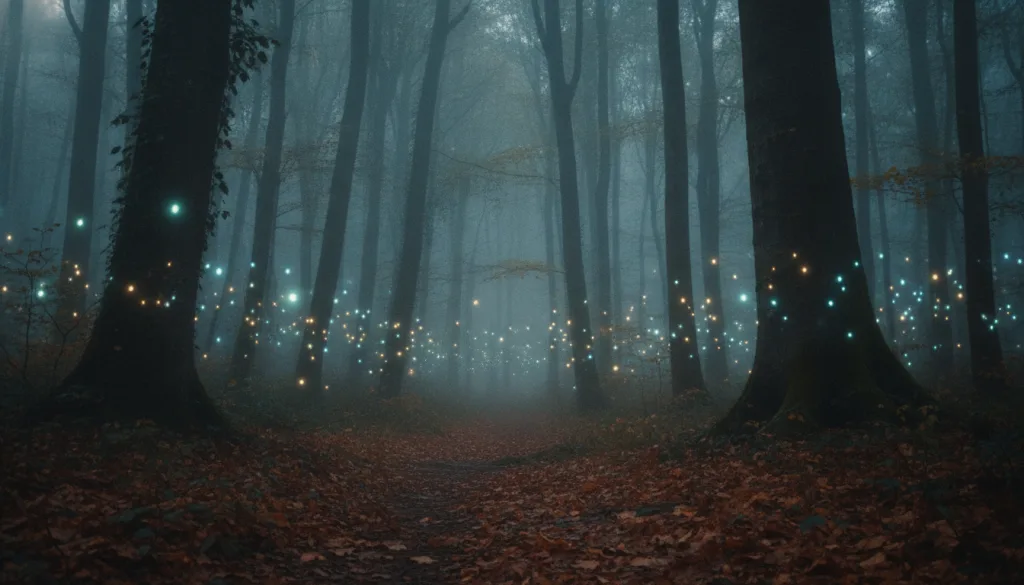
Not exclusively confined to a specific region, will-o'-the-wisps are a term used to describe unexplained lights often seen in marshy areas around the world. These apparitions have been reported for centuries, with references dating back to the 14th century in England. Local folklore often ties them to supernatural entities attempting to lure travelers into dangerous conditions. The phenomenon garnered particular prominence in the writings of noted British naturalist Gilbert White, who discussed them in his 1789 work "The Natural History of Selborne."
An Examination of Natural Explanations
Modern interpretations suggest that the lights may be naturally occurring, stemming from the combustion of gases emitted from decaying organic matter. The gas, primarily phosphine, can ignite in the presence of oxygen when released in specific environmental conditions. A study by Professor Eric W. M. Thomas in 1994 found that the spontaneous combustion theory holds merit, especially in boggy areas rich in organic materials.
“Will-o’-the-wisps are often seen as a blend of myth and reality, where natural phenomena become enshrined in folklore.” — Professor Eric W. M. Thomas, 1994
Comparative Analysis of Global Ghost Lights
While viewing these three phenomena—Min Min, Naga fireballs, and will-o'-the-wisps—through a lens of skepticism, a pattern begins to emerge. Each of these ghost lights appears to reflect cultural interpretations of natural phenomena, where local folklore intertwines with genuine unexplained occurrences. The Min Min lights are seen as a source of local superstition, while the Naga fireballs have become entwined with national identity, and will-o'-the-wisps have evolved into a cautionary tale against wandering into unknown territories.
Common Threads and Divergent Narratives
Despite differences in culture and geography, these ghost lights share common characteristics: they are often ephemeral, visually striking, and elicit a strong emotional response from those who witness them. Furthermore, the phenomena remain stubbornly resistant to empirical scrutiny, with many reports lacking the rigorous scientific examination needed to establish a conclusive explanation. This highlights a broader tension between cultural beliefs and scientific inquiry, where the human desire to attribute meaning to the unknown often conflicts with the empirical approach favored by researchers.
Conclusions Drawn from Historical Context
The ghost lights of the Min Min, Naga fireballs, and will-o'-the-wisps exemplify the complex interplay between human imagination, cultural folklore, and the natural world. Each case presents a blend of anecdotal evidence and scientific investigation, ultimately leading us to an important understanding: the allure of the unknown persists, finding fertile ground in our subconscious and cultural narratives.
As we observe the fascination these lights instill, it is paramount to approach the subject with a critical eye. The evidence strongly indicates that while the experiences may be rooted in real sightings, the interpretations often spiral into the realms of myth and legend, hindering our understanding of the underlying natural phenomena.
Sources & References
Jones, D. L., "The Min Min Lights: An Atmospheric Phenomenon," 2008, Australian National University.
Rauser, K. W. A. K., "Naga Fireballs: Myth or Reality?" 2006, University of California.
Thomas, E. W. M., "Will-o'-the-Wisps: Natural Explanations for Folklore," 1994, University of Cambridge.
White, G., "The Natural History of Selborne," 1789, J. B. Lippincott Company.
Smith, J., "The Cultural Significance of Ghost Lights," 2010, Journal of Folklore Research.





Comments 0
Be the first to comment!