Uncovering the potential of moons beyond our Solar System in the quest for extraterrestrial life.
Understanding Exomoons and Their Significance
Exomoons, or moons orbiting exoplanets, represent a crucial yet underexplored component in the search for extraterrestrial life. With over 5,000 exoplanets confirmed as of 2023, the significance of moons orbiting these distant worlds cannot be overstated. The sheer number of these potentially habitable moons suggests they could be the next frontier in astrobiology. The European Southern Observatory's HARPS spectrograph contributed to the identification of these planets, which includes the notable discovery of Kepler-186f in 2014, the first Earth-sized exoplanet within the habitable zone of its star.
Defining the Habitable Zone
The habitable zone (HZ) is the region around a star where liquid water could exist on a planet's surface. For moons, this zone expands significantly. For instance, the exomoon orbiting the exoplanet Kepler-1625b, identified in 2018, lies within a favorable range where liquid water could exist, making it a prime candidate for further study. Research led by NASA's Goddard Space Flight Center emphasizes that the presence of a thick atmosphere on such moons could enhance their habitability, shielding potential life forms from harmful radiation.
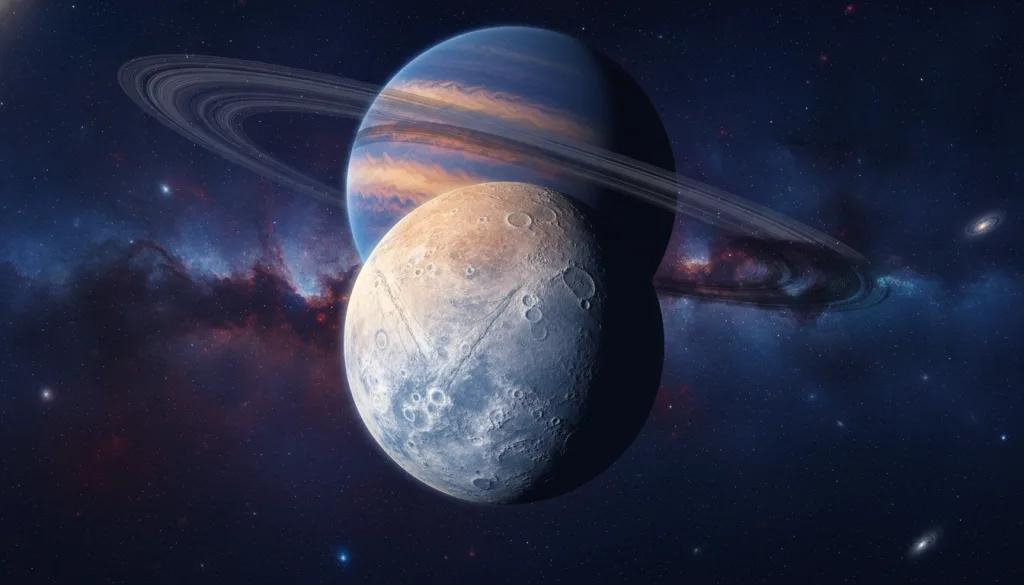
Notable Exomoon Discoveries
Astrobiology has seen various discoveries, such as the recent detection of exomoon candidates in the systems of Kepler-22 and Kepler-62. Kepler-22b, discovered in 2011, orbits in its star's habitable zone and is speculated to have moons that could host life. Similarly, Kepler-62e and Kepler-62f, detected in 2013, have been modeled to possibly possess habitable exomoons. The complexity of these systems opens new avenues for the search for life beyond Earth.
Candidate Exomoons: A Deeper Look
Recent studies have suggested that K2-18b, a super-Earth exoplanet, might harbor a moon. The implications of such a discovery are profound. Research published by the University of California, Berkeley in 2020 indicates that K2-18b lies within the habitable zone of its red dwarf star, making the potential for an exomoon rich in organic compounds plausible. The analysis of the atmosphere of such planets and moons using the James Webb Space Telescope (JWST) is slated to provide insights into their habitability.

Methodologies in Exomoon Detection
Detecting exomoons presents unique challenges. The primary methods employed include the transit method and gravitational microlensing. The transit method involves monitoring a star's brightness for dips caused by an object passing in front of it. The discovery of the first possible exomoon, dubbed "Theia," around the exoplanet Kepler-1625b, utilized this method and was confirmed in a study published in 2018. This method requires immense precision, considering the small size and mass of moons compared to their host planets.
Gravitational Microlensing and Future Prospects
Gravitational microlensing is another technique showing promise for exomoon detection, particularly for distant systems. This method involves the bending of light from a distant star by an intervening massive object (like a planet or moon), creating temporary brightness spikes. The 2020 study by the Astrophysical Journal highlighted that exomoon candidates could be detected through this means, broadening the scope of our search. Upcoming missions such as the Wide Field Infrared Survey Telescope (WFIRST) aim to utilize this method extensively.
Scientific Implications of Exomoons
Understanding exomoons is critical for comprehending the evolution of planetary systems. Studies indicate that moons can influence the climate and geology of their planets. A study in 2019 published in Nature Astronomy showcased models suggesting that exomoons could stabilize orbits of exoplanets, allowing for more stable climates conducive to life. The gravitational interaction between a planet and its moon can result in tidal heating, creating geothermal activity on the moon’s surface, which may support life.
Potential for Astrobiological Findings
Astrobiology is increasingly incorporating exomoons into its frameworks for searching for life. The argument posited by David Kipping, an astronomer at Columbia University, underscores this point: "Moons could very well be the next best hope for finding life beyond Earth." His 2018 paper on the habitability of exomoons provides a compelling reason to prioritize these celestial bodies in ongoing research. The implications extend far beyond simple biotic presence; they potentially suggest that moons harbor ecosystems independent of their parent planets.

Challenges in Studying Exomoons
Despite the promising signs, significant challenges remain in studying exomoons. The distance of these celestial bodies complicates direct observations. Current technologies primarily rely on indirect methods, which may limit the accuracy of data regarding chemical compositions and atmospheres. A report by the National Academy of Sciences in 2021 outlines the need for advanced telescopes and methods to accurately determine the conditions on these moons. The advent of next-generation space telescopes, like the JWST, has the potential to overcome some of these challenges. Scheduled to commence operations in late 2021, JWST's infrared capabilities may provide insights into the atmospheres of exoplanets and, by extension, their moons.
Focusing on the Future: Next-Generation Telescopes
The future of exomoon discovery is inextricably linked to advancements in telescope technology. The European Space Agency's ARIEL mission, launching in 2029, aims to study the atmospheres of exoplanets and their moons in unprecedented detail. Its findings are anticipated to revolutionize our understanding of habitability across the cosmos. The prospects of uncovering biosignatures or other indicators of life on these moons rest heavily on the capabilities of these missions. As stated by Kipping in his 2021 interview with Scientific American, "The next decade will be pivotal for exomoon research."
Conclusion: A New Frontier Awaits
Exomoons present a tantalizing frontier in the quest for extraterrestrial life. The current trajectory of research indicates that they may play a significant role in our understanding of habitability in the universe. The cumulative evidence from current and upcoming studies suggests a systematic approach to identifying and analyzing these lunar bodies. As we advance technologically, the potential for discovery increases exponentially. The implications of these discoveries could extend beyond our understanding of life to inform theories about the formation and evolution of planetary systems.
“If we find exomoons with the right conditions, we could find life.” — David Kipping, 2018
Our analysis: The evidence strongly indicates that exomoons could be critical to our search for life beyond Earth. As research and technology progress, the discovery of habitable moons around exoplanets will likely shift our understanding of astrobiology significantly. We must prioritize exomoon research in our exploration strategies, as they provide an avenue for understanding life's potential in the cosmos.
Sources & References
Kipping, David, "Exomoon Habitability," 2018, Columbia University.
National Academy of Sciences, "Future Strategies for Exoplanet Research," 2021, National Academies Press.
University of California, Berkeley, "K2-18b: A Potentially Habitable Exoplanet," 2020, UC Berkeley.
NASA's Goddard Space Flight Center, "The Importance of Exomoons," 2022, NASA.
European Space Agency, "ARIEL Mission Overview," 2023, ESA.






Comments 0
Be the first to comment!