A profound understanding of dark matter and dark energy reshapes our comprehension of the cosmos.
The Elusive Nature of Dark Matter
Since the late 1920s, the enigma of dark matter has haunted astrophysics, casting a shadow over our understanding of the universe. In 1929, Edwin Hubble established the relationship between a galaxy's distance and its velocity, leading to the realization that the universe is expanding. However, Hubble’s observations also unveiled an anomaly: galaxies did not possess enough visible mass to account for the gravitational effects observed. This inconsistently led to the formulation of dark matter — an invisible substance that does not emit light or energy but accounts for approximately 27% of the universe's total mass-energy content.
Evidence from the Cosmos
One of the most compelling pieces of evidence for dark matter emerged from the Coma Cluster in the 1930s. Swiss astronomer Fritz Zwicky measured the velocities of galaxies within the cluster and found them moving at such high speeds that they should have been flung apart if only visible matter was present. Zwicky postulated the existence of an unseen mass, coining the term "dark matter." This finding was further corroborated by the gravitational lensing effects observed by the Hubble Space Telescope, which revealed distortions in the light from distant galaxies as it passed near clusters rich in dark matter. Such phenomena confirmed that dark matter exerts gravitational influence, even though it remains undetectable through conventional means.
The Unseen Force: Dark Energy
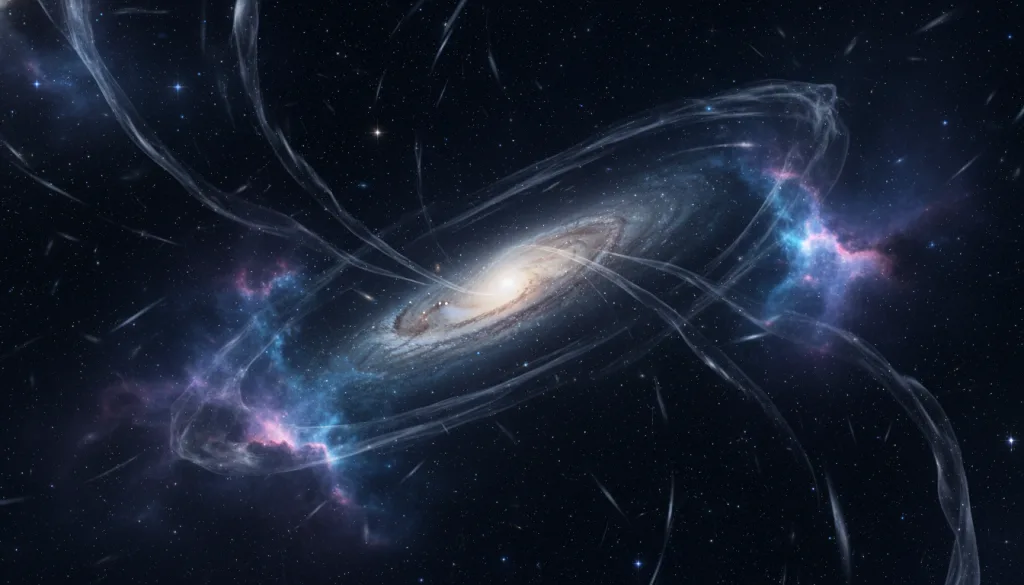
While dark matter binds galaxies together, dark energy is a different beast entirely. In 1998, two independent research teams, the Supernova Cosmology Project and the High-Z Supernova Search Team, provided groundbreaking evidence that the expansion of the universe is accelerating, contrary to previously held beliefs that it was slowing down due to gravity. This acceleration points to an enigmatic force dubbed dark energy, which constitutes about 68% of the universe's mass-energy content.
Cosmic Acceleration and Its Implications
Dark energy's implications are profound. The discovery prompted a reevaluation of fundamental physics, as it suggests that a significant portion of the universe's energy content is pulled from a vacuum energy that permeates space. Astrophysicists now posit that dark energy is responsible for pushing galaxies apart, defying the gravitational pull of dark matter. The essence of this mysterious force was encapsulated by Nobel Laureate Adam Riess in 2011 when he stated, “We’re seeing the universe is not just expanding, it’s accelerating. And we don't really understand why.”
“We’re seeing the universe is not just expanding, it’s accelerating. And we don't really understand why.” — Adam Riess, 2011
The Search for Understanding: Projects and Studies
Ongoing research into dark matter and dark energy takes place in various high-profile projects worldwide. The Large Hadron Collider (LHC) at CERN, located in Geneva, Switzerland, has undergone extensive experiments to detect potential dark matter particles. Meanwhile, the European Space Agency's Euclid mission, set to launch in 2023, aims to map the geometry of the dark universe. By analyzing the light from billions of galaxies, Euclid will help scientists understand how dark energy influences cosmic expansion.
Local Evidence: The Milky Way
Closer to home, in our own Milky Way, scientists have also been gathering data about dark matter through observations of stellar motions and gravitational effects on nearby celestial bodies. The measurements taken by the Gaia space observatory, launched in 2013, have provided a detailed map of our galaxy, revealing the presence of dark matter through the motions of stars. Gaia has cataloged more than 1.3 billion stars, offering insight into the galactic structure and the distribution of dark matter halos surrounding it.
Models and Theories: Understanding the Invisible
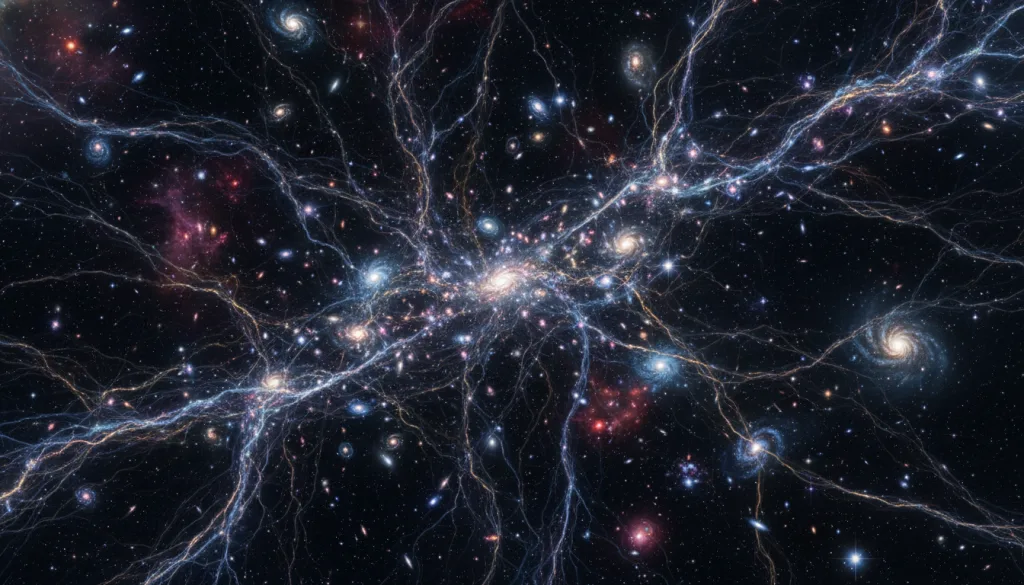
The standard model of cosmology, known as ΛCDM (Lambda Cold Dark Matter), describes the universe's evolution from the Big Bang to its current state. This model incorporates dark energy (denoted by Lambda) and cold dark matter, providing a framework to understand cosmic structures. Despite its success in explaining many phenomena, ΛCDM is not without its challenges. Observations of galaxy rotation curves, cosmic microwave background radiation, and the large-scale structure of the universe sometimes yield results that deviate from model predictions.
Challenges to the Paradigm
Researchers have proposed alternative theories, such as Modified Newtonian Dynamics (MOND) and various forms of dynamic dark energy, to account for these discrepancies. MOND suggests modifications to Newton's laws at low accelerations, positing that visible matter can account for the gravitational anomalies observed in galaxies without invoking dark matter. However, these alternatives have not gained widespread acceptance due to their inability to cohesively explain the universe's large-scale behavior.
Consequences for Future Exploration
The implications of dark matter and dark energy extend beyond theoretical physics; they affect our understanding of potential life beyond Earth. Astrobiology, the study of the origin and evolution of life in the universe, is deeply intertwined with the structure and dynamics of the cosmos. If dark energy continues to drive the universe's expansion, it may alter the fundamental conditions necessary for life as we know it.
Interstellar Implications
The future of observational astronomy hinges on comprehending these cosmic phenomena. Upcoming telescopes, such as the James Webb Space Telescope, are set to survey the universe's earliest galaxies and their interactions, with hopes of unveiling further secrets about dark matter and dark energy. Moreover, understanding the fate of the universe — whether it will continue to expand indefinitely, leading to a “Big Freeze,” or contract back on itself in a “Big Crunch” — could have profound implications for humanity’s long-term survival.
Notre analyse: The evidence surrounding dark matter and dark energy is compelling, driving home the importance of these invisible elements in the cosmic structure. While our knowledge remains incomplete, the consensus is clear: dark matter and dark energy are fundamental components of the universe, shaping everything from galaxy formation to the very fabric of space-time. As we stand on the precipice of extraordinary discoveries facilitated by advanced technology and theoretical rigor, one thing is certain: the invisible universe holds the keys to understanding our place within it.Sources & References
Riess, Adam, “Observational Evidence from Supernovae for an Accelerating Universe and a Cosmological Constant,” 2011, The Astronomical Journal.
Zwicky, Fritz, “Die Rotverschiebung von extragalaktischen Nebeln,” 1933, Helvetica Physica Acta.
Planck Collaboration, “Planck 2018 results I. Overview and the cosmological legacy of Planck,” 2018, Astronomy & Astrophysics.
Gaia Collaboration, “Gaia Data Release 2. Summary of the contents and survey properties,” 2018, Astronomy & Astrophysics.





Comments 0
Be the first to comment!