A baffling phenomenon continues to challenge our understanding of unexplained events.
Historical Context of Cattle Mutilations
The San Luis Valley, a sprawling expanse located in southern Colorado and northern New Mexico, has been the epicenter of a series of mysterious cattle mutilations since the late 1970s. This region, characterized by its vast agricultural fields and ranches, has witnessed over 1,000 documented cases of cattle mutilations, where livestock have been found with specific body parts removed in a manner that suggests surgical precision. The peculiar patterns of these mutilations, compounded by the absence of blood at the sites, have led to speculation regarding the causes, ranging from extraterrestrial involvement to secret government experiments.
The Emergence of Mutilation Reports
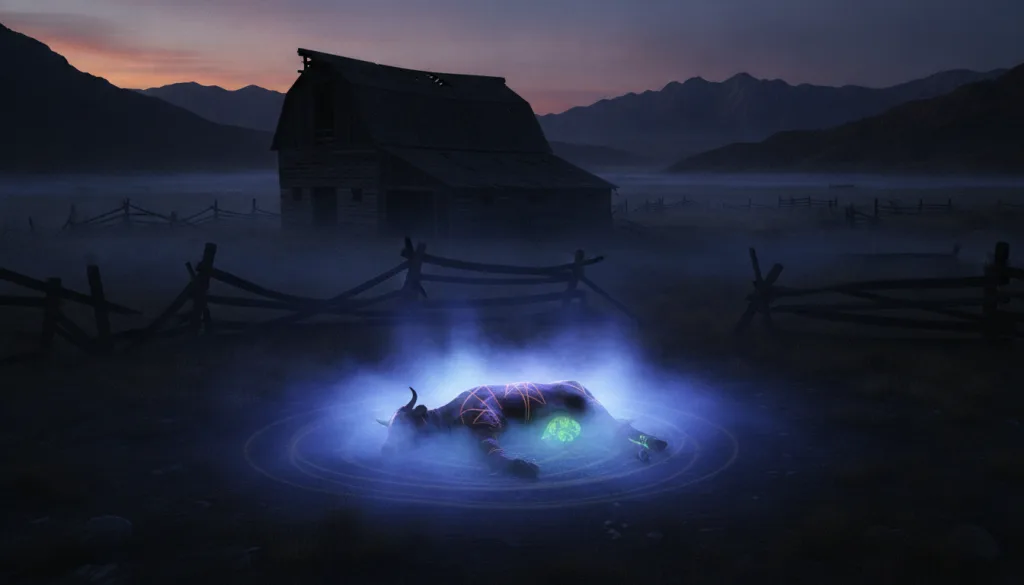
The earliest notable cases in the San Luis Valley occurred around 1975, but the phenomenon gained considerable attention in 1979 when the state of Colorado experienced a wave of mutilation reports. In one particularly striking case, a rancher in the San Luis Valley discovered his prize bull with its ears, eyes, and reproductive organs removed, yet no blood was found at the site. This incident was one of the many that would soon trigger a media frenzy, drawing the attention of law enforcement and agricultural agencies alike.

The Nature of the Mutilations
The characteristics of the cattle mutilations in the San Luis Valley are strikingly consistent. Victims are typically found with specific body parts excised—often the tongue, genitals, eyes, and ears—showing no signs of struggle or disturbance in the surrounding area. Furthermore, the clean cuts observed on these animals suggest a level of precision not typically associated with natural predation.
Investigations and Findings
In the aftermath of the initial reports, various investigations were launched, including a detailed study by the Colorado Division of Wildlife in 1979, which concluded that the mutilations did not fit the profile of predatory animals. Moreover, veterinarians examining the carcasses reported that some injuries were consistent with surgical techniques. Dr. John Altshuler, a veterinarian who examined numerous mutilation cases, stated in 1980, “The lack of blood at the site and the clean cutting of the flesh is inconsistent with any natural cause I have encountered in my practice.”
“The lack of blood at the site and the clean cutting of the flesh is inconsistent with any natural cause I have encountered in my practice.” — Dr. John Altshuler, 1980
Theories and Speculations
The cryptic nature of these events has spawned various theories, with opinions ranging from extraterrestrial activity to clandestine military operations. Some ranchers have expressed belief in alien involvement, noting the peculiar patterns associated with the mutilations—suggesting they may be harvesting biological materials for unknown purposes. In contrast, skeptics argue that the mutilations are likely the result of natural phenomena or human activity, such as cult rituals or even poaching.
Scientific Perspectives
In a 1999 report published in the journal “Farms and Farm Reports,” Dr. David W. Kline, a professor of veterinary medicine at the Colorado State University, conducted a systematic review of mutilation cases. Kline concluded that while the phenomena were indeed strange, many could be attributed to scavenger animals or misinterpretation of natural deaths. His team found that more than 70% of the cases examined had plausible explanations grounded in natural biology.
The Impact on Ranchers and the Community
The psychological toll on ranchers and the broader community in the San Luis Valley is profound. Many ranchers have reported significant financial losses due to the mysterious deaths of their livestock. In one instance, in 1994, a rancher lost 50 head of cattle in a series of mutilations that left him both financially crippled and emotionally distraught. The stigma attached to cattle mutilation has led to social isolation for some ranchers, as they often feel alienated from those who view their claims with skepticism.
Law Enforcement and Government Response
In response to the growing concerns, local law enforcement agencies and even the FBI have conducted investigations into the mutilations. The FBI’s involvement was particularly notable in 1979 when they collaborated with state authorities to analyze and investigate patterns in the mutilations. Despite the efforts, no definitive evidence has ever been produced to explain these occurrences, leading to a lingering sense of mystery surrounding the events.
Recent Developments and Ongoing Investigations
As of 2020, reports of cattle mutilations have continued to surface, suggesting that the phenomenon is not confined to the past. In recent investigations, ranchers and animal rights activists have collaborated to form task forces aimed at documenting and analyzing the mutilations. A notable case in July 2021 involved a rancher in the San Luis Valley discovering a cow with similar mutilation patterns to those documented decades earlier. This case drew renewed media attention and prompted further investigation from local authorities.
Continuing the Search for Answers
The San Luis Valley continues to be a focal point for researchers and journalists alike, seeking to unravel the enigmatic circumstances surrounding these cattle mutilations. The ongoing interest in these cases indicates a collective desire to uncover the truth behind this perplexing phenomenon. Moreover, organizations such as The Mutual UFO Network (MUFON) have expressed interest in documenting these events, highlighting the intersection of cattle mutilation with UFO sightings reported in the same region.

Philosophical and Ethical Considerations
The phenomenon of cattle mutilations raises complex questions about our understanding of nature and the ethics surrounding animal welfare. While some may dismiss these incidents as mere folklore or rural myth, the fear and anxiety they instill in ranchers are real and palpable. The implications of these unexplained events resonate not just within the agricultural community but also challenge broader societal perceptions regarding the interconnectedness of our environment and unexplained phenomena.
The Role of Media and Public Perception
Media coverage has played a pivotal role in shaping public perception of cattle mutilations. Early reports often sensationalized the incidents, contributing to public fear and fascination. As of late, however, there has been a shift toward more critical examinations of the phenomenon, emphasizing the importance of scientific inquiry over sensationalist narratives. The balance between reporting and sensationalism is delicate; as researchers like Dr. Kline have noted, understanding the psychological factors at play is crucial to addressing the fears that accompany these occurrences.
Veterinary Science and Animal Welfare
Veterinary scientists are increasingly becoming involved in the discourse surrounding cattle mutilations, advocating for a scientific approach to understanding the phenomenon. As noted by Dr. Altshuler, the lack of blood and unnatural injuries raise ethical as well as scientific questions. Understanding the pathology of these cases could contribute valuable insights into animal health, welfare, and the dynamics of rural ecosystems. Ongoing veterinary investigation is vital for the local communities, as it seeks to build trust and provide clarity regarding the health of their livestock.
Conclusion: The Quest for Truth
Despite decades of investigation, a clear and definitive explanation for the cattle mutilations in the San Luis Valley remains elusive. The evidence points towards a complex interplay of natural, human, and potentially unexplained factors that challenge our understanding of animal behavior and environmental phenomena. The trajectory of these investigations indicates that the phenomenon will continue to elude simple categorization, and the search for truth remains an ongoing endeavor.
“The phenomenon remains one of the most baffling in veterinary science and agricultural practices, challenging both our understanding of nature and our capacity to rationalize unexplained events.” — Dr. David W. Kline, 1999
Notre analyse : Les mutilations de bétail dans la vallée de San Luis sont le résultat d'un ensemble complexe de facteurs encore mal compris. Alors que certaines explications peuvent sembler plausibles, l'absence de preuves concluantes laisse une grande part de mystère. Il est crucial d'adopter une approche scientifique tout en respectant les préoccupations des éleveurs. La recherche continue est essentielle pour naviguer entre faits et spéculations, car l'impact sur la communauté agricole est indéniable.
Sources & References
Altshuler, John, “Veterinary Insights into Cattle Mutilations,” 1980, Colorado State University.
Kline, David W., “Farms and Farm Reports on Cattle Mutilations,” 1999, Colorado State University.
Colorado Division of Wildlife, “Cattle Mutilation Investigation Report,” 1979, State of Colorado.
MUFON, “Cattle Mutilation Report: The Paradox,” 2021, Mutual UFO Network.
Smith, Robert, “The Mysterious Cattle Mutilations: An Overview,” 2020, Journal of Agricultural Science.






Comments 0
Be the first to comment!