Diving Deep Into the Abyss of Antigravity Rhetoric
The Mythology of Antigravity
When you hear the term "antigravity," does your mind race to the latest episode of your favorite sci-fi show? Or perhaps you visualize the sleek, silver saucers gliding effortlessly through the night sky? While your imagination might have the luxury of soaring through the cosmos, the real question is: Is antigravity a mere figment of a writer's imagination, or is it a hidden reality we are yet to comprehend?
Antigravity propulsion has tantalized us since the dawn of science fiction. From the realms of Isaac Asimov to the modern cinematic landscapes of *Interstellar* and *Star Trek*, the concept has been beautifully romanticized. But what if the narrative is more than just fantasy? What if there exists a hidden layer of classified technology that straddles the line between science and science fiction?
Before we delve into this murky territory, we must define antigravity propulsion. At its core, it suggests a method of controlling gravity to facilitate movement without the conventional propulsion systems that bind us to the Newtonian laws of physics. Sounds like the stuff of dreams, right? But let’s not dismiss this notion outright. After all, fringe science has a way of surprising us—often when we least expect it.
The Quantum Playground
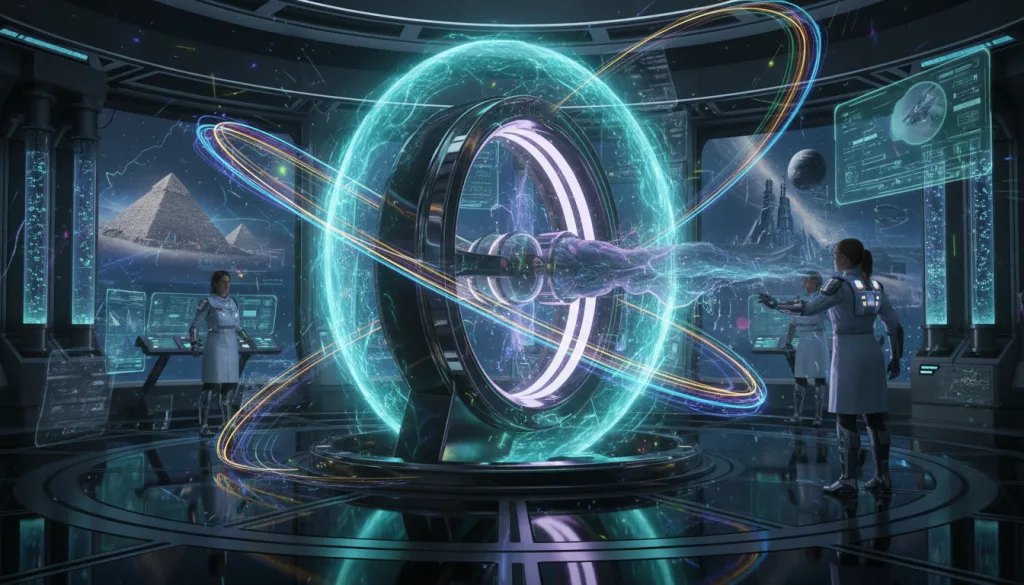
To understand antigravity, we need to wrestle with quantum physics. Yes, that realm where particles behave like both waves and particles, and where the mere act of observation can alter outcomes. Quantum mechanics has already shattered our classical understanding of the universe, so why should we disregard the possibility that it holds the key to antigravity technologies?
Consider the concept of the Casimir effect—a phenomenon that manifests due to quantum vacuum fluctuations. When two uncharged plates are placed extremely close together in a vacuum, they experience an attractive force due to these fluctuations. This begs the question: If we can manipulate vacuum energy in a localized way, can we also create a force that opposes gravity?
Moreover, there are theoretical models that explore the manipulation of spacetime itself. General relativity suggests that mass and energy can warp spacetime, leading some theorists to propose that if we could harness this warping, we could create a "gravity-free" zone. While practical applications remain speculative, the concepts are rooted in established physics, blurring the lines between theoretical musings and potential reality.

Military Applications and the Secretive Nature of Research
Now we step into the shadowy realm of classified technology. Let's not kid ourselves: when it comes to military applications, antigravity research could represent a game-changing leap in technology. We live in an age where defense budgets are astronomical, and clandestine research has become the norm. So, why are we still skeptical about the existence of antigravity propulsion systems being developed behind closed doors?
Consider the infamous Area 51—a site often linked to UFO conspiracies and alleged reverse engineering of extraterrestrial technology. Numerous whistleblowers and former military personnel have claimed that what they witnessed there was beyond human comprehension, involving crafts that defy our understanding of aerodynamics and propulsion. Are we really to believe this is just a coincidence?
Additionally, we have seen significant investments in advanced aerospace technologies, including those investigating gravity manipulation. The U.S. military has long been known to explore "breakthrough" technologies through programs like DARPA (Defense Advanced Research Projects Agency). Could they be inching closer to harnessing antigravity propulsion, while the public remains blissfully unaware of the implications?
The Evidence and Theories: A Double-Edged Sword
Now we arrive at one of the juiciest aspects of our inquiry: the evidence. If antigravity propulsion is real, surely there would be tangible proof—right? Yet, the evidence is as ambiguous as it is tantalizing. Reports of UFO sightings, coupled with testimonies from credible witnesses, consistently cite unusual flight patterns and acceleration capabilities that defy the laws of physics as we know them.
Videos released by the Pentagon showing unidentified aerial phenomena (UAPs) showcase objects maneuvering at speeds and angles that would turn any conventional pilot green with envy. Yet, the official narrative often pivots toward “unknown” rather than “extraterrestrial” or “classified technology.” Why is that?
Could it be that the truth is so unsettling that we're simply asked to accept ignorance rather than confront the implications of such advanced technology? Theories abound, suggesting that what we are witnessing could either be advanced foreign technology or the result of private sector innovation—or perhaps, just perhaps, an undisclosed leap made by our own military.
Consciousness and Antigravity: A Mind-Bending Connection?
Let’s take a bold leap into the existential rabbit hole. Is it possible that our consciousness might play a role in manipulating gravity? The concept of consciousness extending beyond the physical brain has long been a topic in philosophy and fringe science. Some theories posit that our mindset could affect the very fabric of reality—gravity included.
Think about it: if our thoughts can influence matter at a quantum level, could we not potentially harness that ability to achieve antigravity? This notion might sound absurdly esoteric, but leading scientists are beginning to explore the interplay between consciousness and quantum mechanics. The implications, if validated, could turn our understanding of physics on its head.
In pondering this connection, we must acknowledge the research conducted by individuals like Dean Radin, whose work in parapsychology seeks to assess the capabilities of human consciousness. If we accept that consciousness might influence the quantum realm, we must ask ourselves—could we eventually harness this power to manipulate gravity itself?
Challenges Ahead: Scientific Skepticism and Public Perception
As we expertly navigate this labyrinth of possibilities, we encounter the dreaded specter of skepticism. The scientific community is notoriously resistant to ideas that veer too far from established paradigms. Antigravity propulsion, for all its intrigue, faces an uphill battle against entrenched beliefs in gravitational physics.
Critics will assert that antigravity is merely a misunderstanding of existing principles, a misinterpretation of experimental results, or a desire for sensationalism. And while skepticism is a vital component of scientific discourse, it can sometimes serve as an obstacle to exploration of revolutionary ideas. Are we locking ourselves into a box, unwilling to consider possibilities that challenge our understanding?
Public perception also plays a crucial role in the potential advancement of antigravity technology. The more bizarre and fringe the ideas appear, the less likely they are to receive funding and attention. If we continue to dismiss these ideas as mere fantasies, we may inadvertently stifle the innovation that could lead us to a new era of propulsion technology. What does it say about us if we turn our backs on possibilities merely because they require us to question our understanding of reality?
A Roadmap to the Future
So, where do we go from here? The road towards understanding antigravity propulsion is riddled with challenges, yet the potential rewards make it a journey worth embarking upon. Research must continue unhindered, and the walls of conventional thinking must be dismantled to create a space for ideas that defy gravity—both literally and metaphorically.
Engaging with interdisciplinary fields—where physicists, engineers, and even philosophers collaborate—could illuminate aspects of antigravity propulsion that remain shrouded in mystery. We must cultivate a culture of curiosity and support for innovative research, even if it diverges from popular consensus. After all, every scientific breakthrough was once dismissed as lunacy.
Ultimately, the question of whether antigravity propulsion is mere science fiction or classified technology may not be a binary one. Perhaps it exists on a spectrum, where classified research and fringe theories intersect and overlap. One thing is certain: as long as we remain closed off to the possibilities, we shall forever be bound by the very gravity we seek to escape.






Comments 0
Be the first to comment!