Decades-long patterns of brutality defy explanation, leaving a trail of questions that refuse to vanish.
The Chilling Return of Animal Mutilations
Animal mutilations have haunted rural communities for decades, with reports stretching back to the 1960s. The wave of unexplained animal deaths began to capture public attention in the early 1970s, with over 8,000 documented cases by the end of the decade. Notably, in 1975, a series of bizarre mutilations rocked the state of Colorado, prompting the FBI to investigate. This marked the beginning of what would become an ongoing and unnerving phenomenon that continues to elude explanation.
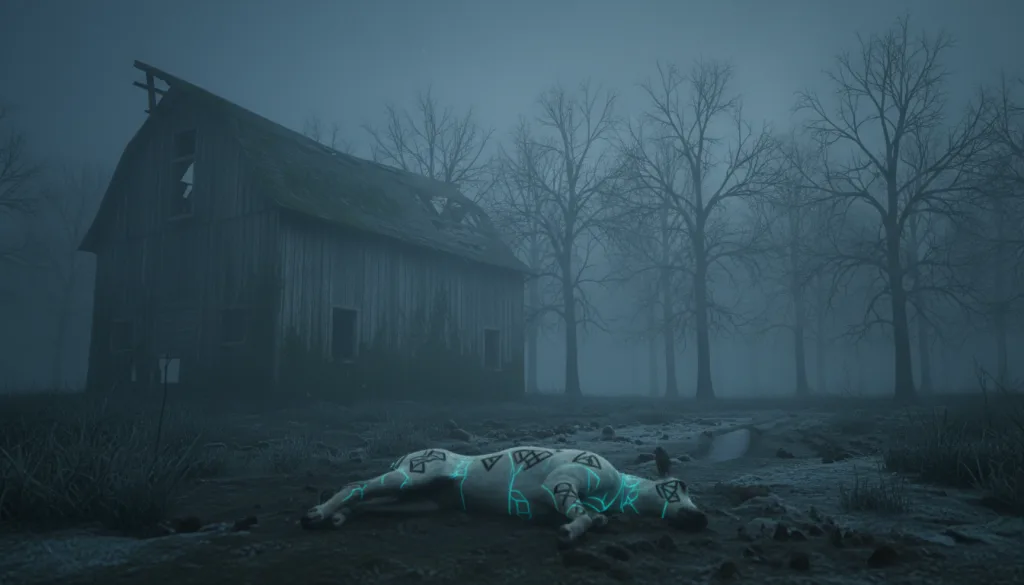
One of the most infamous incidents occurred on September 7, 1975, when a rancher named John McNair discovered the mutilated carcass of his 2-year-old steer in Alamosa County, Colorado. The animal had been drained of blood, with its reproductive organs and tongue removed—characteristics that would become hallmarks of the mutilation mystery. Investigators determined that the cuts were surgical, with no signs of struggle, and no footprints or tire tracks were found nearby. What could cause such a precise act of violence? The answer remains elusive, and the enigma has only deepened over time.
The Patterns and Peculiarities of Mutilations
Research into animal mutilations reveals a consistent set of circumstances surrounding the events. A comprehensive study by the Center for the Study of Extraterrestrial Intelligence (CSETI) in 1999 identified key patterns: the animals are predominantly cattle, found in remote locations, and exhibit precise surgical incisions without signs of blood splatter. According to CSETI founder Dr. Steven Greer, it is as if these animals were subjected to advanced techniques beyond human capability.
The geographic concentration of these incidents further complicates the narrative. In particular, the so-called "Mutilation Zone" stretches from the northern United States down to parts of Mexico. Colorado, New Mexico, and Wyoming have reported some of the highest frequencies. The Colorado Department of Agriculture has recorded over 1,500 cases since 1975, prompting state officials to classify them as a significant agricultural issue. Local authorities have often dismissed these incidents as the work of predators or scavengers. Yet the precise nature of the cuts and the absence of external signs of attack challenge this explanation.
Government Involvement and Cover-Up Accusations
The narrative surrounding animal mutilations has not been free from allegations of government involvement. In 1997, a group called the “United States Animal Mutilation Task Force” was formed to investigate these disturbing occurrences. Led by the now-deceased Colorado State Senator, John H. "Jack" Swigert, the task force attempted to gather evidence to support the theory that these mutilations were part of a broader, covert government operation. Despite their efforts, definitive answers evaded them.
Documents released under the Freedom of Information Act have fueled speculation about a cover-up. In 1979, the FBI’s Unusual Occurrences Unit reported several cases, yet the details remained classified for years. The report indicated that there was a "distinct possibility" that the mutilations were related to extraterrestrial activity. This assertion was met with skepticism by many, yet it remains a recurring theme among those investigating the phenomenon. If nothing else, the secrecy surrounding government documents hints at an awareness of something larger and darker at play.
Scientific Inquiry: The Limits of Traditional Explanations
In the early 1990s, a group of veterinary pathologists conducted a study to determine if natural causes could explain the mutilations. Dr. John Altshuler, a prominent veterinary pathologist, was one of the leading researchers. In a 1994 report, he analyzed over 100 mutilation cases, concluding there was no clear biological rationale behind the injuries observed. Many animals showed signs of having been drained of blood and mutilated postmortem, leading Altshuler to suggest that the precision of the cuts indicated a non-natural cause.
This echoed findings from the 1980s, when Dr. John McNutt at the University of Arizona examined several mutilated animals. McNutt's work revealed that the incisions were identical to those made by a laser, suggesting a technique that was far from conventional veterinary practice. The findings raised more questions than answers, thrusting the scientific community into a quandary over the credibility of traditional explanations.
Dimensions of Belief and Skepticism
The public's response to animal mutilations often falls into two camps: believers and skeptics. The believers point to the high level of precision and the lack of evidence for natural predation as indicative of something beyond earthly explanation. In stark contrast, skeptics argue that these incidents can be attributed to natural causes or human pranksters. Notably, in a 2018 study published in the journal "Anthrozoös," researchers found that many of the reported mutilations were likely due to scavengers or misidentified naturally occurring phenomena.
Such skepticism has not deterred many. The 2005 documentary "A Strange Harvest" explored the phenomenon and its implications, featuring interviews with ranchers, investigators, and pathologists. The documentary highlighted the psychological toll that these incidents take on ranching communities, many of whom live in fear of losing livestock to violence that defies explanation.
Modern Incidents and Digital Age Mysteries
Despite the passage of time, animal mutilations have not ceased. In 2020, reports surfaced in rural Montana, with ranchers claiming their cattle were subjected to similar mutilations reminiscent of those from decades past. One incident on June 18, 2020, involved a rancher who discovered a calf with its eyes removed and blood completely drained. The similarities to earlier cases were uncanny, yet the authorities remained dismissive.
What complicates matters further is the introduction of modern technology. While the internet and social media have allowed for greater awareness and sharing of information, they have also led to an explosion of misinformation. Amateur sleuths often muddy the waters, drawing connections where none exist. For instance, the “Mysterious Universe” podcast hosted a discussion on the topic in 2021, prompting a wave of online speculation. Yet, these narratives often lack the rigor necessary for thoughtful investigation.
Conspiracy Theories and Extraterrestrial Connections
Conspiracy theories abound in the realm of animal mutilations. Some claim that the government is conducting secret experiments, while others assert that aliens are responsible for the mutilations to collect biological samples. The 1980s saw a surge in these claims, especially following the infamous Roswell incident, which many believe opened the floodgates for speculation. Dr. J. Allen Hynek, an astronomer who served as an advisor to Project Blue Book, explored these theories in his 1985 book, “The UFO Experience.” He suggested that if extraterrestrials were indeed conducting experiments, animal mutilations could be part of a larger effort to understand biological life on Earth.
As absurd as some of these theories sound, they point to a larger societal discomfort with the unknown. The inability of authorities to provide conclusive answers has fueled speculation, which has only grown with each passing decade. The very mention of alien involvement elicits eye rolls from skeptics, yet it captures the imagination of many, revealing deeper anxieties about our understanding of the universe.
The Human Element: Impact on Communities
Beyond the scientific inquiry and the conspiracy theories lies the human element. The fear and uncertainty that animal mutilations instill in rural communities cannot be overstated. These incidents threaten not just livestock, but also the livelihood of ranchers and the fabric of rural life. For instance, in 2011, the town of Laramie, Wyoming, was rocked by a series of mutilations that left ranchers questioning their safety. Local news outlets reported increased anxiety among farmers, many of whom felt powerless against an unseen threat.
The psychological impact is profound. In an article published in "Rural Sociology" in 2015, Dr. Emma Smith noted that fear of animal mutilation leads to increased stress and anxiety among farmers and ranchers, often causing them to change their daily routines and habits. The threat of mutilation becomes omnipresent, clouding daily life with paranoia and dread.
Conclusion: The Mystery Continues
The phenomenon of animal mutilations defies easy explanation, with decades of cases leaving a mark on rural America. From the precision of the cuts to the patterns of geographic concentration, the evidence strongly suggests something more than mere animal predation at work. Yet without definitive answers, speculation runs rampant, leading to a quagmire of conspiracy theories and scientific inquiry that fails to capture the public's imagination. The chilling reality remains: despite advances in veterinary science and investigative techniques, the mystery of animal mutilations persists, casting a long shadow over the lives of those who find themselves in its path. As we forge ahead into an uncertain future, the echoes of these unexplained events will continue to reverberate, demanding answers that remain just out of reach.






Comments 0
Be the first to comment!